
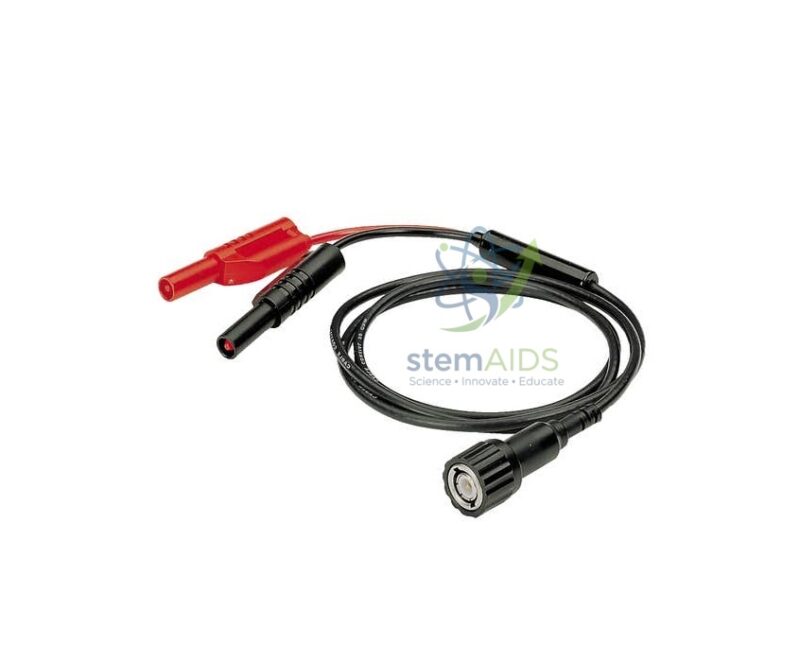
Quick Answer: The Electro PJP BNC to safety banana cord is a test lead with a BNC plug at one end and two shrouded banana plugs, red and black, at the other. It carries a signal from a generator to a circuit, or from a circuit to an oscilloscope, while keeping the banana ends compatible with safety sockets.
How the Cord Is Wired
The BNC end of the Electro PJP cord locks onto an instrument socket with a bayonet collar. From there a coaxial section carries the signal on the centre conductor and the return on the braided screen. At the far end the two conductors separate into flexible tails: the centre conductor to the red safety plug and the screen to the black one, as the product photograph shows. Each plug has an insulating sleeve around its pin, so it fits shrouded sockets on modules, meters and power supplies.
A cord like this is a 1:1 connection, not an attenuating oscilloscope probe. Whatever voltage appears between the red and black plugs reaches the instrument unchanged, which keeps calculations simple in student work. The coaxial section does add some capacitance across the circuit, roughly in proportion to its length, which is negligible at mains and audio frequencies but can round off fast edges.
Using It With an Oscilloscope
Connected to an oscilloscope, the cord turns a pair of shrouded terminals into a measured trace: across a resistor to see current waveforms, across a capacitor to follow charging and discharging, or across a coil to show induced voltage. Because the black plug is joined to the oscilloscope’s earthed shell, it must go to the circuit’s common point, and with two cords on two channels both black plugs end up connected together through the instrument. Planning where the common point is before plugging in avoids the classic accidental short across a component. A T adapter at the BNC end lets the same signal go to a second instrument.
Specifications
| Product | Electro PJP BNC to safety banana cord |
| Instrument end | BNC plug with bayonet collar |
| Circuit end | Two shrouded safety banana plugs, red and black |
| Wiring | Centre conductor to red, screen to black |
| Signal path | Direct 1:1 connection (not an attenuating probe) |
| Cord length | Confirm at enquiry |
Practicals the Cord Serves
- Displaying voltage waveforms from shrouded terminals of circuit modules on an oscilloscope
- Feeding a function generator signal into circuits wired with safety leads
- Capacitor charging and discharging, and RC and RL time-constant practicals
- Induced-voltage experiments with coils and magnets
Care & Handling
- Coil the Electro PJP cord loosely in large loops; tight bends and knots break the screen near the connectors
- Disconnect by holding the plug bodies and the BNC collar, never by pulling the cable
- Inspect the plug sleeves and cable sheath before each class and withdraw any cord with cracks or exposed conductors
- Hang cords on a wall-mounted lead rack or reel rather than leaving them in a heap in a drawer
Why Choose LabEquip
Science departments use this cord wherever an oscilloscope or generator meets circuit modules with shrouded sockets. LabEquip can supply cords in class quantities with matching adapters; send your bench count through our contact page, and see related physics lab equipment.
Frequently Asked Questions
Is this cord the same as an oscilloscope probe?
No. A probe usually has a high-impedance tip, often with a switchable divider, and is designed to load the circuit very little. This cord is a direct 1:1 connection with shrouded banana plugs, ideal for low-frequency teaching measurements where a ready-made safety connection matters more than minimal loading.
Which plug carries the signal?
The red plug is connected to the BNC centre conductor and carries the signal. The black plug is connected to the screen and the BNC shell, which is the common or earth side.
Can the cord be plugged into ordinary unshrouded sockets?
Shrouded safety plugs fit many plain banana sockets and binding posts, though the sleeve may stop them going fully home on some designs. Try the fit on your equipment; the cord is designed primarily for shrouded safety sockets.
Why do both black plugs connect together when two channels are used?
On most oscilloscopes the shells of all BNC inputs are joined to each other and to mains earth. Two cords therefore share one common point, and their black plugs must go to the same node in the circuit.
Does cable length matter?
For low-frequency signals the length makes little difference. For fast edges and high frequencies, longer coaxial cable adds more capacitance and delay, so the shortest cord that reaches comfortably gives the cleanest trace.
How should damaged cords be handled?
Take them out of use at once. A cracked plug sleeve, a split sheath or an intermittent reading means the cord should be replaced, since repairs to moulded safety plugs rarely restore their insulation.
Last Updated: October 2026




Reviews
There are no reviews yet.