
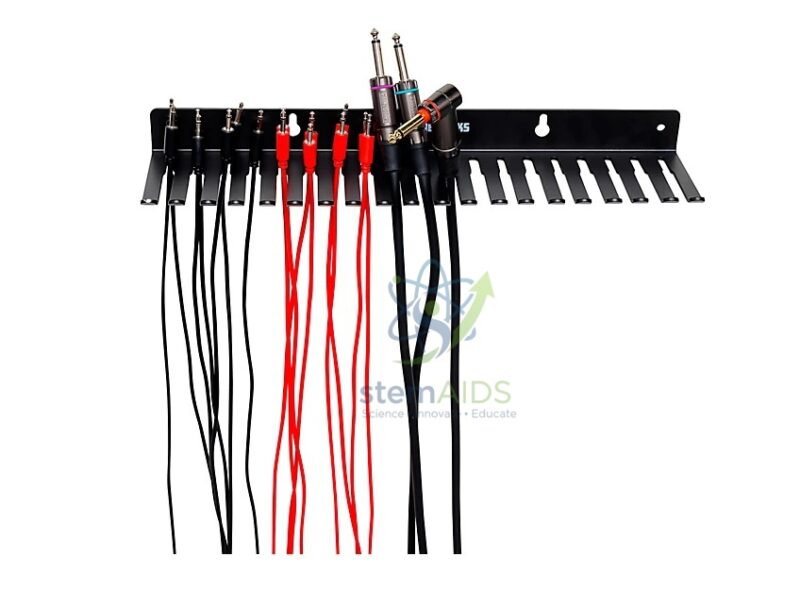
Quick Answer: This adjustable wall-mounted lead rack is a slotted rail that screws to the wall and holds laboratory leads hanging by their plugs, as the product photograph shows with red and black leads in place. It keeps leads untangled, sorted by colour or length, and visible for a quick check before each class.
Why Leads Belong on a Rack
Laboratory leads stored in a drawer tangle, kink and break at the plugs, and a broken lead is hard to spot in a heap. Hanging them on a rack solves most of that. Each lead drops straight down from its plug, so the insulation is not bent around tight corners, and a full rack shows at a glance whether a set is complete. Students collecting leads at the start of a practical can take exactly what they need, and returning leads to the same slots at the end becomes part of clearing up.
The rail in the photograph has a row of open slots along its length. A lead’s plug sits above a slot with the cable passing through it, so leads can be lifted out with one hand. Sorting by colour, by length or by plug type, for instance plain leads on one section and safety leads on another, makes the right lead easy to find.
Mounting and Adjustment
Fixing the rack at a comfortable height near the benches where leads are used reduces the temptation to leave them lying around. The wall fixings should suit the wall material, with plugs for masonry or suitable anchors for board, and the rack should be level so leads do not slide to one end. The title describes the rack as adjustable; what can be set, such as position, length or slot arrangement, depends on the design and is worth checking against your wall space. For a movable alternative, the rolling cord holder with tray can be wheeled between rooms.
Specifications
| Product | Adjustable wall-mounted lead rack |
| Form in the photograph | Black slotted rail with leads hanging by their plugs |
| Mounting | Fixed to the wall with screws |
| Holds | Laboratory leads, hung by their plugs |
| Fixings | Choose to suit the wall material |
| Adjustable features and slot count | Confirm at enquiry |
Applications
- Storing laboratory leads by colour, length or plug type next to the benches
- Making missing or damaged leads easy to spot before a practical
- Keeping BNC to safety banana cords and other special leads apart from ordinary ones
- Organising leads in prep rooms and technician stores
Care & Handling
- Fix the rack securely into a wall that can carry the weight of a full set of leads
- Hang each lead by its plug rather than looping the cable over the rail
- Inspect the hanging leads regularly for cracked plugs and worn insulation
- Wipe the rail with a damp cloth; no other maintenance is needed
Why Choose LabEquip
Schools and colleges replacing drawers full of tangled leads with visible storage are the usual buyers of this lead rack. LabEquip can supply it with leads to fill it; send your requirements through our contact page, or browse physics lab equipment.
Frequently Asked Questions
How do leads hang on the rack?
Each lead is dropped into a slot so that its plug rests on top of the rail and the cable hangs straight down. Leads can then be lifted out with one hand.
Why is a rack better than a drawer for leads?
Hanging leads do not tangle or kink, and damaged or missing leads are obvious at a glance. Leads last longer when they are not crushed and bent in a drawer.
Can safety leads be stored on the rack?
Yes, provided their plugs are larger than the slot width so they rest on the rail. Leads with very slim plugs may slip through, so try the fit with your own leads.
Where should the rack be mounted?
Close to the benches where leads are used, at a height students can reach comfortably, and away from sinks so wet hands do not drip onto leads.
What fixings are needed?
Use screws and wall plugs or anchors suited to the wall: masonry plugs for brick or block, and suitable cavity anchors for plasterboard. A full rack of leads is heavier than it looks.
Can leads be grouped on one rack?
Yes. Many labs keep red leads, black leads and special cords in separate sections, or arrange leads by length, so students and technicians find the right one quickly.
Last Updated: October 2026




Reviews
There are no reviews yet.