
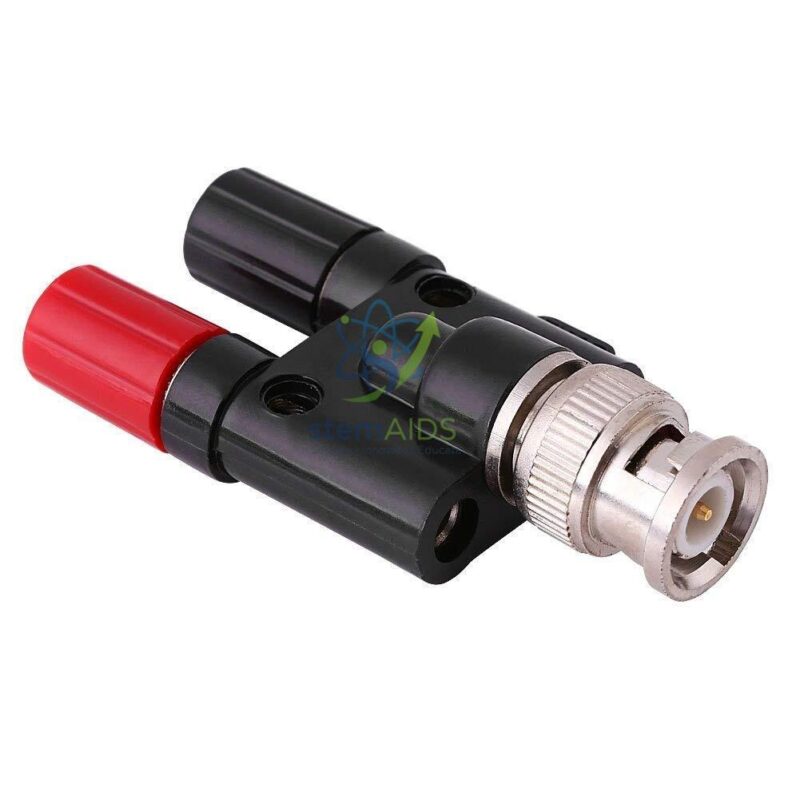
Quick Answer: The BNC banana adapter shown here is a BNC plug fitted to a block carrying two binding posts, one red and one black. It plugs straight onto an oscilloscope, generator or meter with a BNC socket and lets ordinary banana-plug leads or bare wire ends be connected to that instrument.
Two Connection Systems in One Block
Instruments built for signals, such as oscilloscopes and function generators, mostly use BNC sockets, while school circuit boards, power supplies and component holders use banana plugs and screw terminals. The BNC banana adapter joins the two directly at the instrument. In the product photograph, the BNC plug with its bayonet collar is on one side and two binding posts stand side by side on the other; the red post connects to the BNC centre pin and the black post to the outer shell, which is the convention to check before first use.
Binding posts are more versatile than plain sockets. The top of each post accepts a banana plug, a hole through the post takes a stripped wire end, and the knurled cap then clamps the wire. That makes the adapter handy for quick jobs such as connecting a pair of wires from a coil, a microphone capsule or a thermocouple to an oscilloscope without making up a special lead.
Earth and the Black Post
On most mains-powered oscilloscopes, the outer shell of every BNC input is connected to the protective earth of the instrument. The black binding post of the adapter therefore sits at earth potential once it is on the oscilloscope. Clipping it to a point in a circuit that is not meant to be earthed creates an unintended path, so students should connect the black post only to the circuit’s common or 0 V line. Where the shrouded connectors of safety leads are required, the BNC to safety banana adapter is the right choice instead.
Specifications
| Product | BNC banana adapter |
| Instrument side | BNC plug with bayonet locking collar |
| Circuit side | Two binding posts, red and black, as in the product photograph |
| Binding post connection | Banana plug in the post top, or bare wire clamped by the cap |
| Polarity convention | Red to BNC centre pin, black to BNC shell (check on receipt) |
| Suitable for | Low-voltage signal and bench circuits |
Typical Uses
- Connecting a coil, microphone or sensor with bare leads to an oscilloscope for waveform display
- Taking a function generator output to a circuit board with ordinary banana leads
- Using a BNC-input frequency counter or meter with standard laboratory leads
- Quick checks of a signal at a screw-terminal board without making up a dedicated cable
Care & Handling
- Tighten the binding post caps by hand only; overtightening cracks the insulating body or strips the thread
- Strip wire ends neatly so no loose strands bridge the red and black posts
- Support heavy leads so their weight does not bend the BNC socket of the instrument
- Keep the BNC banana adapter for low-voltage work, since its exposed posts are not insulated for hazardous voltages
Why Choose LabEquip
This adapter suits schools and colleges whose oscilloscopes and generators have BNC sockets but whose circuit kits use banana leads. LabEquip can supply it with BNC cords and safety adapters so each bench has a matching set; ask through our contact page with the number of benches, and see other physics lab products.
Frequently Asked Questions
How does this adapter differ from a safety banana adapter?
This adapter has open binding posts that take plain banana plugs and bare wire, which is convenient for low-voltage signal work. A safety banana adapter has shrouded connections designed for the covered plugs of safety leads, so no metal is exposed when connected. Choose by the leads your laboratory uses.
Which binding post connects to the BNC centre pin?
By common convention the red post is joined to the centre pin and the black post to the outer shell of the BNC plug. It is a good habit to verify this with a continuity test when a new adapter arrives, so polarity-sensitive measurements are not reversed.
Can bare wire be connected to the adapter?
Yes. Each binding post has a hole through it; push the stripped end through and tighten the cap to clamp it. Twist the strands first so they stay together, and keep the exposed length short.
Is the black post connected to earth?
When the adapter is plugged into a mains-powered oscilloscope, usually yes, because the instrument earths the outer shell of its BNC inputs. Connect the black post only to the common or 0 V side of a circuit, never to a point that sits at a different potential.
Will the adapter work with a function generator?
Yes. On a generator’s BNC output the red post carries the signal and the black post the return, so ordinary banana leads can take the waveform to a speaker, coil or circuit board.
Does the adapter affect high-frequency signals?
Leaving the coaxial cable for two separate posts and leads loses the screening, so long unscreened leads pick up interference and add capacitance. For audio-frequency and most school work this has little effect; for fast signals keep the leads short or stay with coaxial cable.
Last Updated: October 2026




Reviews
There are no reviews yet.