
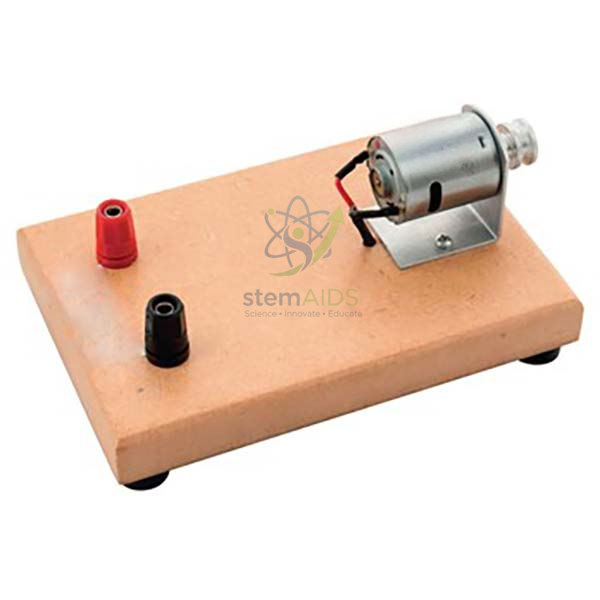
Quick Answer: The Motor 12V on Bracket is a small direct-current electric motor, rated for the 12 V given in its name, fixed to a bracket so it can be clamped to a stand or screwed to the bench. This 12V DC motor is used to demonstrate the motor effect, to measure speed and efficiency, and to show that a motor turned by hand works as a generator.
From Current to Rotation
Any wire carrying current across a magnetic field is pushed sideways, and a motor puts that push to work on the coil, or armature, mounted between its magnets. One side of the coil is driven up while the other is driven down, so together they twist the shaft. Left alone, the coil would stop once it had turned to face the field; the commutator prevents this. It is a ring split into two halves, touched by a pair of brushes, and it swaps the coil’s connections at each half revolution, so the twisting effect keeps the same sense and the shaft carries on turning.
Swap the two supply leads and the motor runs the other way, a result students can predict beforehand with Fleming’s left-hand rule. As the motor speeds up, its spinning coil also cuts the magnetic field and generates a voltage that opposes the supply: the back emf. That is why a motor draws a large current when starting or stalled and a much smaller one when running freely.
Why the Bracket Matters
A loose motor jumps and rolls when it starts, and its leads tug at the terminals. On a bracket the motor can be clamped to a retort stand or the edge of the bench, and a pulley, string and load can be attached to the shaft. That makes quantitative work possible: winding a known mass up through a measured height and timing it gives the useful output power, which can be compared with the electrical input measured with a voltmeter and ammeter.
Investigations
- Demonstrating the motor effect and the job of the commutator
- Investigating how speed depends on supply voltage and load
- Measuring efficiency by lifting a mass on a string wound onto the shaft
- Turning the shaft by hand to show generator action, as on the motor and generator model
Specifications
| Type | Direct-current electric motor |
| Rated voltage | 12 V (as titled) |
| Mounting | On a bracket for clamping or fixing |
| Principle | Motor effect with brushes and commutator |
| Shaft fitting, speed and current | Confirm at enquiry |
Care & Handling
- Clamp the bracket firmly before switching on, and keep fingers, hair and loose clothing clear of the rotating shaft.
- Run the 12V DC motor at or below its rated voltage; a stalled motor draws a high current and heats up, so switch off at once if the shaft jams.
- Disconnect the supply before changing pulleys, strings or wiring.
- Keep the motor dust-free and stored dry so the commutator and brushes stay clean.
Why Choose LabEquip
Physics departments use bracket-mounted motors both in electromagnetism lessons and in energy-transfer practicals. LabEquip supplies the motor alongside sources and meters from our physics lab equipment range; ask through the contact page about the shaft fitting if you plan to attach your own pulleys.
Frequently Asked Questions
How do I reverse the direction of the motor?
Swap the two supply connections. With the current flowing the opposite way through the coil, the push on each of its sides is reversed and the shaft turns the other way. Reversing the magnetic field would do the same, but with permanent magnets changing the connections is the practical choice.
Why does a stalled motor take a much larger current?
Once turning, the motor produces its own opposing voltage, the back emf, which holds the current down. When the shaft is stalled there is no back emf, so only the low resistance of the windings limits the current, which becomes large. A stalled motor heats quickly and should be switched off.
Can the motor be run from less than 12 V?
Yes. A DC motor runs more slowly at lower voltage, because its speed tracks the applied voltage fairly closely. Below a certain voltage it cannot overcome friction and will not start, a threshold students can find by raising the supply gradually.
How do I measure the efficiency of the motor?
Tie a string to the shaft or a small pulley and let the motor wind up a known mass through a measured height. Useful output energy is mass times g times height; input energy is voltage times current times time. Their ratio, as a percentage, is the efficiency at that load.
Can this motor work as a generator?
Yes. Turning the shaft by hand or with another motor makes the coil cut the magnetic field and produces a voltage at the terminals that can move a meter or light an LED. It shows that a motor and a generator are the same machine with the energy transfer reversed.
What is the commutator for?
It is the split ring on the shaft that connects the coil to the supply through two brushes. Every half turn it reverses the connections, so the current in each side of the coil always flows in the direction that keeps the rotation going.
Last Updated: October 2026




Reviews
There are no reviews yet.