
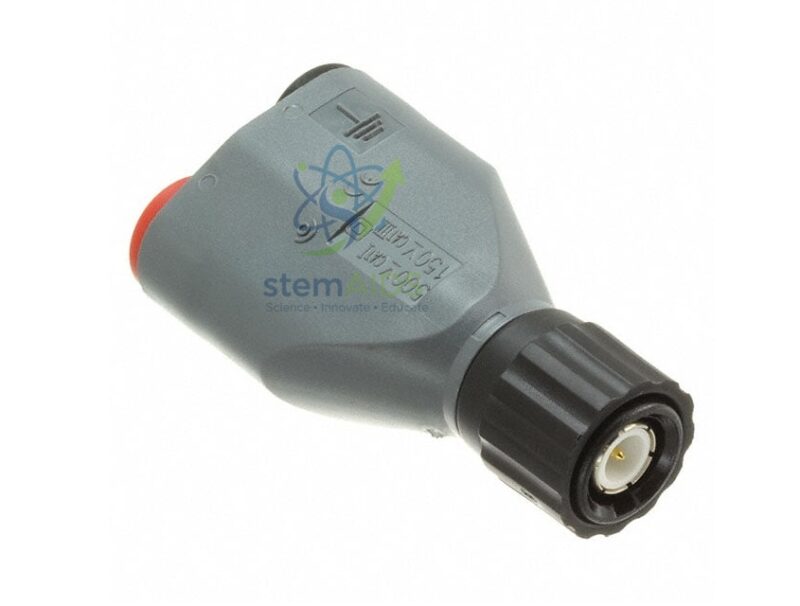
Quick Answer: The BNC to safety banana adapter is a compact grey housing with a BNC connector at one end and shrouded, colour-coded banana connections at the other. It lets coaxial cables and BNC instruments work with the safety leads used on modern school and college benches, keeping the metal parts covered.
Shrouded Connections and Why They Matter
Safety leads have plugs whose metal pin sits inside an insulating sleeve, and they fit shrouded sockets with a matching recess. Neither part exposes bare metal once connected, so a stray finger or a dropped tool cannot touch a live contact. Many laboratories now use safety leads throughout, which creates a problem with oscilloscopes and generators that only offer BNC sockets. This adapter solves that by carrying the coaxial signal into the same shrouded system.
The product photograph shows a grey body with a black BNC connector on the end and a red shrouded connection on the side, matching the usual red-for-signal, black-for-common scheme. Whether the banana side is made as plugs or as sockets decides which way round the adapter sits in a set-up, so it is worth checking against the leads and instruments it will join.
Keeping the Signal Reference Correct
Inside the adapter, the BNC centre conductor is connected to the red banana contact and the outer shell to the black one. The shell side of an oscilloscope input is normally tied to mains earth, so the black side of the adapter becomes an earth connection whenever an earthed instrument is involved. Students should attach it only to the 0 V or common rail of the circuit. If two channels are used, both black sides are joined through the oscilloscope, which is a common reason for unexpected short circuits in practicals.
Applications
- Connecting an oscilloscope with BNC inputs to a circuit wired entirely with safety leads
- Taking a function generator output to shrouded terminals on circuit modules
- Using BNC-input meters and counters in laboratories that have standardised on safety leads
- Joining a BNC cable to a safety lead when a longer or more flexible connection is needed
Specifications
| Product | BNC to safety banana adapter |
| Coaxial side | BNC connector, black, as in the product photograph |
| Banana side | Shrouded connections, colour-coded red and black |
| Wiring | Centre conductor to red, shell to black |
| Housing | Grey insulating body |
| Plug or socket on each side | Confirm at enquiry |
Care & Handling
- Insert safety plugs fully so the sleeve seats in the shroud; a half-inserted plug gives a poor contact
- Pull on the plug body or the adapter housing, never on the lead
- Wipe the housing with a dry cloth and keep the BNC end capped or boxed when not in use
- Check that the instrument and circuit voltages are suitable for the leads and adapter in use
Why Choose LabEquip
Laboratories moving over to safety leads often need a handful of BNC to safety banana adapters per room to keep their oscilloscopes and generators usable. LabEquip can supply them with Electro PJP BNC to safety banana cords and the open-post BNC banana adapter; browse more physics lab equipment or send your list through the contact page.
Frequently Asked Questions
What is a safety banana connection?
It is a banana connector in which the metal contact is recessed inside an insulating shroud, so there is no exposed metal when a safety plug is inserted. Safety plugs and shrouded sockets are designed to fit each other, and the system reduces the chance of touching a live contact.
Can ordinary banana plugs be used with this adapter?
A plain, unshrouded banana plug may not seat properly in a shrouded connection, and using one gives up the protection the shroud provides. Use safety leads with this adapter, or choose an adapter with open binding posts if your leads are the plain type.
Which colour carries the signal?
The red connection carries the BNC centre conductor, the signal side, and the black connection carries the outer shell, the common or earth side. Keep that convention throughout the circuit so both channels of an oscilloscope share the same reference point.
Does the adapter isolate the oscilloscope from the circuit?
No. It is a direct connection. The shell side remains linked to the oscilloscope’s earth, so it must go to the circuit’s common line. Isolating a measurement needs a differential probe or an isolated instrument, not an adapter.
Is the adapter suitable for high frequencies?
It is intended for the signal frequencies met in teaching laboratories. Once the signal leaves coaxial cable for separate leads it loses screening, so keep safety leads short for fast waveforms and route them together to limit pick-up.
How is the adapter cleaned and stored?
Wipe it with a dry or slightly damp cloth, keep liquids out of the connectors and store it in a closed box with other BNC fittings. Inspect the shroud for cracks before use, since a damaged shroud defeats the purpose of a safety connection.
Last Updated: October 2026




Reviews
There are no reviews yet.