









In Stock
Tube Block
₹12,356.00
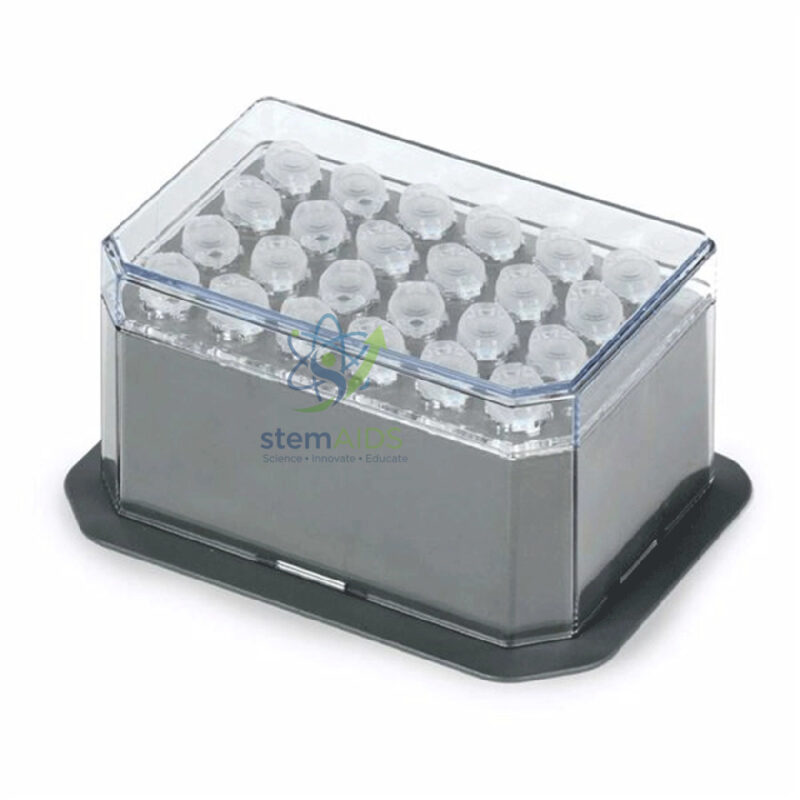
Quick Answer: The Tube Block is a metal block with rows of wells for straight-sided laboratory tubes, used in a dry bath to heat samples or pre-chilled to keep them cold; the photo shows it with a clear cover and a dark base tray.
A Block for Everyday Tubes
Where the Block for Conical Tube is shaped for tapered tips, this block has straight or round-bottomed wells for ordinary tubes. The photo shows a grey block with evenly spaced wells in rows, set in a dark tray and covered by a transparent lid. The cover keeps warm or cold air around the tubes and dust out of the wells; a cover for tube blocks is also listed on its own, so whether the pictured cover is included should be checked.
Metal blocks are useful cold as well as hot. A block pre-chilled in a refrigerator holds tubes near its own temperature for a useful time on the bench, which suits enzyme set-ups and samples that must stay cold during pipetting. On a dry bath, the same kind of block gives even heat to every tube.
Tube diameter and the number of wells are not given in the title, and the block must suit the heater if it is to be used on one. Matching the well size to your tubes gives the close contact that makes any block work.
Uses on the Bench
- Keeping enzyme reactions cold while they are assembled
- Heating tubes evenly in a dry bath for incubations
- Holding thawed samples at a steady temperature while aliquoting
- Carrying tubes between bench and instrument in a stable, covered block
Specifications
| Type | Metal block for straight-sided tubes |
| Pictured with | Clear cover and dark base tray |
| Use | On a dry bath for heating, or pre-chilled for cold work |
| Wells | Rows of evenly spaced wells, as pictured |
| Tube size, well count and heater fit | Confirm at enquiry |
Care & Handling
- Dry the block and wells after cold use, because condensation collects in them.
- Pre-chill or pre-warm the block before adding tubes, so samples do not sit at room temperature.
- Clean the cover with mild detergent and a soft cloth, and keep solvents off it.
Why Choose LabEquip
Molecular biology and biochemistry labs keep a block like this for both cold set-ups and heated incubations. Blocks, covers and heaters are in General Lab Products; ask through the contact page about well sizes.
Frequently Asked Questions
How does this block differ from the conical version?
It has straight or round-bottomed wells for ordinary tubes, while the conical version tapers its wells to fit centrifuge tube tips. Use the block whose wells match your tubes.
Can the block be used cold?
Metal blocks are commonly pre-chilled in a refrigerator to keep tubes cold on the bench. Check that the block and any cover suit freezer use before putting them in a freezer, and wipe away condensation afterwards.
Is the clear cover included?
The photo shows the block with a cover and base tray, and a cover for tube blocks is also sold separately. Ask us to confirm what is included when you enquire.
Why do tubes warm up quickly on the bench?
The block drifts towards room temperature once it leaves the refrigerator. Keep the cover on, work quickly and return the block to the cold between steps.
How is the right well size chosen?
Measure your tubes’ outside diameter and length and match them to the wells. A snug fit gives good contact; a loose fit leaves an air gap that slows heating and cooling.
How should the block be cleaned?
Rinse the wells with mild detergent, then dry the block thoroughly, especially after cold use when water collects in the wells. Store it dry to avoid corrosion.
Last Updated: September 2026
You must be logged in to post a review.
Bestsellers





Reviews
There are no reviews yet.