
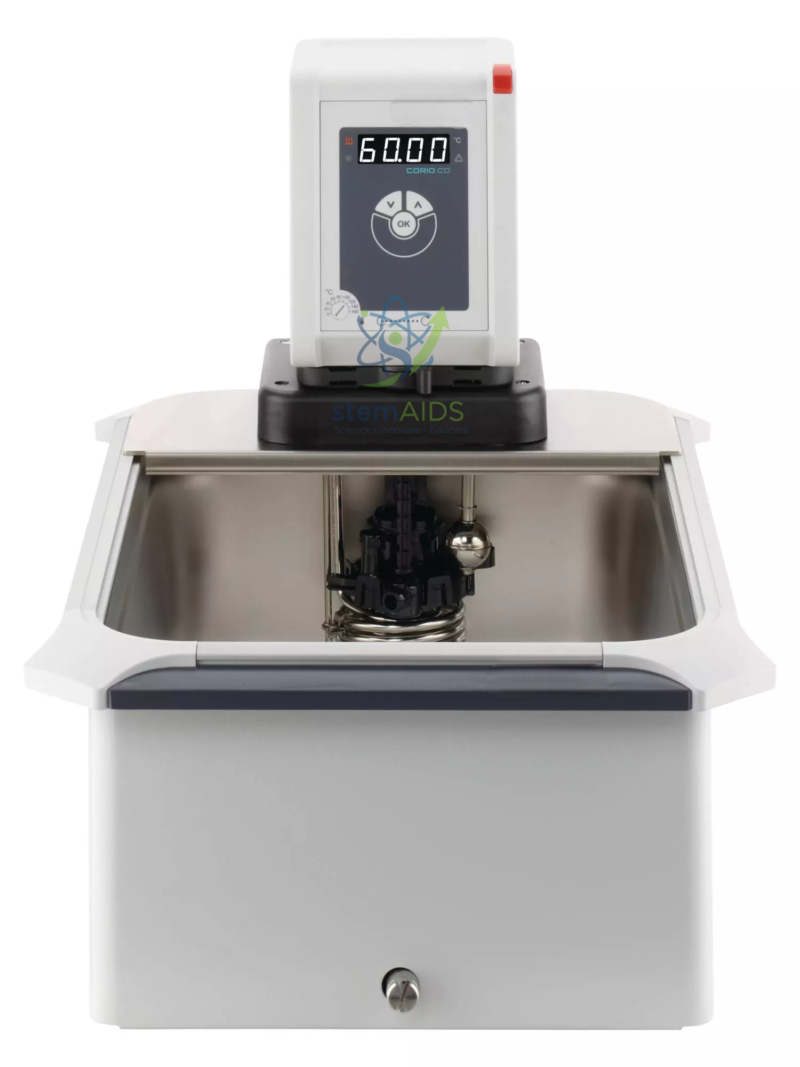
Quick Answer: The Thermostatic bath CORIO C-B is a heated circulating bath, pictured as a CORIO circulator head with a digital display mounted on the rear bridge of an open stainless steel tank, which heats the bath liquid and keeps it moving so that samples in the tank reach an even, controlled temperature.
Circulator Head and Steel Tank
CORIO is the name of JULABO’s range of compact heating circulators. In a thermostatic bath of this type, all the active parts sit in the head: a heating coil and a small pump hang down into the water, while the controller and display stay above it. The photo shows the coil and pump under the head at the back of the tank, leaving the rest of the tank free for racks, flasks and sample bottles.
The pump is what separates a circulating bath from a plain water bath. In an unstirred bath, warm water rises and cooler water collects in the corners, so samples in different positions can sit at slightly different temperatures. Constant circulation evens this out, which matters for viscosity and density measurements, enzyme kinetics and other methods that depend on a known sample temperature.
In JULABO’s naming the B stands for a bath version, and this CORIO C-B thermostatic bath uses an open stainless steel tank with a drain tap at the front, as pictured. Stainless steel is robust, easy to clean and suited to hot water work. Where samples must stay visible, the CORIO C-BT has a transparent tank instead, and settings below room temperature need a refrigerated unit such as the CD-200F circulating cryostat, because the C-B only heats.
Specifications
| Type | Heating circulator mounted on an open bath tank |
| Series | CORIO C-B, as titled |
| Tank | Stainless steel in a white housing, with front drain tap, as pictured |
| Control head | Digital display with navigation keys, as pictured |
| Circulation | Pump in the head keeps the bath liquid moving |
| Cooling | None; heating only, so it works above room temperature |
| Tank volume and temperature range | Confirm at enquiry |
What a Heated Circulating Bath Is Used For
- Holding samples at 25 °C, 37 °C or 40 °C for viscosity, density and enzyme measurements
- Warming media bottles and reagents evenly before use
- Keeping tubes and flasks at a fixed temperature during timed reaction experiments
- Supplying warm fluid to an external jacketed vessel or instrument, where the pump has outlets
Care & Handling
- Fill to between the minimum and maximum marks; running below the minimum leaves the heater exposed and can damage it.
- Use distilled water and keep the bath covered on long runs to limit scale and evaporation.
- Drain through the front tap once the water is cool, then wipe the tank dry.
- Descale the heating coil with a mild acid descaler when white deposits appear, and rinse well afterwards.
Why Choose LabEquip
Physical chemistry, food and pharmaceutical QC labs choose a stainless steel CORIO bath when they need a steady, uniform temperature for measurements and sample conditioning. LabEquip lists it in General Lab Products; send your required temperature and tank size through the contact page.
Frequently Asked Questions
What is the difference between a thermostatic bath and a water bath?
Both heat a liquid to a set temperature. A thermostatic circulating bath also pumps the liquid around the tank, so the temperature is more uniform from one position to another than in an unstirred water bath.
Can the CORIO C-B cool samples?
No. It has a heater but no refrigeration, so it works above room temperature. Colder settings need a refrigerated circulator or a cooling unit designed for the bath.
What liquid goes in the bath?
Distilled or deionised water for most work. Any other bath fluid should only be used within the temperature limits stated for both the unit and the fluid.
Why is there a tap at the front?
It drains the tank without tipping or lifting the bath. Let the water cool, place a container under the outlet and open the tap slowly.
What is the difference between the C-B and the C-BT?
Both use the same kind of CORIO circulator head. The C-B has an opaque stainless steel tank, while the C-BT has a transparent tank that lets you watch samples through the walls.
Should the bath be covered?
A lid reduces evaporation and heat loss, especially at higher settings, and stops the level falling below the minimum mark. Use a cover that leaves room for the circulator head.
Last Updated: October 2026







Reviews
There are no reviews yet.