
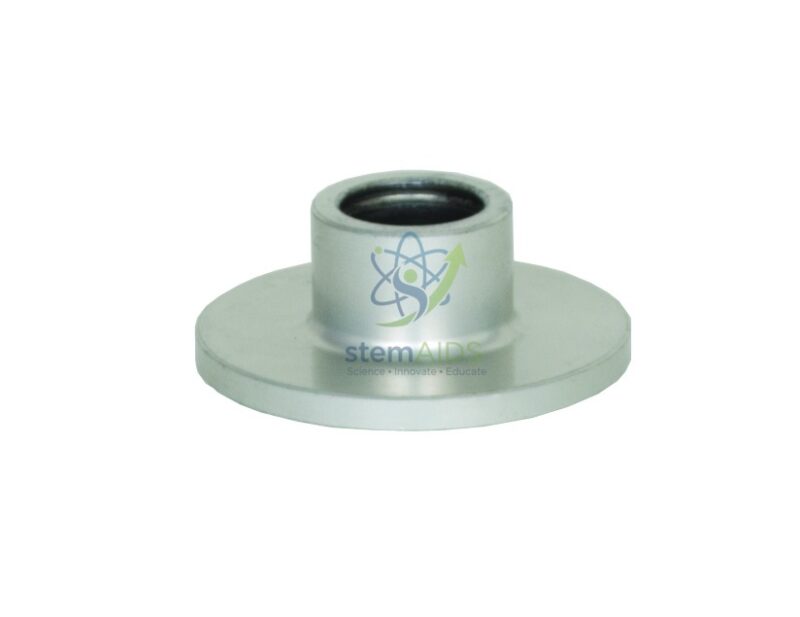
Quick Answer: The Thermal adapter 500 mL is a metal heat-transfer piece, pictured as a flat disc with a raised collar, that sits on a hotplate or cooling plate and holds a 500 mL vessel so heat moves through metal contact rather than across an air gap.
How the Thermal Adapter Improves Heat Transfer
A round-bottomed flask touches a flat hotplate at a single point, so most of the heat has to cross a thin layer of air, and warming is slow and uneven. A thermal adapter bridges that gap: the flat underside of the disc lies on the plate, and the raised collar wraps the lower part of the vessel, so heat is conducted through metal into a much wider band of glass. On a cooling plate the same contact works in reverse.
The 500 mL in the name sets the vessel the collar is made for. Contact only works when the glass seats snugly, which is why adapters of this type are sold one size per vessel volume; a 250 mL or 1 L flask would rock or fail to seat. The photo shows a light metal finish of the kind usually seen on aluminium, a metal chosen for heat-transfer parts because it conducts heat well and weighs little.
On a stirring hotplate the field still reaches a stir bar in the flask, since aluminium is non-magnetic, and unlike an oil bath there is no hot liquid to spill or ignite. A heating block for flasks is another dry approach, in block form.
Specifications
| Type | Heat-transfer adapter for a flat heating or cooling plate |
| Vessel size | 500 mL, as titled |
| Form | Flat base disc with a raised collar, as pictured |
| Material | Metal with a light, aluminium-type finish as pictured |
| Used on | Hotplates, stirring hotplates and cooling plates with a flat top |
| Vessel shape the collar suits | Confirm at enquiry |
Where a 500 mL Adapter Is Used
- Heating a 500 mL round-bottom flask under reflux on a stirring hotplate, with the stir bar still turning
- Warming a 500 mL batch of buffer, medium or reagent evenly before use
- Holding a reaction at a set temperature when the hotplate is regulated by a probe in the liquid
- Replacing an oil bath in teaching labs where hot oil is a spill and fire concern
Care & Handling
- Keep the underside of the adapter and the plate top clean; a grain of grit or a baked-on spill creates an air gap and a hot spot.
- Handle the adapter with heat-resistant gloves or tongs, as metal stays hot long after the plate is switched off.
- Wash with a mild detergent and dry; strong alkaline cleaners attack aluminium and dull the contact faces.
Why Choose LabEquip
Chemistry teaching labs and research groups that already own a stirring hotplate buy the Thermal adapter 500 mL to heat round-bottomed glassware without an oil bath. The stainless steel sand bath in General Lab Products suits other vessel shapes; send your hotplate model and flask type through the contact page so the fit can be checked.
Frequently Asked Questions
What does a thermal adapter do that a bare hotplate cannot?
A flat hotplate touches a round-bottomed flask at one small point, so heating is slow and patchy. The adapter gives metal contact around the lower part of the flask, spreading the heat over a larger area and making the contents easier to hold at temperature.
Will the adapter fit a 250 mL or 1 L flask?
No. The collar is sized for a 500 mL vessel, and good heat transfer depends on a close fit. A smaller flask would sit loosely and a larger one would not seat.
Can a stir bar still be used through the adapter?
Yes, provided the adapter is aluminium or another non-magnetic metal. The field from the stirring hotplate passes through it, although the flask sits higher above the magnet, so begin at a moderate speed and increase it once the bar is spinning steadily.
Is a thermal adapter safer than an oil bath?
It removes the hot oil, so there is nothing to spill, smoke or catch fire and no oily glassware to clean. The metal still gets very hot, so gloves and a clear bench remain essential.
Where should the temperature be measured?
Measure the liquid, not the metal. Put a thermometer or temperature probe into the flask contents; if the hotplate accepts an external probe, it can then regulate itself to hold the liquid at the set value.
How is the adapter cleaned after a spill?
Let it cool, wipe off the spill, wash it with a mild detergent and dry it. Avoid caustic cleaners and steel wool, which corrode or scratch aluminium.
Last Updated: September 2026




Reviews
There are no reviews yet.