
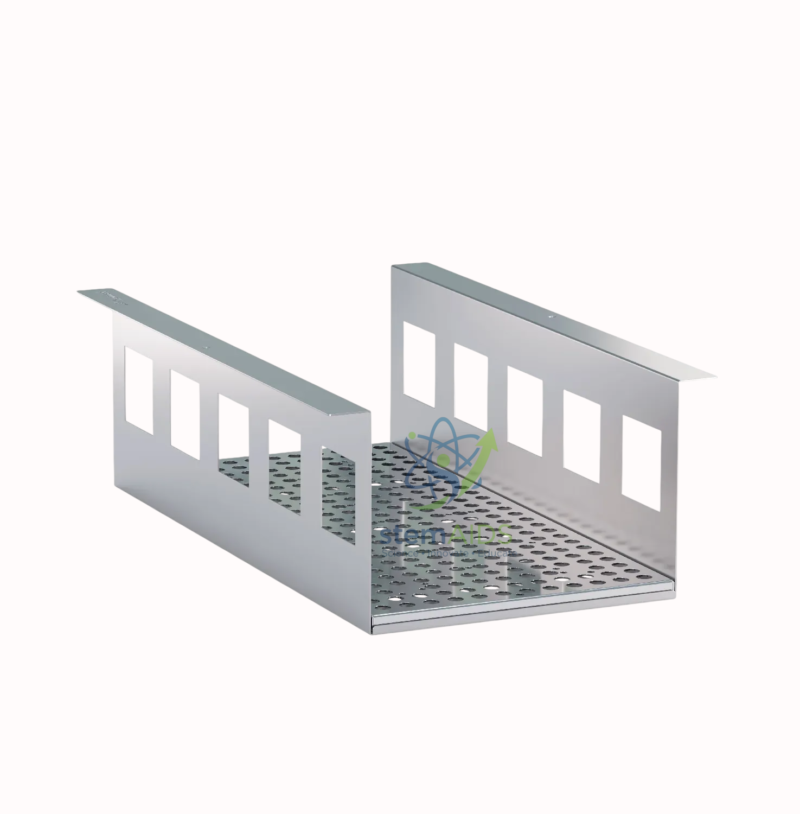
Quick Answer: The Support plate for stirring device is a perforated stainless steel carrier tray, pictured as a U-shaped channel with a hole-punched floor, two windowed side walls and outward-folded top flanges, that holds vessels or racks inside a water bath fitted with a stirring or shaking unit.
Reading the Shape of the Plate
The photo explains more than the title does. The floor is punched with rows of round holes, the two long sides rise as walls with a line of rectangular windows, and the top edge of each wall is folded outward into a narrow flange. Flanges like these let a tray rest on, or be fixed to, a supporting frame, while the height of the walls sets how far below that frame the floor hangs.
Stirring device in the title is probably a translation of the French dispositif d’agitation, a phrase used for stirring and shaking units alike. Among the bath accessories in this range, the agitation device for water baths moves a frame to and fro inside the tank, and a perforated tray of this kind is the usual way to carry beakers, bottles or small racks on such a frame. Because the title does not name the device, its fit should be checked before ordering.
Every hole and window has a job in warm water. Water passes through the floor and the side walls, so vessels on the plate are surrounded by water at bath temperature instead of sitting in a stagnant pocket, and the plate drains within seconds when it is lifted out. A solid tray would trap water, slow heat transfer and add needless weight to a moving frame.
Specifications
| Material | Stainless steel sheet, as pictured |
| Form | U-shaped tray with a perforated floor and two side walls |
| Side walls | Row of rectangular windows; top edges folded outward into flanges |
| Use | Carries vessels or racks in a bath with a stirring or shaking unit |
| Water flow | Through the floor holes and the wall windows |
| Device and bath it fits | Confirm at enquiry |
Care & Handling
- Fix the plate securely to the device or frame before switching on, and recheck the fixings after the bath has been moved.
- Spread vessels evenly across the floor so the plate is not pulled to one side.
- Rinse after use and let water drain from the holes before drying; dried salt and buffer residues block perforations.
- Inspect the flanges for bending, which can make the plate sit unevenly on its frame.
Where the Plate Is Used
- Carrying beakers, bottles or small flasks on a bath shaking frame during warm incubations
- Giving tube racks a flat, level base inside a moving or stirred bath
- Holding sample containers at a fixed depth so the bath water covers their contents
- Lifting a whole set of vessels out of the bath together at the end of a run
Why Choose LabEquip
Labs that have added a shaking or stirring unit to a water bath buy this plate to carry vessels that have no clamp of their own. LabEquip lists it in General Lab Products; send the model of your bath and stirring device through the contact page so the plate can be matched.
Frequently Asked Questions
What does the support plate do?
It is a perforated tray that carries vessels or racks inside a water bath fitted with a stirring or shaking unit. Its floor gives them a flat, level base, and its holes let water flow freely around them.
Why does the title say stirring device?
The wording appears to come from the French dispositif d’agitation, which can mean a stirring or a shaking unit. The plate belongs with that kind of add-on, so identify which device and bath you have before choosing it.
Why are the side walls cut with windows?
The windows let bath water pass through the sides as well as the floor. Vessels near the walls then stay at the same temperature as those in the middle, and the plate is lighter for the drive to move.
Can loose bottles stand on the plate while it moves?
Only low, stable vessels at gentle speeds. Tall flasks and tubes belong in clamps or in a rack fixed to the plate, because a moving tray can tip anything that is simply standing on it.
Is stainless steel suitable for long periods in warm water?
Yes. It does not rust in normal bath use and is unaffected by water up to boiling. Salt solutions and bleach should be rinsed off promptly, since chlorides can leave pits over time.
How is the plate cleaned?
Rinse it under running water, wash it with a mild detergent and a soft brush that reaches into the holes, then dry it. Dilute citric acid removes white scale left by hard water.
Last Updated: October 2026







Reviews
There are no reviews yet.