




















In Stock
Maquette Minitecto
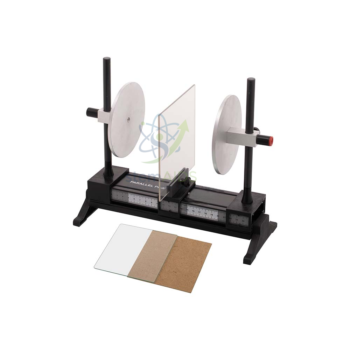
Maquette Minitecto, Modular Multi-Stratum Tank Configuration Facilitates the synthesis of complex geological scenarios, including continental rifting and orogenic mountain building.
Precision Tension/Compression Sliders enable students to evaluate the mechanical properties of lithospheric materials under varying tectonic regimes.
₹2,015.00
Quick Answer: Maquette Minitecto is a compact tectonics model (maquette is French for model) used to reproduce on the bench how rock layers fold and fault when the crust is deformed, so students can run and repeat small analogue experiments in geology lessons.
Analogue Modelling on a Small Scale
Geologists cannot watch a mountain range grow, so they build analogue models: small experiments in which weak materials, such as layered sand, stand in for strong rocks deformed over millions of years. The name Minitecto suggests this idea in miniature, a small tectonics model, and the listing presents it as a way to visualise stress, folding and faulting. A compact model has the advantage that several groups can run their own experiments in one lesson.
In small analogue models, students typically build a stack of thin coloured layers, apply a slow push or pull, and watch structures develop: folds and thrusts under shortening, or normal faults and a central trough under stretching. Repeating the run with a different layer thickness or speed shows which factors control the result, which is also how researchers use analogue models. The listing does not specify the parts or modelling materials supplied, so confirm what is included before ordering.
The title keeps the French word maquette, which simply means model or scale model; in English the product would be called a mini tectonics model.
Practical Ideas
- Group experiments on how layers respond to shortening or stretching
- Testing the effect of layer thickness or deformation speed on the structures formed
- Photographing stages to build a time sequence for a lab report
- Comparing model structures with photographs of real folded and faulted rocks
Handling Tips
- Build layers on a level bench and avoid knocks or vibration, which disturb thin layers before the experiment starts.
- Deform slowly and steadily; structures are clearest at low speed.
- Collect and dry any granular material after use and store it in labelled, sealed containers by colour.
- Clean any clear panels with a soft damp cloth rather than paper towels, which scratch.
Specifications
| Type | Compact tectonics (analogue) model |
| Title note | ‘Maquette’ is French for model |
| Structures shown | Folds and faults in layered material |
| Classroom format | Compact, for group work on a bench |
| Parts and modelling materials | Confirm at enquiry |
Why Choose LabEquip
Geology teachers who want students to experiment, not just watch, look for small models that groups can operate themselves. LabEquip lists the Maquette Minitecto in General Lab Products; for a demonstration focused on squeezing the crust see the Tectonic Model of Compression, and model details can be confirmed through the contact page.
Frequently Asked Questions
What does Maquette Minitecto mean?
Maquette is French for model or scale model, and the second word suggests mini tectonics. Together the name describes a small model for demonstrating tectonic deformation such as folding and faulting.
What is analogue modelling in geology?
It is the use of scaled physical experiments, often with sand, clay or silicone layers, to reproduce how rocks deform. Weak materials are chosen so that small forces over a short time imitate large forces acting over geological time.
Why does sand behave like rock in tectonic models?
Dry sand breaks along faults when stressed, much like brittle upper crustal rock, and it is weak enough to deform by hand at model scale. Coloured layers make the resulting structures easy to see.
How is a small model useful compared with a large demonstration?
Several groups can run their own experiments at once, each changing one variable, and then compare results. That turns a demonstration into an investigation with evidence the students produced themselves.
What variables can students change?
Typical variables are the thickness and number of layers, the speed of deformation, the amount of shortening or stretching, and whether a weak layer is included. Each changes the spacing and style of the structures.
How should results be recorded?
Photograph the model from the side at fixed intervals of movement, measure fault angles and fold spacing on the images, and draw an annotated cross-section of the final state.
Last Updated: September 2026
You must be logged in to post a review.
Bestsellers





Reviews
There are no reviews yet.