



























In Stock
Stop Cocks, Plastic
Multi-Port Fluid Management: Available in bidirectional and tridirectional configurations, these stopcocks feature precision-machined internal plugs that ensure a 360-degree hermetic seal under low-to-medium pressure environments.
Serrated Universal Barbs: Integrated tapered hose connections provide high-friction retention for various flexible tubing diameters, preventing accidental disconnection and ensuring laminar flow during hazardous chemical transfers or pressurized fluid delivery.
₹280.00
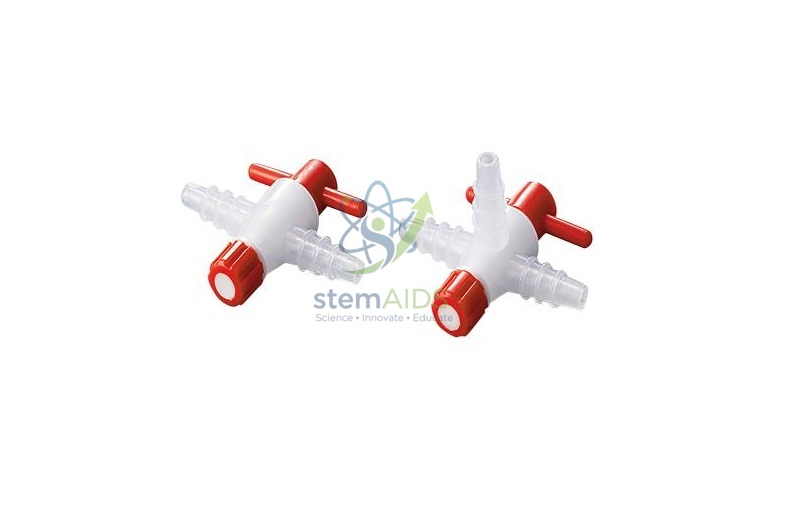
Quick Answer: Plastic stopcocks are small valves with a turning key and barbed ends that push into flexible tubing, used to start, stop or redirect the flow of water, gas or solutions in a laboratory set-up. The listing photo shows a straight two-way stopcock and a T-shaped three-way one, both with red keys.
Two-Way and Three-Way Patterns
A two-way stopcock has one inlet and one outlet, so turning the key simply opens or closes the line. It is the tap on an aspirator bottle, the shut-off between a water pump and a filter flask, or the control on a water line to a condenser. A three-way stopcock has a third port, and the bore in its key connects different pairs of ports as it turns; one supply can then feed either of two outlets, or a line can be vented to air without disconnecting anything.
The photo shows serrated hose-barb ends, which grip flexible PVC, rubber or silicone tubing when the tube is pushed fully over the ridges. Valves of this kind are light, need no grease as ground-glass keys do, and are not brittle. They are not suited to high pressure, hot oil lines or solvents that attack the plastic, and the resin is not named in the title.
For a ground-glass connection with its own tap, see the right-angle cone adapter with stopcock; for a ready-made dispensing reservoir, the plastic carboy with stopcock comes with its tap fitted.
Applications
- Controlling cooling-water flow to a condenser in distillation or reflux set-ups
- Shutting off a vacuum line between a water pump and a filtration flask
- Switching a gas supply between two delivery tubes with a three-way stopcock
- Fitting a tap to an improvised aspirator bottle or a siphon line
Specifications
| Item | Plastic stopcock (valve) for flexible tubing |
| Forms in photo | Straight two-way and T-shaped three-way |
| Connections | Serrated hose-barb ends |
| Key | Turning key, shown in red in the photo |
| Types, bore and tubing size supplied | Confirm at enquiry |
Care & Handling
- Push tubing fully over the barbs, and secure it with a clip where the line is under pressure or vacuum.
- Turn the key gently; forcing a stiff key can crack the body or distort the seal.
- Flush with clean water after salt or sugar solutions, which dry into crystals that make the key stick.
- Check chemical resistance before passing organic solvents or concentrated acids through the valve.
Why Choose LabEquip
Chemistry technicians rely on small valves like these to build and repair tubing systems for water, gas and vacuum lines. You will find them in LabEquip’s chemistry lab equipment range; share the tubing size you use via the contact page.
Frequently Asked Questions
What is the difference between a two-way and a three-way stopcock?
A two-way stopcock only opens or closes one line. A three-way stopcock has three ports and can connect the inlet to either outlet, or link all three, depending on the position of the key.
Do these stopcocks need grease?
No. Plastic keys are designed to seal against the body without the silicone grease used on ground-glass stopcocks. Grease can make some plastics swell or let the key slip.
What tubing fits the barbed ends?
Flexible PVC, rubber or silicone tubing with an internal diameter close to the barb size. The tube should need a firm push to go on; if it slides on easily, it may leak or pull off.
Can the stopcock be used on a vacuum line?
Yes, for the modest vacuum of a water aspirator or a small laboratory pump. Use thick-walled vacuum tubing so the tube itself does not collapse at the joint.
How do I tell which way the three-way stopcock is open?
Look at the key: on most designs the handle arms or markings line up with the open ports. Test the setting with water before connecting a gas supply or a reaction vessel.
Why has the key become stiff?
Dried salts, sugar solutions or chemical attack on the plastic are the usual causes. Soak the stopcock in warm water, work the key gently, and replace it if the body shows cracks or swelling.
Last Updated: September 2026
You must be logged in to post a review.
Bestsellers





Reviews
There are no reviews yet.