















In Stock
Reagent Bottle (Wide Mouth), Plastic
Advanced Polymeric Durability: Manufactured from high-density polyethylene (HDPE) or polypropylene (PP), ensuring superior chemical inertness against aggressive acids, bases, and alcohols.
Hermetic Threaded Closure: Features a precision-engineered, deep-threaded cap with an integrated seal ring to guarantee a 100% airtight and moisture-resistant barrier for sensitive reagents.
₹525.00
Quick Answer: A wide mouth plastic reagent bottle is a moulded bottle with a broad neck, used to store powdered and crystalline solids, granules and pastes that must be scooped out with a spatula. The listing image filename describes a white HDPE bottle of this type.
Built for Spatulas and Scoops
A solid cannot be poured through a narrow neck without clogging, and a spatula must reach every part of a bottle to empty it. A wide neck solves both problems. Salts such as copper(II) sulfate crystals, sodium chloride, calcium carbonate chips and granulated zinc are stored this way in almost every school prep room.
The title only says plastic, but the image filename describes white high-density polyethylene (HDPE). HDPE is tough, does not shatter and resists most dilute acids, alkalis and salts; it is generally not autoclavable and is slightly permeable to some organic vapours. An opaque white body also shields the contents from some light.
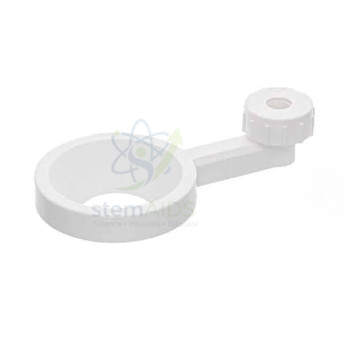
Filling is easiest with a plastic powder funnel, whose wide stem does not clog. For liquid reagents, use the narrow mouth version of this bottle instead.
Specifications
| Item | Reagent bottle with a wide neck for solids |
| Material | Plastic; listing image filename indicates white HDPE |
| Typical contents | Powders, crystals, granules, pellets and pastes |
| Heat | HDPE is generally not autoclavable |
| Capacity and closure | Confirm at enquiry |
Care & Handling
- Use a clean, dry spatula for each reagent so solids are not cross-contaminated or dampened.
- Keep hygroscopic solids such as calcium chloride or sodium hydroxide pellets tightly closed, as they absorb moisture and cake.
- Wash empty bottles with warm water and detergent, rinse, and dry fully before refilling with a solid.
Applications
- Storing laboratory salts, carbonates and metal granules in a school prep room
- Holding sodium hydroxide pellets, which should not be kept in glass-stoppered bottles
- Collecting soil, sediment or plant samples for later testing
- Storing agar powder, media components and other dry supplies in a biology lab
Why Choose LabEquip
Prep room technicians who keep dozens of solid reagents need wide-necked bottles that do not crack when knocked. The bottle is part of LabEquip’s chemistry lab equipment range; ask about capacities through the contact page.
Frequently Asked Questions
What is a wide mouth reagent bottle used for?
Solids. Powders, crystals, granules and pellets are scooped in and out with a spatula, which a narrow neck would not allow. Liquids are better stored in narrow mouth bottles, which pour more cleanly.
Why keep sodium hydroxide pellets in a plastic bottle?
Sodium hydroxide absorbs moisture and carbon dioxide from the air and forms a film that can fuse a glass stopper to its neck. A plastic bottle with a well-fitting cap avoids a stuck stopper and resists the alkali.
Is HDPE suitable for storing iodine?
No. Iodine vapour passes into and stains polyethylene, and the bottle soon turns brown. Store iodine crystals in a glass bottle with a glass stopper, in a cool place.
Can I autoclave the bottle?
HDPE generally softens at autoclave temperatures and should not be autoclaved. If sterilisation is needed, choose a polypropylene bottle and loosen the cap before autoclaving.
How do I stop solids caking in the bottle?
Close the cap straight after use, keep the bottle in a dry cupboard, and never return unused or damp material to it. Hygroscopic salts may need a desiccator for long-term storage.
Does a white bottle protect light-sensitive solids?
Opaque white plastic blocks some light but not all. For solids that decompose in light, such as silver nitrate, an amber bottle kept in a closed cupboard gives better protection.
Last Updated: September 2026
You must be logged in to post a review.
Bestsellers





Reviews
There are no reviews yet.