











In Stock
Flask, Distillation
Integrated Sidearm Geometry: Features a precision-angled side delivery tube positioned at a standardized height to optimize vapor condensation and prevent distillate reflux during sensitive fractionation processes.
Superior Hydrolytic Resistance: Manufactured from Type I, Class A Borosilicate 3.3 glass, ensuring the vessel remains chemically inert and resistant to leaching when exposed to aggressive boiling solvents or corrosive reagents.
₹475.00
Quick Answer: A distillation flask is a glass boiling flask with a round body and a side arm on its neck that leads vapour away to a condenser. It is used for simple distillation, such as recovering water from a salt solution or separating a liquid from dissolved solids, with a thermometer or stopper fitted in the top of the neck.
How a Side-Arm Flask Works in Simple Distillation
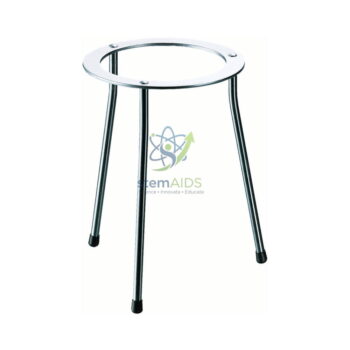
The distillation flask combines the boiling vessel and the still head in one piece of glass. The side arm leaves the neck at a downward angle, so vapour rising from the boiling liquid turns into the arm and flows on into a condenser, while the top of the neck is closed with a bored bung carrying a thermometer. It is the classic piece of laboratory distillation apparatus in school and college practicals, needing only a condenser, a receiver, a stand and a heat source to complete it.
Thermometer placement decides whether the recorded boiling point means anything. The bulb should sit level with, or just below, the opening of the side arm, where it is bathed in vapour that is about to leave. Placed higher it reads low; pushed down towards the liquid, it records superheated liquid instead of the vapour.
On traditional designs the side arm is a plain tube, joined to the condenser with a bored bung or a sleeve of tubing rather than a ground joint. That keeps the set-up simple for teaching. Fractional distillation needs a column between the boiling liquid and the condenser, which usually means a round flask with a ground neck instead. A Liebig condenser is the usual partner for this flask. Capacity, arm position and glass type are not stated in the listing.
Specifications
| Body | Round-bodied boiling flask |
| Side arm | Leaves the neck at a downward angle to feed a condenser |
| Top opening | Takes a bored bung with thermometer, or a stopper |
| Heating | Heating mantle, water bath, or burner with gauze |
| Capacity, arm position and glass type | Confirm at enquiry |
Care & Handling
- Add two or three anti-bumping granules to the cold liquid before heating, never to liquid that is already hot.
- Charge the flask to about half or two thirds at most, and stop before it runs dry, since overheated residues can decompose or crack the glass.
- Start the condenser water, entering at the lower end, before any heating begins.
- Heat flammable liquids such as ethanol with a water bath or mantle rather than a naked flame.
Applications
- Distilling pure water from salt or ink solution to show a solvent being separated from dissolved solids
- Measuring the boiling point of a pure liquid such as ethanol during distillation
- Recovering a solvent after an extraction practical
- Concentrating ethanol from a fermented sugar solution in school biotechnology practicals
Why Choose LabEquip
Teachers building a first distillation practical and colleges replacing breakage in their teaching sets are the usual buyers of side-arm flasks. LabEquip can supply it alongside condensers and receivers from the chemistry lab equipment catalogue; give the capacity and quantity on the contact page.
Frequently Asked Questions
What is the difference between a distillation flask and a round bottom flask?
A distillation flask has a side arm built into the neck to carry vapour to the condenser, so no separate still head is needed. A plain round bottom flask has a single neck and needs a still head or adapter on top before it can be used for distillation.
Where should the thermometer bulb go?
Level with, or just below, the junction of the side arm with the neck. At that height the bulb sits in the vapour stream leaving the flask, so it reads the boiling point you want to record.
Can this flask be used for fractional distillation?
Not on its own. Fractional distillation needs a packed or Vigreux column between the boiling liquid and the condenser, which a side-arm flask cannot hold well; the usual arrangement is a round bottom flask, a column and a still head.
Why do anti-bumping granules matter in distillation?
Without them, liquid can superheat and then boil in a sudden burst, called bumping, which can throw hot liquid into the condenser or crack the flask. The porous granules give small bubbles a place to form steadily.
Can I distil flammable solvents in it?
Yes, with precautions: heat with a water bath or heating mantle instead of a naked flame, keep the receiver end open to the air, and work in a well-ventilated area away from other ignition sources.
How is the condenser connected to the side arm?
On traditional flasks the side arm is a plain tube that passes through a bored bung in the condenser inlet or is joined with a short sleeve of tubing. Ask LabEquip whether the arm is plain or jointed if it must match condensers you already own.
Last Updated: September 2026
You must be logged in to post a review.
Bestsellers





Reviews
There are no reviews yet.