














In Stock
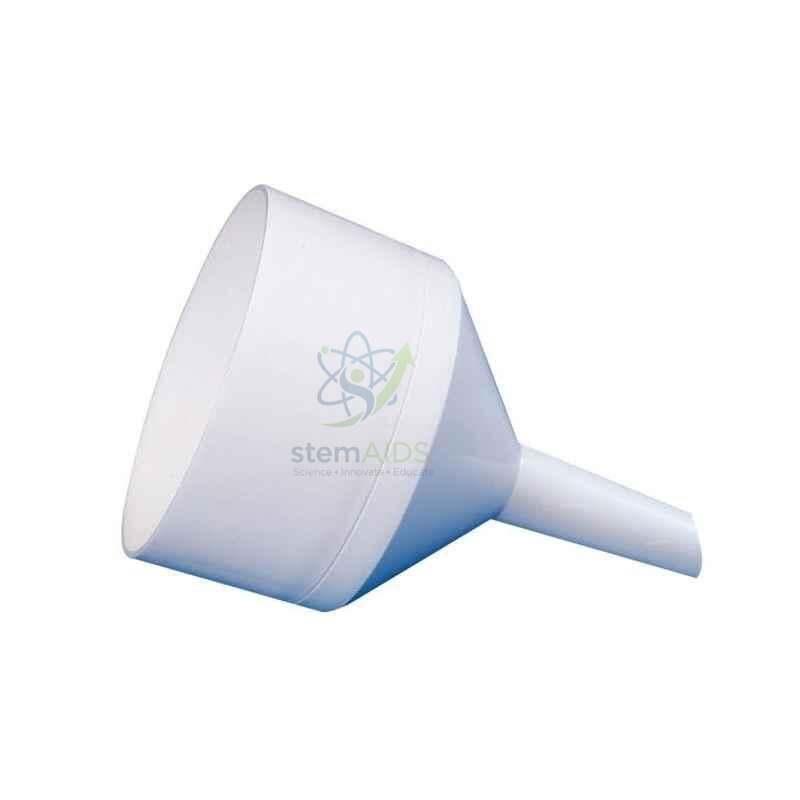
Buchner Funnel, Plastic
Modular Two-Piece Architecture: Engineered with a precision-fit detachable design that simplifies the recovery of filter cakes and ensures thorough decontamination of the internal perforated plate.
Vacuum-Stable Polypropylene Composition: Constructed from high-modulus, medical-grade polypropylene that resists mechanical deformation under sustained negative pressure and provides broad-spectrum resistance to aggressive acids and alkalis.
$1.86
Quick Answer: A plastic Buchner funnel is a funnel with a flat, perforated plate inside, used with a filter paper circle and a filtering flask to separate solids from liquids by vacuum filtration. The listing image shows a white funnel with a short stem.
Filtering Faster Under Suction
Gravity filtration through a cone of paper is slow, especially with fine crystals. In a Buchner funnel the filter paper lies flat on a perforated plate, and a vacuum applied beneath the plate pulls the liquid through quickly. The solid collects as a flat cake that can be washed with cold solvent and sucked almost dry, which is why this set-up is used to collect crystals after recrystallisation.
Plastic Buchner funnels are usually polypropylene. Compared with porcelain they are lighter and do not shatter, and some designs separate into two parts so the underside of the plate can be cleaned. Polypropylene resists most aqueous acids and alkalis and is generally autoclavable, but hot organic solvents can soften it, so porcelain or glass remains preferable for hot solvent filtrations.
The funnel sits in the neck of a filtering flask through a rubber bung or cone adapter, and the flask’s side arm is connected by thick-walled tubing to a filter pump or vacuum line.
Specifications
| Item | Buchner funnel with flat perforated plate |
| Material | Plastic, as titled; usually polypropylene |
| Used with | Filter paper circle, filtering flask, bung or cone adapter, vacuum source |
| Main use | Vacuum filtration of precipitates and crystals |
| Plate diameter and construction | Confirm at enquiry |
Applications
- Collecting crystals of aspirin, benzoic acid or copper(II) sulfate after recrystallisation
- Separating precipitates in inorganic preparations
- Filtering larger volumes of suspension that would clog a gravity filter
- Washing and drying a solid on the filter before moving it to a watch glass
Care & Handling
- Choose filter paper that covers every hole but lies flat without curling up the wall, and wet it with the solvent before applying vacuum.
- Break the vacuum at the tubing before turning off a water pump, so water is not sucked back into the flask.
- Rinse the plate from below as well as above after use, because fine solids lodge in the holes.
Why Choose LabEquip
Organic chemistry courses and school labs running crystallisation practicals choose plastic Buchner funnels to avoid broken porcelain. LabEquip offers the full set-up within its chemistry lab equipment range; ask about plate sizes through the contact page.
Frequently Asked Questions
What size of filter paper should I use in a Buchner funnel?
Use a circle slightly smaller than the plate, so it covers all the holes but lies flat without folding up the sides. Paper that climbs the wall lets solid bypass the filter.
Why is the filter paper wetted before filtering?
Wetting with the same solvent seals the paper against the plate when suction is applied, so the first portion of the mixture does not run under the edge of the paper.
Can a plastic Buchner funnel be used with hot solvents?
Hot aqueous solutions are usually fine for polypropylene, but hot organic solvents can soften it. For hot solvent filtrations, a porcelain or glass Buchner funnel is the safer choice.
How is the funnel connected to the flask?
The stem passes through a rubber bung or a conical rubber adapter in the neck of a filtering flask. The side arm of the flask is connected with thick-walled tubing to a vacuum source.
Why does water from the pump sometimes flow back into the flask?
When a water aspirator is turned off while the flask is still under vacuum, water is drawn back along the tubing. Disconnect the tubing or release the vacuum first, or fit a trap bottle between pump and flask.
How do I clean the perforated plate?
Rinse from underneath with a wash bottle or running water to push solids out of the holes, then wash with detergent. If the funnel separates into two parts, take it apart for thorough cleaning.
Last Updated: September 2026
You must be logged in to post a review.
Bestsellers





Reviews
There are no reviews yet.