






In Stock
Inoculating Loops, Metal
₹425.00
Quick Answer: Metal inoculating loops are reusable microbiology tools made of a fine wire bent into a small closed ring and fixed in a handle. The wire is heated to red heat in a flame before and after each use, then used to streak agar plates, pick colonies and carry a drop of culture from one medium to another.
How a Reusable Wire Loop Works
The working part of a metal loop is the wire itself. A ring of wire only a few millimetres across holds a thin film of liquid by surface tension, in the same way a bubble wand holds soap, so a single dip lifts a small, fairly repeatable volume of broth culture. Drawn lightly across agar, the same ring spreads cells in a thin line without tearing the surface. Being metal, it is sterilised on the bench by heating it in a flame until it glows.
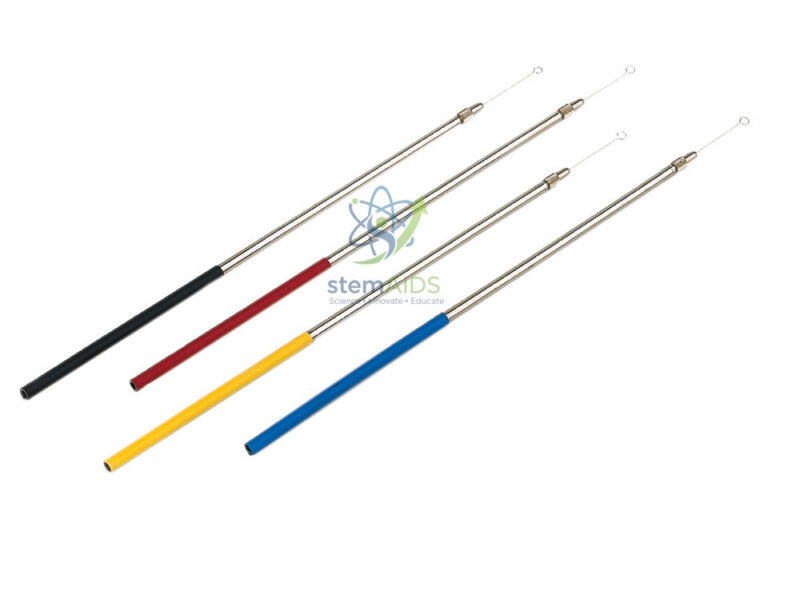
The listing photograph shows loops mounted in metal holders with coloured grips, a common arrangement that keeps the hand well back from the flame. The wire alloy is not named in the title. Nichrome is the usual choice for teaching laboratories because it tolerates repeated heating; platinum loops cool faster and last longer but are rarely bought for class sets. Loop diameter and the number of loops supplied should be confirmed with the order.
Metal loops and disposable plastic loops do the same job in different ways. The metal version is bought once and flamed for years, which suits a lab with gas taps and time to teach flaming; the plastic inoculating loops in the same range need no flame at all and are thrown away after one transfer.
Microbiology Practicals
- Streaking a mixed culture across an agar plate in three or four sections to obtain isolated colonies
- Transferring a loopful of broth culture to a fresh broth, slope or plate
- Placing a small amount of culture into a drop of water on a slide to make a smear for Gram staining
- Training students in aseptic technique: flaming, cooling, lifting the lid only slightly and re-flaming
Care & Handling
- Rest a hot loop in a loop holder or stand, never flat on the bench, and let the wire cool before touching agar.
- If a loop opens or bends, reform it into a closed ring with fine forceps; an open ring holds no film and gouges the agar.
- Replace a wire that has turned thin or brittle.
Specifications
| Item | Reusable inoculating loop: wire loop fixed in a holder |
| Working end | Fine wire formed into a small closed ring |
| Holder | Metal handle with coloured grip, as shown in the listing photograph |
| Sterilisation | Heating the wire to red heat in a Bunsen or spirit-lamp flame |
| Wire alloy, loop size and quantity | Confirm at enquiry |
Why Choose LabEquip
Metal loops are usually ordered as class sets alongside plates and media for a microbiology course. LabEquip lists them in the Biology Lab Products range with borosilicate glass Petri dishes for the plates they are used on. Tell us how many benches you equip through the LabEquip contact page and we will confirm wire type, loop size and packing.
Frequently Asked Questions
How do I sterilise a metal inoculating loop?
Hold the loop in the hottest part of the flame, just above the blue inner cone, and heat the whole wire from the holder end to the ring until it glows red. Let it cool for a few seconds before touching a culture, otherwise the heat kills the cells you want to transfer and the agar sizzles.
Why does a loop sometimes spit when it is flamed?
Culture left on the wire boils suddenly and throws out droplets that can carry live organisms. Warm a wet loop first in the cooler outer part of the flame so it dries, then move it into the hot zone. An enclosed electric loop steriliser prevents spattering altogether.
Should a school choose metal or plastic loops?
Metal loops last for years and suit labs with Bunsen burners or spirit lamps where flaming is part of the syllabus. Plastic loops need no flame and avoid spatter, but each one is used once and discarded, so they have to be bought again for every practical.
What is the difference between an inoculating loop and an inoculating needle?
A loop has a closed ring that holds a film of liquid and spreads cells over agar. A needle is a straight wire used to stab a culture deep into a tube of agar or to touch a single small colony without disturbing its neighbours.
What should I do if the wire ring gets bent open?
Reshape it around a thin rod or with fine forceps until the ring closes neatly and lies flat. An open or twisted loop does not pick up a film of broth and digs into the agar surface. Wire that snaps or looks scaled should be replaced.
Which part of the loop goes into the flame?
Only the wire and the first part of the metal shaft go into the flame. The grip stays outside it. Hold the handle like a pencil at an angle so the wire lies along the hottest zone, and point the loop away from yourself and others while it heats.
Last Updated: September 2026
You must be logged in to post a review.
Bestsellers




Reviews
There are no reviews yet.