
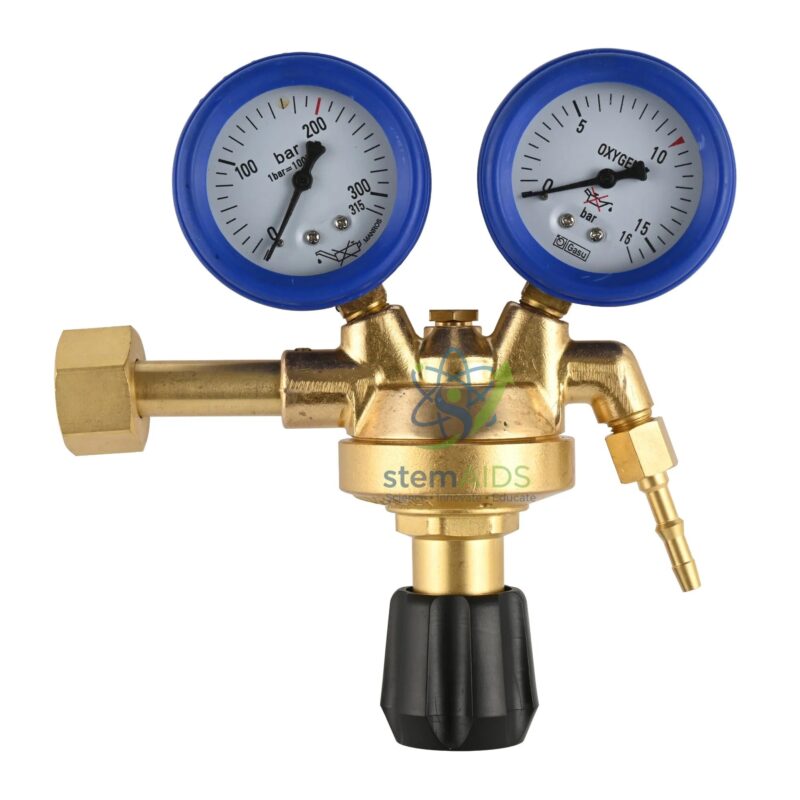
Quick Answer: The Pressure Regulator AIR LIQUIDE is a brass gas pressure regulator that screws onto a compressed-gas cylinder and lowers the high, falling cylinder pressure to a steady working pressure for apparatus. The photographed unit carries two dial gauges, an adjusting knob underneath and a hose-tail outlet at the side.
How a Gas Pressure Regulator Holds Pressure Steady
Inside a gas pressure regulator a spring pushes on a flexible diaphragm, and the diaphragm opens or closes a small valve seat between the cylinder side and the outlet side. Turning the adjusting knob inwards compresses the spring, so a higher outlet pressure is needed to push the diaphragm back and close the seat. When apparatus draws gas, outlet pressure dips, the seat opens a little and the pressure recovers, so the delivery pressure stays close to the set value while the cylinder empties.
On a two-gauge regulator such as the one pictured, the gauges answer two different questions. The inlet gauge shows cylinder pressure, which for a permanent gas such as oxygen or nitrogen falls roughly in proportion to the gas left, by Boyle’s law at constant temperature. The outlet gauge shows the pressure being sent down the hose, which is the figure the experiment actually depends on.
Setting Up the Regulator on a Cylinder
Before fitting the regulator, check that its connection matches the cylinder outlet. Regulators are made for particular gases, and the threads differ between gas families so that the wrong regulator cannot easily be fitted. Wind the adjusting knob out until it turns freely, which closes the regulator, then open the cylinder valve slowly while standing to the side of the gauges. Only then wind the knob in until the outlet gauge reads the pressure the apparatus needs.
To shut down, close the cylinder valve first, let the gas in the regulator bleed away through the apparatus until both gauges read zero, and then wind the knob out again so the next opening does not send a pressure surge into the hose.
Specifications
| Product | Gas pressure regulator, listed as Air Liquide |
| Construction in photograph | Brass body with two dial gauges, adjusting knob and hose-tail outlet |
| Function | Reduces cylinder pressure to a steady, adjustable outlet pressure |
| Gauges | Inlet (cylinder contents) and outlet (delivery pressure) |
| Used with | A gas cylinder, gas tubing with hose clips, and a cylinder trolley or wall restraint |
| Gas type, cylinder connection and pressure ranges | Confirm at enquiry |
Where the Regulator Is Used
- Supplying oxygen or another cylinder gas at a controlled pressure for combustion and gas demonstrations
- Filling gas jars, balloons or gas syringes for gas-law work at a low, known delivery pressure
- Flushing air out of apparatus with a steady gas stream before a reaction is started
- Teaching the spring-and-diaphragm regulator as an everyday example of negative feedback
Care & Handling
- Keep the regulator, its threads and the cylinder valve free of oil and grease, which matters most on oxygen service
- Test new joints for leaks with leak-detection fluid or soapy water, never with a flame
- Use the regulator only for the gas it is intended for, and never force a connection that does not fit
- Have a damaged gauge or a creeping outlet pressure checked before further use
Why Choose LabEquip
Schools, colleges and teaching labs that keep a gas cylinder for demonstrations buy a regulator so the gas reaches glassware at a pressure it can take. LabEquip can supply the regulator together with a gas cylinder trolley and the gas pipe used with it, alongside the wider physics lab equipment range. Tell us the gas and the cylinder connection when you contact LabEquip.
Frequently Asked Questions
Why does the outlet pressure need to be lower than the cylinder pressure?
Cylinder gas is stored at a pressure far above what glassware, tubing or a balloon can take. The regulator brings it down to a working pressure and keeps it there, so the flow stays gentle and steady from a full cylinder to a nearly empty one.
What does creep mean on a regulator?
Creep is when the outlet pressure keeps rising slowly after the flow has stopped, usually because the valve seat no longer seals fully. A regulator that creeps should be taken out of service and checked, because the pressure in the hose can climb past the set value.
Can one regulator be used for oxygen and for other gases?
Not as a rule. Regulators are made for a particular gas or gas family, connections differ to prevent mix-ups, and a regulator used on another gas may carry traces that are unsafe in oxygen service. Use it only on the gas it is intended for.
Which way do I turn the knob to increase pressure?
Turning the adjusting knob inwards, usually clockwise, compresses the spring and raises the outlet pressure. Turning it outwards until it feels loose closes the regulator. Always start with it wound out before opening the cylinder valve.
How do I check the joints for leaks?
Brush leak-detection fluid or soapy water over each joint with the gas on. Growing bubbles show a leak. Close the cylinder valve, release the pressure, remake the joint and test again. Never search for a gas leak with a flame.
Which gas and cylinder connection does this regulator suit?
The listing gives the regulator name only, so the intended gas and the cylinder connection should be confirmed when you enquire. Tell us the gas and the cylinder outlet you use so the right regulator is matched to it.
Last Updated: October 2026




Reviews
There are no reviews yet.