



















In Stock
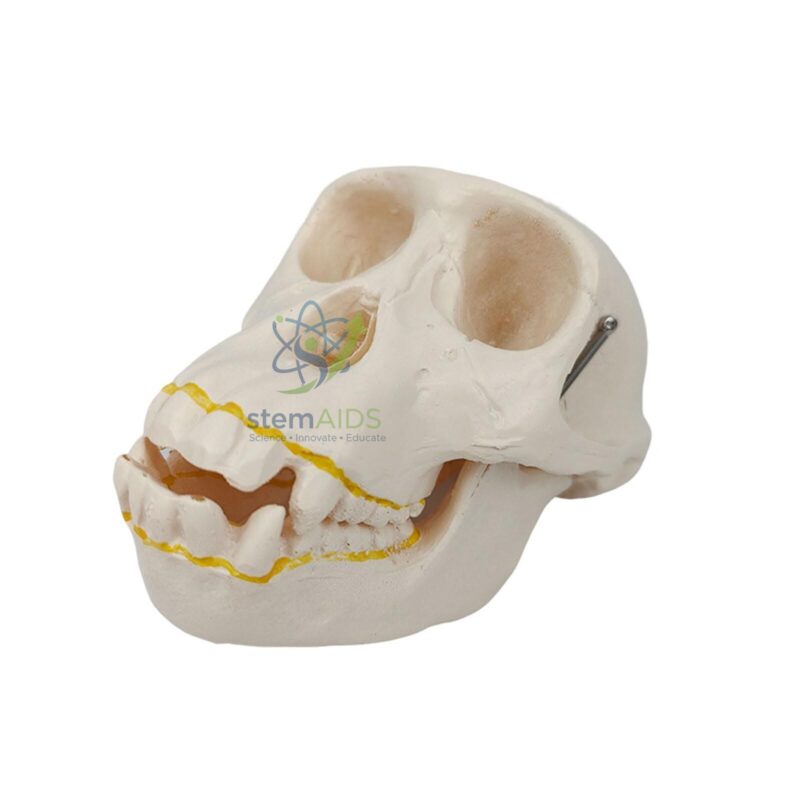
Adult Chimpanzee Skull
Crâne de chimpanzé adulte Features a spring-hinged mandible with a complete, biologically accurate primate dental formula, including prominent canines and molars for forensic-level dietary and behavioral analysis.
Morphological Landmark Precision Cast from an adult male specimen to preserve fine-grain textures of the supraorbital torus, sagittal crest, and foramen magnum for high-accuracy comparative craniometry and landmark identification.
₹12,400.00
Quick Answer: The Adult Chimpanzee Skull is a teaching skull of an adult chimpanzee, used in biology and anthropology to compare ape and human anatomy. Students examine features such as the brow ridge, projecting jaw, large canines and the position of the foramen magnum to understand human evolution.
Reading a Chimpanzee Skull
Chimpanzees are among humans’ closest living relatives, and their skull shows both what we share and where we differ. It has a heavy brow ridge above the eye sockets, a face that projects forward below them, a relatively small braincase and a long, U-shaped row of teeth, with the rows of cheek teeth running roughly parallel. A human skull has a high, rounded braincase, a flat face tucked beneath it and a curved, parabolic dental arch.
The teeth tell their own story. Adult chimpanzees have large, pointed canines, most prominent in males, with gaps in the opposite jaw, called diastemata, into which they fit when the mouth closes. Human canines are small and barely project. Underneath, the foramen magnum, where the spinal cord leaves the braincase, lies further back in the chimpanzee than in humans, reflecting a spine that meets the skull at an angle rather than from directly below as in an upright biped.
The product photo shows the skull with its lower jaw attached by a spring, so the jaw can be opened to compare the teeth. The listing does not state the material, whether the skull is a cast reproduction, the sex of the individual represented or its size, so confirm these points. Placed beside a human skull model, it makes the comparison concrete.
Comparative Anatomy Lessons
- Side-by-side comparison of ape and human skulls in evolution lessons
- Relating the position of the foramen magnum to upright walking
- Comparing dentition and diet across primates
- Anthropology and archaeology courses introducing hominin fossil features
Specifications
| Specimen | Skull of an adult chimpanzee |
| Parts shown in the product photo | Cranium with lower jaw attached by a spring |
| Comparative features | Brow ridge, facial projection, canines and diastemata, foramen magnum, dental arch |
| Subjects | Biology, human evolution, anthropology, comparative anatomy |
| Material, size and sex represented | Confirm at enquiry |
Care & Handling
- Hold the skull by the braincase with both hands, never by the jaw, cheekbones or eye sockets, which are the most fragile parts.
- Open the spring-mounted jaw gently and let it close slowly so the spring and hinge are not strained.
- Dust with a soft brush and store it in a padded box or on a shelf where it cannot roll.
Why Choose LabEquip
Biology and anthropology departments use a chimpanzee skull alongside a human one because comparing real proportions teaches evolution better than a list of differences. The skull is in LabEquip’s biology lab products; to confirm material and size, use the contact page.
Frequently Asked Questions
How does a chimpanzee skull differ from a human skull?
The chimpanzee skull has a heavy brow ridge, a forward-projecting face, a smaller braincase, large canines with gaps for them in the opposite jaw and a U-shaped tooth row. The human skull has a high rounded braincase, a flat face, small canines and a curved dental arch.
What does the position of the foramen magnum show?
In humans the foramen magnum sits centrally under the skull, because the head balances on top of a vertical spine. In chimpanzees it lies further back, matching a body that usually moves on all fours. Its position in fossil skulls is used as evidence of upright walking.
How big is a chimpanzee’s brain compared with a human’s?
An adult chimpanzee’s cranial capacity is roughly 300 to 500 cubic centimetres, while an adult human’s is typically around 1,200 to 1,500 cubic centimetres, about three times larger.
Why do male chimpanzees have large canines?
Large canines are used in threat displays and in fights between males for rank, and they are bigger in males than in females. Human canines are small in both sexes, a change seen early in human evolution.
Are chimpanzees our ancestors?
No. Chimpanzees and humans share a common ancestor that lived several million years ago, and both lineages have evolved since. Chimpanzees, together with bonobos, are our closest living relatives, not our ancestors.
How should the skull be cleaned?
Brush dust from the surface and openings with a soft brush. If more cleaning is needed, use a barely damp cloth and dry the skull at once; avoid soaking it or using solvents.
Last Updated: September 2026
You must be logged in to post a review.
Bestsellers




Reviews
There are no reviews yet.