











Sale
In Stock
Satellite Communication Model
Original price was: ₹1,150.00.₹565.00Current price is: ₹565.00.
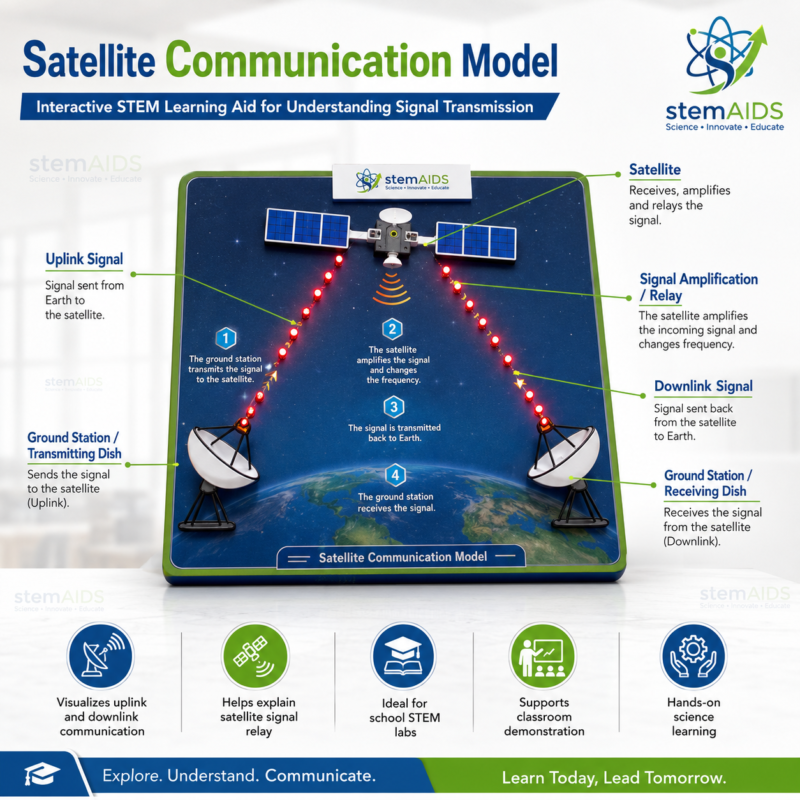
Quick Answer: The Satellite Communication Model is a teaching model that shows how a signal is sent from a ground station up to an orbiting satellite (uplink), amplified and retransmitted, and received by distant stations below (downlink). It makes an invisible chain of radio links easy for students to follow.
Following a Signal Through Space
Television broadcasts, remote-area phone links and weather data all rely on the same sequence. A dish at a ground station beams a microwave signal upwards; equipment on the satellite called a transponder receives it, shifts it to a different frequency, amplifies it and sends it back down to a wide region of Earth. The satellite communication model lays out these stages in order, so students can point to each one and name it.
The model also opens a discussion of orbits. Most broadcast satellites are geostationary: they orbit above the Equator at about 35,786 km and complete one orbit per day, so they stay over the same point and a fixed dish never needs to move. Newer internet constellations fly in low Earth orbit instead, closer and quicker but constantly passing overhead, so users need tracking antennas or many satellites in turn.
Where It Fits in the Syllabus
- Physics: electromagnetic waves, microwaves and their use for communication
- Geography: how satellites support weather forecasting, mapping and remote communication
- ICT and technology lessons on how data reaches places without cable links
- Science exhibitions and space-week displays explaining a working satellite link
Specifications
| Type | Educational model of a satellite communication link |
| Stages shown | Transmitting ground station, uplink, satellite, downlink, receiving station |
| Concepts | Microwave links, transponder, geostationary orbit |
| Subjects | Physics, geography, ICT |
| Size and construction | Confirm at enquiry |
Care & Handling
- Handle the satellite communication model by its base; antennas and solar-panel parts on satellite figures are thin and easily bent.
- Dust with a soft brush and keep it away from damp storerooms.
- Keep small detachable parts in a labelled bag between lessons.
Why Choose LabEquip
Physics and geography departments buy this model to anchor lessons on communication technology and space applications. LabEquip lists it among its Astronomy Lab Kits, together with the Rocket Trajectory Learning Model for the launch side of the story. Enquiries go through the LabEquip contact page.
Frequently Asked Questions
What are uplink and downlink?
The uplink is the signal sent from a ground station up to the satellite; the downlink is the signal the satellite sends back down. They use different frequencies so the satellite’s strong outgoing signal does not swamp the weak one arriving from Earth.
Why do satellite TV dishes point at one fixed spot?
Broadcast satellites are usually geostationary. They orbit above the Equator once every day, turning at the same rate as Earth, so from the ground they appear to hang in one place and the dish can stay fixed.
Why is there a delay on some satellite calls?
A signal via a geostationary satellite travels about 36,000 km up and the same distance down. Even at the speed of light that takes around a quarter of a second one way, enough to notice in conversation.
Does GPS work in the same way?
Not quite. Navigation satellites orbit much lower than geostationary ones and broadcast precise time signals one way. A receiver compares signals from several satellites to calculate its own position; it does not send anything back.
Why are microwaves used rather than ordinary radio waves?
Microwaves pass through the atmosphere and ionosphere with little reflection and can be focused into narrow beams by dish antennas. They also carry large amounts of data, which suits television and internet traffic.
Which classes use this model?
It suits middle-school science and geography lessons on space technology, and senior physics topics on electromagnetic waves and orbits. ICT teachers also use it when explaining how remote places connect to the internet.
Last Updated: September 2026
You must be logged in to post a review.
Bestsellers
Sale
Sale

Sale

Sale
Sale

Sale

Sale


Reviews
There are no reviews yet.