
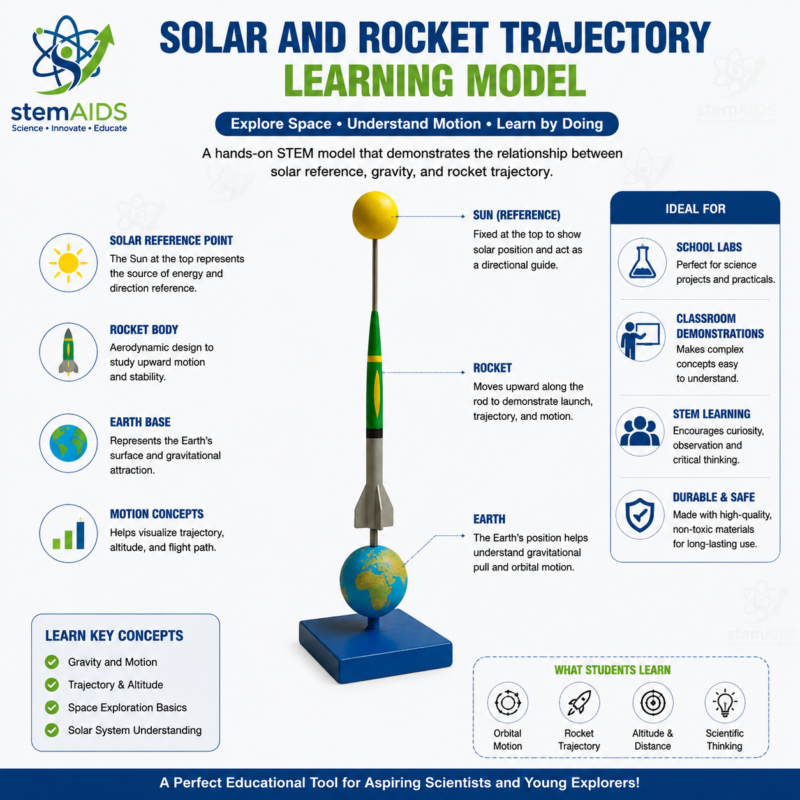
The rocket trajectory learning model is an educational space-science model used for explaining how launch angle, initial motion and gravity affect a rocket’s flight path. It helps students, teachers and STEM learners visualise trajectory concepts through a controlled classroom demonstration rather than an operational rocket launch.
Recommended product image ALT text: Rocket trajectory learning model demonstrating launch angle and curved flight path in a classroom.
Product Description
The STEMAids Rocket Trajectory Learning Model provides a visual reference for discussing the path followed by a rocket after launch. Teachers can use the model to introduce ascent, changing velocity, gravitational influence, launch direction and the difference between a simplified projectile path and a powered rocket flight.
The model supports physics, astronomy and engineering lessons by connecting trajectory diagrams with a physical demonstration. Its exact movement system, trajectory range and component construction must be confirmed from the approved STEMAids specification. It should not be presented as a calibrated launcher, flight simulator or predictive engineering instrument without supporting documentation.
Key Features
- Trajectory visualisation: makes a rocket’s changing flight path easier to examine.
- Launch-angle learning: supports discussion of how initial direction affects a simplified trajectory.
- Physics integration: connects motion, velocity, gravity, force and acceleration.
- Space-science context: introduces the distinction between atmospheric flight and orbital motion.
- Hands-on demonstration: encourages observation, prediction and comparison during lessons.
- Reusable teaching format: suitable for classroom activities, STEM clubs and exhibitions.
- Controlled learning aid: teaches trajectory principles without combustible rocket motors.
- Transparent limitations: displayed paths should be treated as educational representations unless verified quantitatively.
Technical Specifications
|
Specification |
Detail |
|
Product name |
Rocket Trajectory Learning Model |
|
Brand |
STEMAids |
|
Product type |
Educational space-science and motion model |
|
Teaching capacity |
Rocket launch path and trajectory concepts |
|
Concepts demonstrated |
Launch angle, motion, gravity, acceleration and flight path |
|
Standards or certifications |
No applicable certification confirmed |
What’s Included in the Kit
Confirm the final packing list against the approved product record. The supplied configuration may include:
- Rocket Trajectory Learning Model main assembly
- Rocket representation or moving marker
- Launch platform or adjustable support
- Trajectory arm, track or display path
- Angle scale or measurement markings
- Base or demonstration board
- Teacher instructions or student activity sheet
Applications / Uses
- Introducing rocket ascent and flight-path terminology.
- Comparing simplified trajectories at different launch angles.
- Teaching displacement, velocity, acceleration and gravity.
- Distinguishing powered rocket flight from basic projectile motion.
- Discussing atmospheric flight, escape and orbital insertion conceptually.
- Supporting school STEM projects and science exhibitions.
- Encouraging learners to predict and explain changes in motion.
Extend the lesson with STEMAids educational science models, practical physics laboratory products, project-based STEM kits and interactive teaching-learning material kits.
How to Use the Rocket Trajectory Learning Model
- Place the model on a firm, level demonstration surface.
- Identify the rocket representation, launch point and displayed trajectory.
- Set the starting position or launch angle according to the supplied instructions.
- Operate the model gently using its approved manual or powered mechanism.
- Observe how the represented flight path changes with the selected setting.
- Ask learners to identify the forces and motion variables involved.
- Compare the demonstration with a trajectory graph or classroom calculation.
Safety note: This product should be used only as an educational model. Do not add combustible propellants, compressed-gas cartridges or improvised launching devices. Keep hands clear of moving parts and supervise student operation.
Care & Maintenance
- Clean the model with a soft, dry cloth and avoid abrasive products.
- Do not force launch arms, tracks, pivots or adjustment mechanisms.
- Keep detachable components together in labelled storage.
- Store the model in a dry cabinet away from excessive heat and direct sunlight.
Why Choose STEMAids
STEMAids manufactures and supplies educational science models, laboratory products, STEM kits and teaching-learning resources. Its catalogue supports visual and practical instruction in schools, laboratories and institutional learning environments. STEMAids serves educational customers in India and abroad and supports institutional requirements. Buyers should confirm the operating mechanism, materials and supplied components in the approved quotation.
Frequently Asked Questions
What is a rocket trajectory learning model used for?
It is used to explain how launch conditions and physical forces affect a rocket’s represented flight path. It supports introductory lessons on motion, gravity and spaceflight.
Is rocket motion the same as projectile motion?
No. A simple projectile follows a path after its initial launch force ends, while a rocket may continue generating thrust during flight. Classroom models often simplify this distinction.
Is the model suitable for schools?
Yes. It is suitable for supervised physics, astronomy, space-science and STEM activities when used according to the supplied instructions.
Can the launch angle be adjusted?
Adjustable-angle operation has not been verified. Confirm the model’s available settings before describing this as a supplied feature.
Does the model launch a real rocket?
No real rocket-launch capability has been confirmed. The product should be presented as a learning model unless an approved technical document specifies another safe operating format.
Can students calculate trajectory values from the model?
Students may compare observations with classroom calculations. Quantitative measurements should be used only when the model includes verified scales, angles and operating parameters.
Contact STEMAids to confirm the mechanism, dimensions and activity configuration, or explore the complete Educational Science Models range.


Reviews
There are no reviews yet.