
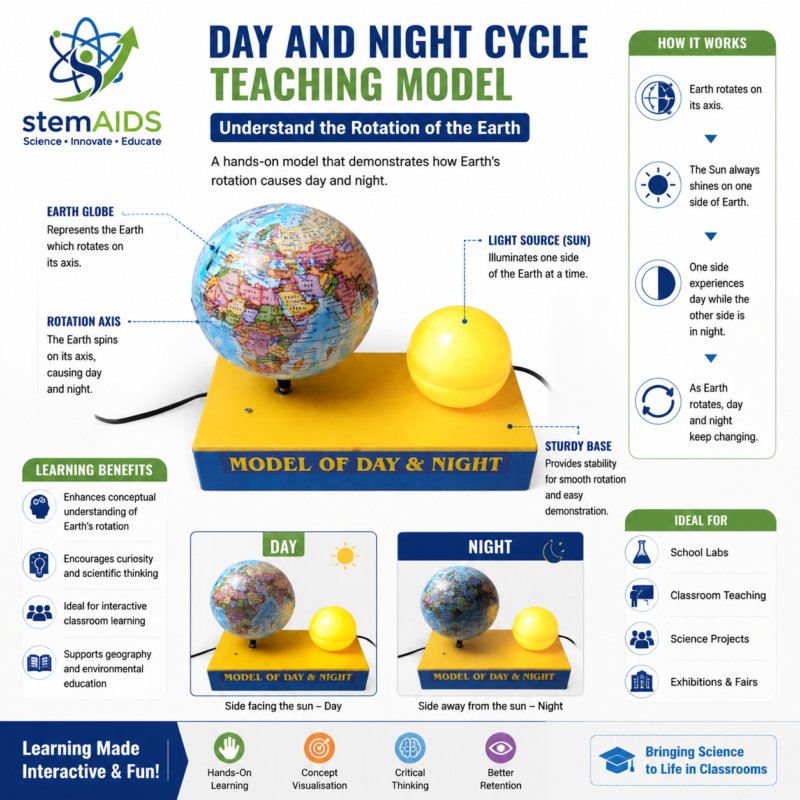
Quick answer: The Day and Night Cycle Teaching Model demonstrates how Earth’s rotation creates alternating periods of daylight and darkness, using a rotating Earth component and a light source or Sun representation to make the day-night cycle directly observable.
Product Description
The LabEquip Day and Night Cycle Teaching Model presents Earth and a light source or Sun representation in a classroom demonstration format. As the Earth component rotates, the side facing the light represents daytime, while the side facing away represents nighttime.
The model makes Earth’s rotation easier to observe than a static diagram, supporting lessons on the day-night cycle, local time differences and the Sun-Earth relationship.
Specifications
| Specification | Detail |
|---|---|
| Product name | Day and Night Cycle Teaching Model |
| Brand | LabEquip |
| Product category | Astronomy / Earth science laboratory apparatus; day-night demonstration model |
| Primary function | Demonstrating how Earth’s rotation produces day and night |
Suggested Use
- Position the light source or Sun representation to illuminate one side of the Earth component.
- Slowly rotate the Earth component and point out the illuminated (day) and shadowed (night) sides.
- Mark a location on the Earth component and track how it moves between day and night as rotation continues.
- Relate the observed cycle to the 24-hour rotation period of the real Earth.
Care & Maintenance
- Handle the Earth component and rotation mechanism carefully to avoid damage.
- Keep the light source and components clean and free of dust.
- Store the model in a stable location when not in use.
- Check any moving or electrical parts periodically before classroom use.
Why Choose LabEquip
For related Earth-Sun teaching resources, see our Four Seasons Educational Apparatus, Eclipse Demonstration Working Model, or visit the LabEquip homepage to browse our full catalogue of astronomy lab kits.
Related Products
- Four Seasons Educational Apparatus: Moves from daily rotation to the yearly orbit, showing how the tilted axis produces the seasons.
- Earth Sun Planetarium: An Earth-Sun planetarium showing rotation and revolution together for a fuller Sun-Earth lesson.
- Political World Globe: A political globe for locating the countries used when discussing time differences between day and night.
- Time Indicator Manual Model: A hand-set teaching clock for linking one rotation of Earth to the 24 hours on a clock face.
Frequently Asked Questions
How does the Earth’s rotation cause day and night?
Earth spins on its axis once in about 24 hours. At any moment the half facing the Sun has daytime and the half facing away has night. As the planet turns, each place is carried from the lit side into the dark side and back again, which is the pattern a day and night model makes visible.
How do you demonstrate day and night with a rotating Earth model?
Darken the room, place the light or Sun representation to one side and stick a small marker on your own country. Turn the Earth slowly from west to east and ask students to call out sunrise, midday, sunset and midnight as the marker passes through the light and shadow.
Which way does the Earth rotate, and why does the Sun rise in the east?
Earth rotates from west to east, anticlockwise when seen from above the North Pole. Because we are carried eastward into the sunlight, the Sun first appears on the eastern horizon, seems to cross the sky and sets in the west. Rotating the model the wrong way is a quick check on whether students have this idea.
Why are day and night not the same length all year?
Earth’s axis is tilted, so through the year one hemisphere leans towards the Sun and has longer days while the other has longer nights. Near the equinoxes in March and September, day and night are close to equal everywhere. Tilting the model’s Earth and repeating the demonstration shows the lit area moving north and south.
Why is it daytime in one country while it is night in another?
Only half of Earth faces the Sun at once, so places on the far side are in darkness. Earth turns 15 degrees of longitude per hour, which is the basis of time zones: noon in India comes several hours before noon in Europe. Marking two countries on the model shows the time difference directly.
What age group is a day and night teaching model suited to?
Young primary pupils use it to replace the idea that the Sun moves around Earth or hides at night. Upper primary and middle-school students go further, linking rotation to sunrise direction, time zones and day length. It also helps older students revise before moving on to seasons.
Last Updated: November 2026


Reviews
There are no reviews yet.