


Sale
In Stock
Water Cycle Model
Original price was: ₹1,150.00.₹565.00Current price is: ₹565.00.
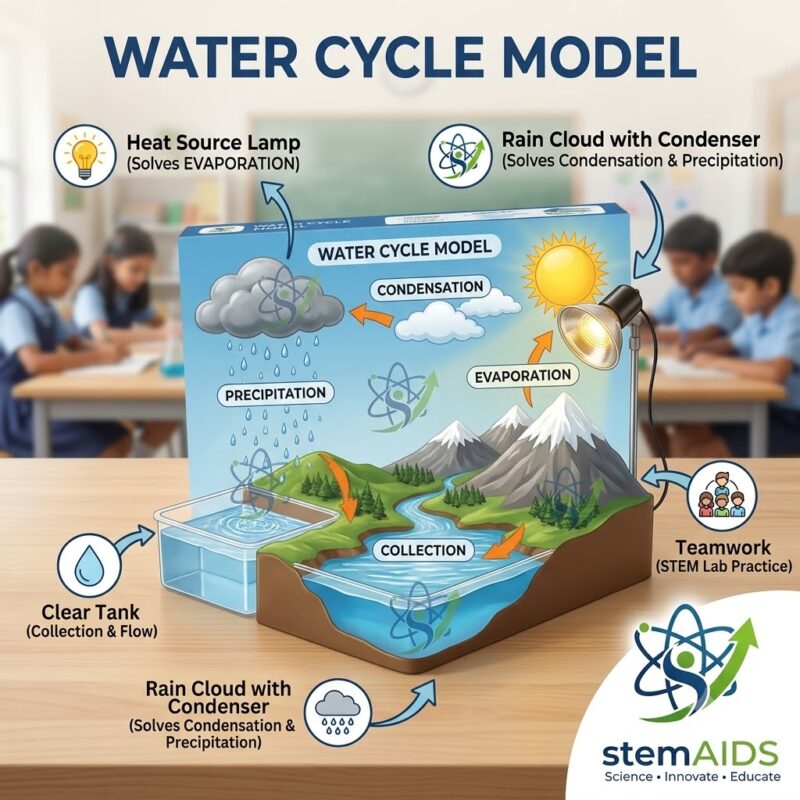
The Water Cycle Model is an educational science model used for explaining the continuous movement of water between Earth’s surface and the atmosphere. It helps students, teachers and learning-centre instructors visualise evaporation, condensation, precipitation, collection and runoff through one classroom demonstration display.
Product Description
The STEMAids Water Cycle Model provides a simplified representation of the hydrological cycle. Depending on the confirmed product design, it may show water evaporating from oceans, lakes or soil, condensing into clouds, returning as precipitation and collecting in rivers, groundwater or other surface reservoirs.
The model supports lessons on weather, climate, freshwater availability and solar-driven circulation. It may be supplied as a static labelled display or as a working model with visible water movement. The exact operating method, components, materials and electrical requirements must be confirmed against the current STEMAids technical specification.
Key Features
- Explains the complete water cycle: Connects evaporation, condensation, precipitation and collection in one visual system.
- Shows continuous circulation: Demonstrates that water changes location and physical state rather than disappearing.
- Supports weather education: Helps learners connect atmospheric cooling and cloud formation with precipitation.
- Introduces surface movement: Can illustrate runoff, river flow and collection where these features are represented.
- Supports groundwater lessons: May help explain infiltration and underground storage when included in the model.
- Connects energy with phase change: Shows how solar heating can drive evaporation from surface water.
- Suitable for group instruction: Supports classroom teaching, environmental-science activities and exhibitions.
Technical Specifications
|
Specification |
Detail |
|
Product name |
Water Cycle Model |
|
Brand |
STEMAids |
|
Product category |
Earth-science teaching model / environmental education display |
|
Display capacity |
One hydrological-cycle representation |
|
Teaching concepts |
Evaporation, condensation, precipitation, collection, runoff and infiltration |
|
Intended users |
Primary and secondary students, science teachers and environmental-learning centres |
|
Standards or certifications |
No product-specific certification publicly verified |
What’s Included in the Kit
- One Water Cycle Model or landscape display
- Ocean, lake or surface-water representation
- Cloud, mountain and precipitation elements
- Water reservoir and circulation tubing
- Pump, heater, lamp or power accessories
- Labels, activity guide and operating instructions
Applications and Uses
- Teaching evaporation from oceans, lakes and wet surfaces.
- Explaining condensation and cloud formation.
- Demonstrating rain, snow or other forms of precipitation.
- Introducing runoff, collection and river movement.
- Discussing infiltration and groundwater storage.
- Connecting the water cycle with weather and climate.
- Supporting science lessons, projects and environmental exhibitions.
How to Use the Water Cycle Model
- Place the model on a stable, water-resistant surface.
- Identify the surface-water, land, cloud and atmospheric sections.
- Trace the movement of water from the surface through evaporation.
- Explain how cooling water vapour forms droplets through condensation.
- Identify the represented precipitation path.
- Trace runoff and collection back toward the surface-water reservoir.
- Operate any pump, heater or lighting feature only as instructed.
- Discuss how the cycle repeats and how human activity may affect it.
Safety and handling: Keep electrical connectors dry and disconnect powered components before filling, draining or cleaning the model. Use heated or moving-water features only under adult supervision.
Care & Maintenance
- Drain standing water after use unless the instructions state otherwise.
- Clean reservoirs and tubing regularly to limit deposits or biological growth.
- Wipe painted and labelled surfaces with a soft, damp cloth.
- Dry the complete model before storage and protect projecting features from impact.
Why Choose STEMAids
STEMAids develops educational models, STEM kits and laboratory products for practical science instruction. Buyers can explore related educational science models, earth-science learning resources, STEM learning kits and the complete scientific and educational product range. Buyers should request the current model image, labelled features, working mechanism, electrical rating and packing list before procurement.
Frequently Asked Questions
What is a Water Cycle Model used for?
It is used to explain how water circulates through evaporation, condensation, precipitation, runoff, infiltration and collection.
What drives the water cycle?
Solar energy drives much of the evaporation, while gravity causes precipitation and moves water through runoff and underground flow.
Is the model a working model?
The operating configuration is not publicly verified. Confirm whether it uses a pump, heating element, mist generator or static labelled display.
Does the model demonstrate real evaporation?
That depends on its design. A heated or illuminated model may demonstrate evaporation, while a static model represents the process visually.
Can the model explain groundwater?
It can support groundwater lessons when infiltration, soil layers or underground storage are represented in the supplied model.
Is the Water Cycle Model suitable for schools?
Yes. It is suitable for supervised primary and secondary science, geography and environmental-education lessons.
Explore more educational science models from STEMAids for Earth science, weather and environmental learning.
Recommended primary image ALT text: Water Cycle Model showing evaporation, clouds, precipitation, runoff and collection.
Recommended detail image ALT text: Educational hydrological cycle model with labelled land, water and atmospheric processes.
Recommended application image ALT text: Teacher explaining evaporation and precipitation with a Water Cycle Model.
You must be logged in to post a review.
Bestsellers
Sale

Sale

Sale

Sale


Reviews
There are no reviews yet.