
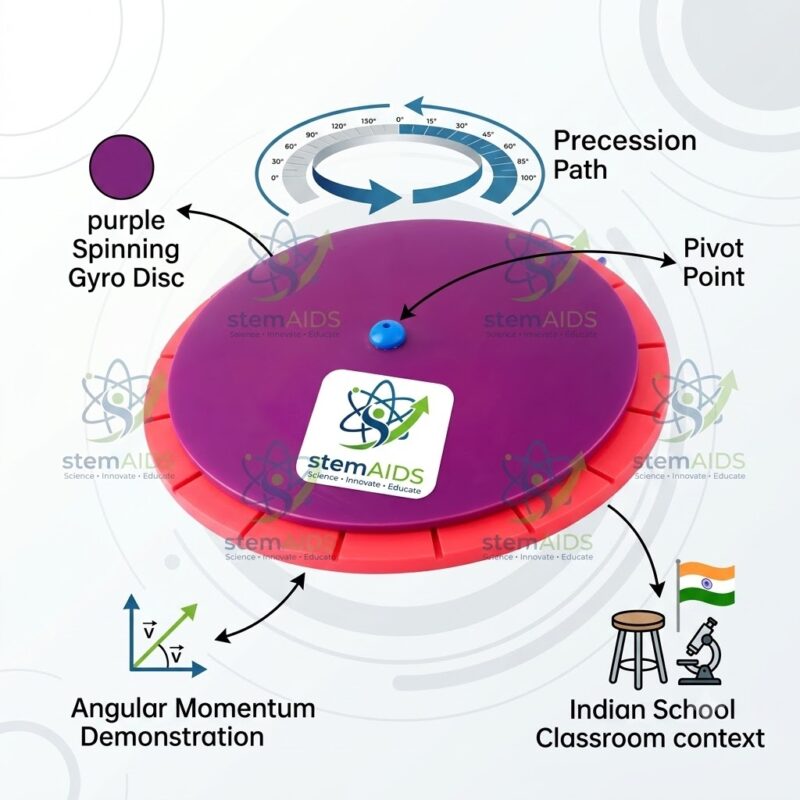
The Gyroscopic Motion Demonstration Model is a physics teaching apparatus used for demonstrating angular momentum, rotational stability and gyroscopic precession. It helps students, teachers and laboratory instructors observe how a spinning rotor responds to applied torque through a clear, supervised mechanics experiment.
Product Description
The STEMAids Gyroscopic Motion Demonstration Model provides a practical way to study the behaviour of a rotating body. When its rotor is spinning, the apparatus resists changes to the direction of its rotational axis because it possesses angular momentum. An applied torque can then produce precession rather than immediate toppling.
The model is suitable for mechanics lessons, rotational-motion demonstrations and introductory engineering activities. The exact rotor configuration, bearing system, support frame, drive method and operating limits must be confirmed against the current STEMAids technical sheet before procurement or use.
Key Features
- Demonstrates gyroscopic motion: Makes rotational stability and axis behaviour directly observable.
- Shows precession: Helps learners see how a spinning rotor responds when an external torque acts on its axis.
- Explains angular momentum: Connects the direction and speed of rotation with resistance to changes in orientation.
- Hands-on mechanics learning: Supports instruction beyond static diagrams and mathematical descriptions.
- Suitable for guided comparison: Users can compare the rotor’s behaviour while stationary and while rotating.
- Useful across disciplines: Supports physics, mechanics and introductory engineering demonstrations.
- Reusable classroom apparatus: Intended for repeated demonstrations when operated within confirmed mechanical limits.
Technical Specifications
|
Specification |
Detail |
|
Product name |
Gyroscopic Motion Demonstration Model |
|
Brand |
STEMAids |
|
Product category |
Rotational mechanics apparatus / physics demonstration model |
|
Demonstration capacity |
One gyroscopic-motion experimental unit |
|
Teaching concepts |
Angular momentum, rotational stability, torque and gyroscopic precession |
|
Intended users |
Secondary schools, colleges, physics teachers and engineering instructors |
|
Standards or certifications |
No product-specific certification publicly verified |
What’s Included in the Kit
- One Gyroscopic Motion Demonstration Model
- Rotor or flywheel assembly
- Axle, bearings and supporting frame
- Drive cord, handle or motorised drive
- Balancing masses or adjustable weights
- Experiment instructions
Applications and Uses
- Demonstrating conservation of angular momentum.
- Observing gyroscopic precession under an applied torque.
- Comparing the stability of stationary and spinning rotors.
- Explaining rotational inertia and axis orientation.
- Introducing gyroscope applications in navigation and stabilisation.
- Supporting mechanics practicals, engineering demonstrations and science exhibitions.
How to Use the Gyroscopic Motion Demonstration Model
- Place the apparatus on a stable, level laboratory bench.
- Check that the rotor, axle, bearings and supports are secure.
- Observe the apparatus with the rotor stationary and gently apply a small change in axis position.
- Spin the rotor using only the supplied or approved drive method.
- Allow the rotor to reach a steady rotational speed.
- Apply the permitted load or torque as described in the experiment guide.
- Observe the direction and rate of precession without touching the rotating parts.
- Allow the rotor to stop fully before changing weights or adjustments.
Safety and handling: Keep hands, hair and loose clothing away from the rotating rotor. Do not exceed the confirmed speed or load limits, and operate the model only under trained adult supervision.
Care & Maintenance
- Remove dust with a soft, dry cloth after the rotor has stopped completely.
- Inspect the axle, bearings, fasteners and supports before each use.
- Do not lubricate bearings unless the manufacturer’s instructions require it.
- Store the model in a dry location with the rotor protected from impact and deformation.
Why Choose STEMAids
STEMAids supplies scientific laboratory instruments, experiment setups and educational models for practical science instruction. Buyers can explore related physics laboratory products, educational science models, STEM learning kits and the wider scientific and educational product catalogue. The company supports schools, institutions and international procurement enquiries. Buyers should request the current technical drawing, operating limits and packing list before approving an order.
Frequently Asked Questions
What is a Gyroscopic Motion Demonstration Model used for?
It is used to demonstrate angular momentum, rotational stability, torque and precession in a spinning mechanical system.
What is gyroscopic precession?
Gyroscopic precession is the gradual change in the direction of a spinning rotor’s axis when an external torque acts on it.
Why does a spinning gyroscope resist falling?
A spinning rotor has angular momentum. When gravity produces torque, the axis tends to precess instead of immediately moving in the direction of the applied torque.
Is the model suitable for school physics laboratories?
Yes. It is suitable for supervised rotational-mechanics demonstrations in secondary schools, colleges and introductory engineering laboratories.
Is the gyroscope manually or electrically driven?
The drive mechanism is not publicly verified. Confirm whether the current model uses a cord, hand-operated system or electric motor before ordering.
What material is the flywheel made from?
The rotor material, mass and dimensions have not been publicly verified. These details should be added only from the current STEMAids technical specification.
Explore more physics laboratory apparatus from STEMAids for mechanics, motion and rotational-dynamics experiments.
Recommended product image ALT text: Gyroscopic Motion Demonstration Model with spinning rotor for angular momentum and precession experiments.



Reviews
There are no reviews yet.