
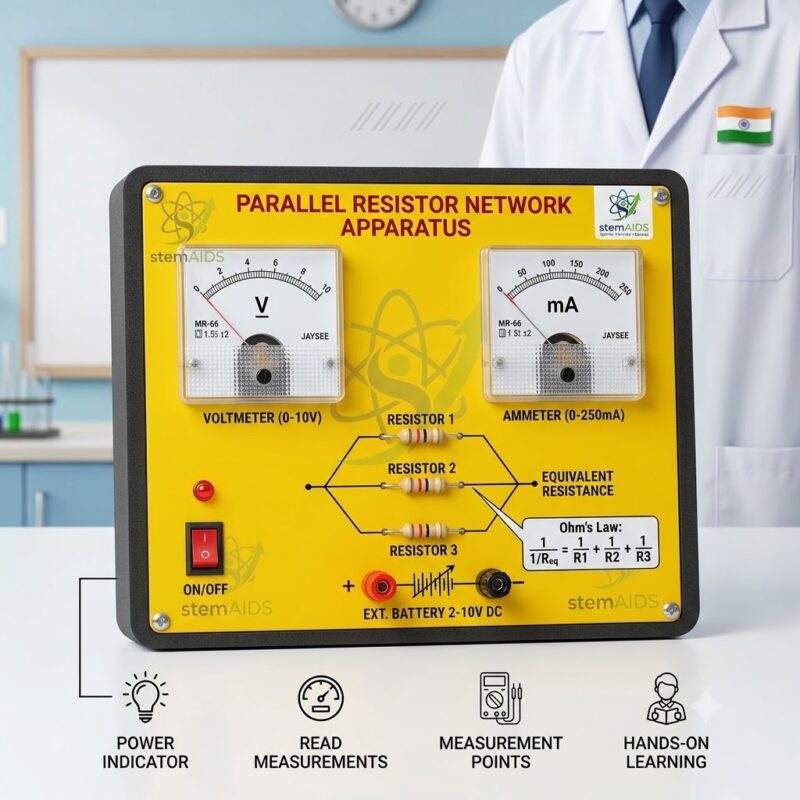
The Resistance in Parallel Apparatus is a physics laboratory teaching aid used for demonstrating the behaviour of resistors connected across common circuit nodes. It helps students, teachers and laboratory instructors investigate branch current, common potential difference and equivalent resistance through supervised electrical measurements.
Product Description
The STEMAids Resistance in Parallel Apparatus supports practical study of parallel resistor networks. In a parallel circuit, each resistor branch is connected across the same two points. The potential difference is therefore common to each branch, while the total current divides between the available paths.
Students can use the apparatus to compare measured current and voltage values with calculations based on Ohm’s law and the parallel-resistance relationship. The exact resistor values, circuit layout, terminals, meters and construction materials must be confirmed from the current STEMAids technical sheet.
Key Features
- Demonstrates parallel resistance: Shows how multiple resistor branches operate across the same supply voltage.
- Supports current measurement: Helps learners compare total circuit current with current in individual branches.
- Explains equivalent resistance: Demonstrates why total resistance is lower than the resistance of any individual parallel branch.
- Reinforces Ohm’s law: Allows measured voltage and current values to be compared with calculated resistance.
- Hands-on circuit learning: Converts circuit diagrams and equations into observable laboratory results.
- Suitable for repeated teaching: Supports teacher demonstrations and supervised student practical work.
- Clear procurement controls: Unverified electrical ratings and components are identified for confirmation before use.
Technical Specifications
|
Specification |
Detail |
|
Product name |
Resistance in Parallel Apparatus |
|
Brand |
STEMAids |
|
Product category |
Electricity experiment apparatus / physics laboratory teaching aid |
|
Demonstration capacity |
Single parallel-circuit demonstration setup |
|
Teaching concepts |
Parallel resistance, branch current, common voltage and equivalent resistance |
|
Intended users |
Secondary schools, colleges, physics teachers and laboratory instructors |
|
Standards or certifications |
No product-specific certification verified |
What’s Included in the Kit
- One Resistance in Parallel Apparatus
- Installed resistor branches
- Connection terminals or sockets
- Patch cords or connecting leads
- Ammeter and voltmeter
- Power supply and instruction sheet
Applications and Uses
- Verifying the equivalent resistance of parallel-connected resistors.
- Showing that voltage is common across parallel branches.
- Comparing total current with the sum of branch currents.
- Applying Ohm’s law to individual branches and the complete network.
- Investigating how an additional branch affects total resistance and current.
- Supporting school practicals, laboratory assessments and science demonstrations.
How to Use the Resistance in Parallel Apparatus
- Place the apparatus on a clean, dry and stable laboratory bench.
- Identify the common nodes and each resistor branch on the circuit layout.
- Confirm the resistor ratings and required supply voltage before making connections.
- Connect an ammeter in series with the complete circuit to measure total current.
- Connect a voltmeter across the parallel network to measure potential difference.
- Energise the circuit briefly and record the total voltage and current.
- Measure the current in each branch using the approved connection procedure.
- Calculate equivalent resistance and compare the result with the measured values.
Safety and handling: Use only the specified low-voltage supply. Switch off power before changing connections, avoid short circuits and do not exceed any resistor or meter rating.
Care & Maintenance
- Disconnect the apparatus from its power source before cleaning or storage.
- Wipe the panel with a soft, dry cloth and keep terminals free from dust.
- Inspect leads, sockets and resistors for looseness, overheating or damage before use.
- Store the apparatus in a dry cabinet away from moisture and mechanical impact.
Why Choose STEMAids
STEMAids supplies scientific laboratory instruments, educational models and experiment kits for practical science learning. Buyers can explore related physics laboratory products, educational science models, STEM learning kits and the complete scientific and educational product range. STEMAids serves schools, institutions and export customers. Procurement teams should request the latest circuit diagram, ratings and packing list before ordering.
Frequently Asked Questions
What is a Resistance in Parallel Apparatus used for?
It is used to demonstrate voltage, current and equivalent resistance in a parallel resistor network.
How is total resistance calculated in a parallel circuit?
The reciprocal of total resistance equals the sum of the reciprocals of the individual branch resistances.
Is voltage the same across parallel resistors?
Yes. Ideal parallel branches connected between the same two circuit nodes have the same potential difference.
Does current divide in a parallel circuit?
Yes. Total current divides between the branches according to their resistance and equals the sum of the branch currents.
Are meters and a power supply included?
The current packing configuration is not verified. Confirm whether ammeters, a voltmeter, leads and a suitable low-voltage supply are included.
Can this apparatus be used in schools?
Yes. It is suitable for supervised secondary-school and introductory college physics experiments when operated within its confirmed electrical ratings.
Explore more physics laboratory apparatus from STEMAids for electricity, circuits and measurement experiments.
Recommended product image ALT text: Resistance in Parallel Apparatus with multiple resistor branches for school electricity experiments.





Reviews
There are no reviews yet.