











Sale
In Stock
Nuclear Power Plant Model
Original price was: ₹1,700.00.₹840.00Current price is: ₹840.00.
Quick Answer: The Nuclear Power Plant Model is a classroom display that traces how a nuclear power station generates electricity. It lays out the reactor with fuel and control rods, the coolant loop, steam generator, turbine, generator and cooling system, so students can follow energy from nuclear fission to heat, steam, motion and finally electrical energy.
Following the Energy Through the Plant
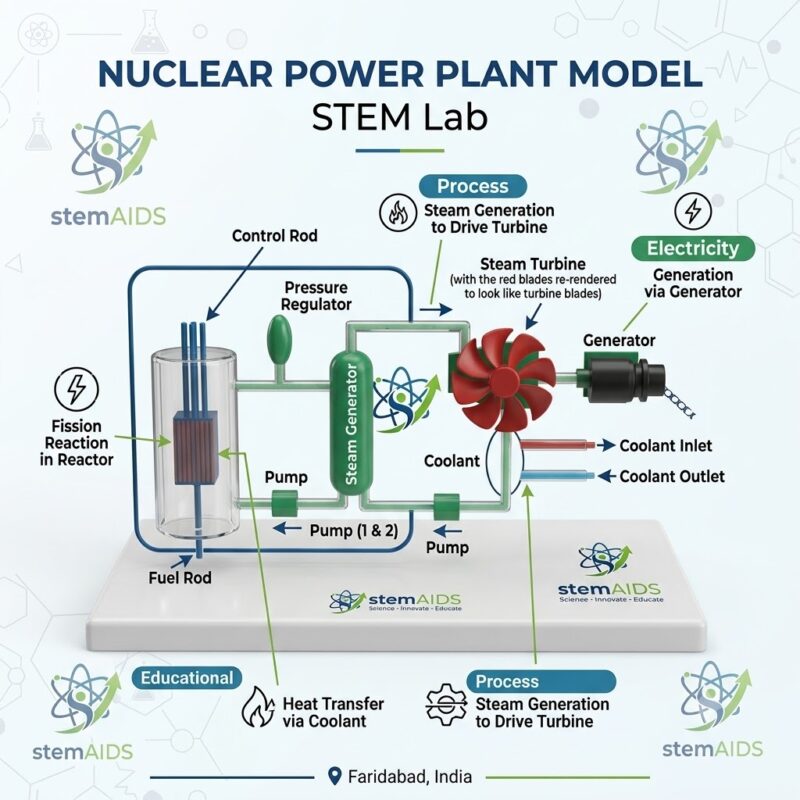
The listing image shows the nuclear power plant model as a baseboard with a reactor vessel holding fuel and control rods, a pressure regulator, a steam generator, pumps, a turbine, a generator and coolant pipes, laid out in the style of a pressurised water reactor. Labelling each stage lets a teacher walk the class through the chain of energy transfers in order.
In the reactor, a slow neutron splits a uranium-235 nucleus into two smaller nuclei and releases two or three more neutrons along with a large amount of energy. Those neutrons can split further nuclei, giving a chain reaction. Control rods made of neutron-absorbing materials such as boron or cadmium are lowered or raised so that, on average, each fission causes exactly one more, holding the reaction steady. Water around the fuel acts as the moderator that slows the neutrons and as the coolant that carries heat away.
In a pressurised water reactor the primary water is kept under high pressure so that it does not boil. It passes through the steam generator, where it heats a separate secondary loop into steam; the steam turns the turbine, the turbine spins the generator, and a condenser and cooling system turn the used steam back into water. Keeping the loops separate is also a safety feature, since the radioactive primary water never reaches the turbine.
Applications
- Teaching nuclear fission and chain reactions in physics
- Drawing energy-transfer diagrams from fuel to electricity
- Comparing nuclear, coal, hydro and solar power stations
- Debates on energy choices, radioactive waste and safety
Specifications
| Item | Educational model of a nuclear power station |
| Stages shown | Reactor, pressure regulator, steam generator, turbine, generator, pumps and coolant loop, as pictured |
| Reactor type represented | Pressurised water reactor layout |
| Energy chain | Nuclear to thermal to kinetic to electrical |
| Format | Baseboard display with labelled components |
| Moving or illuminated parts | Confirm at enquiry |
Care & Handling
- Keep the model on a stable shelf or table and lift it by the baseboard, never by the pipes or turbine.
- Dust with a soft brush; small labels and fittings can be pulled off by cloths.
- If the model has lights or moving parts, disconnect the power before moving or storing it.
- Store it covered and away from damp to keep the printed labels legible.
Why Choose LabEquip
Physics teachers covering sources of energy, and science exhibitions on power generation, are the usual buyers of this model, since a real plant can otherwise be shown only in diagrams. LabEquip lists it in the STEM kits range and also offers the Nuclear Fusion Educational Model, so students can compare splitting heavy nuclei with joining light ones. Send your requirements through the contact page.
Frequently Asked Questions
What is nuclear fission?
Fission is the splitting of a heavy nucleus, such as uranium-235, into two smaller nuclei after it absorbs a neutron. The process releases energy and two or three new neutrons, which can cause further fissions in a chain reaction.
What do the control rods do?
Control rods absorb neutrons. Lowering them into the reactor core captures more neutrons and slows the chain reaction, while raising them lets more neutrons cause fission. Operators use them to keep the power output steady or to shut the reactor down.
Why does a nuclear plant need a steam turbine?
The reactor only produces heat. Like a coal-fired station, the plant uses that heat to boil water into steam, the steam spins a turbine and the turbine drives a generator. Only the heat source is different.
What is the moderator for?
Neutrons released by fission move too fast to be captured easily by uranium-235. The moderator, often ordinary water or graphite, slows them down so they are more likely to cause further fission.
Why are there separate water loops in a pressurised water reactor?
The primary loop carries water that passes through the reactor core and becomes radioactive. It transfers heat to a separate secondary loop in the steam generator, so the steam reaching the turbine is not radioactive.
Does a nuclear power station emit carbon dioxide while running?
Almost none from generating electricity, because no fuel is burned. Emissions arise elsewhere, in mining, fuel processing and construction, and the plant produces radioactive waste that must be stored safely for a very long time.
Last Updated: September 2026
You must be logged in to post a review.
Bestsellers

Sale

Sale
Sale


Reviews
There are no reviews yet.