


Sale
In Stock
Magnet Learning Kit
Original price was: $5.64.$2.71Current price is: $2.71.
Quick Answer: The Magnet Learning Kit is a hands-on science set of assorted magnets and accessories for investigating magnetism. Students test which materials are attracted, find north and south poles, see like poles repel and unlike poles attract, and map magnetic field patterns, building the basic ideas that later lead to electromagnetism.
Magnetism Activities the Kit Supports
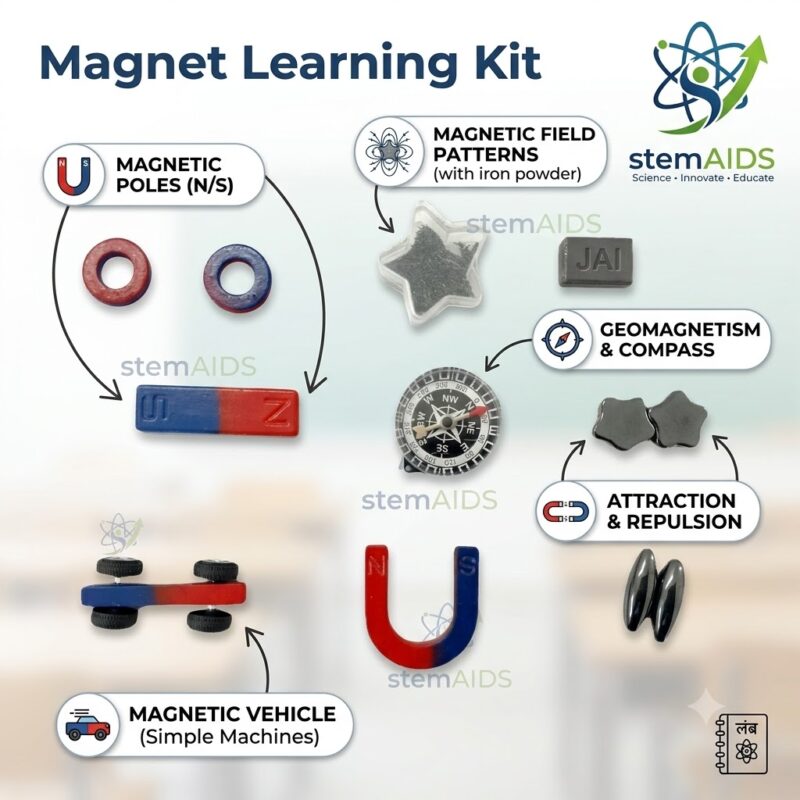
The listing image of the magnet learning kit shows bar, horseshoe and ring magnets, shaped magnets, a compass, a small magnetic vehicle and iron powder for revealing field patterns. The exact contents should be confirmed when ordering, but a set like this covers the magnetism activities that school syllabi ask for from the primary years onward.
Most lessons start with sorting. Students predict which objects a magnet will pick up and find that only some metals respond, mainly iron, steel, nickel and cobalt, while aluminium, copper and plastics do not. Next they discover poles by dipping a bar magnet into iron filings and seeing the filings cluster at the ends, and hang a magnet freely to show that it settles pointing north and south. Bringing two magnets together shows repulsion between like poles, which is also the only sure test that an object is a magnet, since plain iron is attracted too.
Field patterns make the invisible visible. Sprinkling iron filings on a sheet of paper over a magnet, or moving a small compass around it, reveals lines running from pole to pole, crowded where the field is strong. Ring magnets stacked on a pencil float apart when like poles face each other, a simple model of magnetic levitation, and a magnet-driven vehicle turns attraction and repulsion into motion.
Applications
- Sorting magnetic and non-magnetic materials in primary science
- Identifying poles and testing the law of magnetic poles
- Drawing field lines with iron filings and a plotting compass
- Using a compass to find directions and discussing Earth’s magnetic field
- Levitation and magnetic-vehicle challenges in STEM clubs
Specifications
| Item | Assorted magnetism activity set |
| Magnet shapes | Bar, horseshoe and ring magnets, as shown in the listing image |
| Field mapping | Iron powder and compass |
| Activity piece | Magnetic vehicle for attraction and repulsion games |
| Topics | Poles, attraction and repulsion, field patterns, magnetic materials |
| Full contents and quantities | Confirm at enquiry |
Care & Handling
- Keep small magnets away from young children who might swallow them; swallowed magnets can attract each other inside the body and cause serious harm.
- Store bar magnets in pairs with unlike poles side by side and keepers across the ends, so they keep their strength.
- Do not drop or hammer magnets, and keep them away from heat, which weakens magnetism.
- Keep magnets away from phones, bank cards, computers and anyone with a pacemaker.
- Keep iron filings in a sealed shaker or a clear plastic bag so they do not stick to the magnets.
Why Choose LabEquip
Primary and middle-school science teachers usually buy one magnet kit per group so every student handles the magnets rather than watching. LabEquip lists it in the STEM kits range; teachers moving on to electromagnetism can pair it with the Series and Parallel Circuit Kit for the circuit side of the topic. Share your class numbers through the contact page.
Frequently Asked Questions
Which materials are attracted by a magnet?
Iron, steel, nickel and cobalt, and alloys containing them, are attracted. Most other metals, such as copper, aluminium, brass and gold, are not, and neither are wood, plastic or glass.
How can students tell if an object is a magnet?
Repulsion is the reliable test. A magnet attracts any piece of iron, magnetised or not, but only another magnet can be pushed away. If one end of the object repels a pole of a known magnet, the object is a magnet.
Why does a freely suspended magnet point north?
Earth behaves like a huge magnet. A freely hanging magnet lines up with Earth’s magnetic field, so its north-seeking pole points towards geographic north. A compass needle is simply a small, light magnet on a pivot.
How do iron filings show a magnetic field?
Each filing becomes a tiny magnet in the field and turns to line up with it. Together they form lines running from one pole to the other, crowded near the poles where the field is strongest.
Can magnets lose their magnetism?
Yes. Heating, dropping or hammering can weaken them, and storing magnets with like poles together slowly demagnetises them. Keepers across the poles of bar and horseshoe magnets help them hold their strength.
Is the kit safe for primary pupils?
With supervision, yes. Larger magnets are easy to handle, but small magnets and iron powder should be managed by the teacher, and pupils should wash their hands after using filings.
Last Updated: September 2026
You must be logged in to post a review.
Bestsellers

Sale

Sale
Sale

Sale


Reviews
There are no reviews yet.