







Sale
In Stock
Human Respiratory System Jar Model
Original price was: ₹700.00.₹340.00Current price is: ₹340.00.
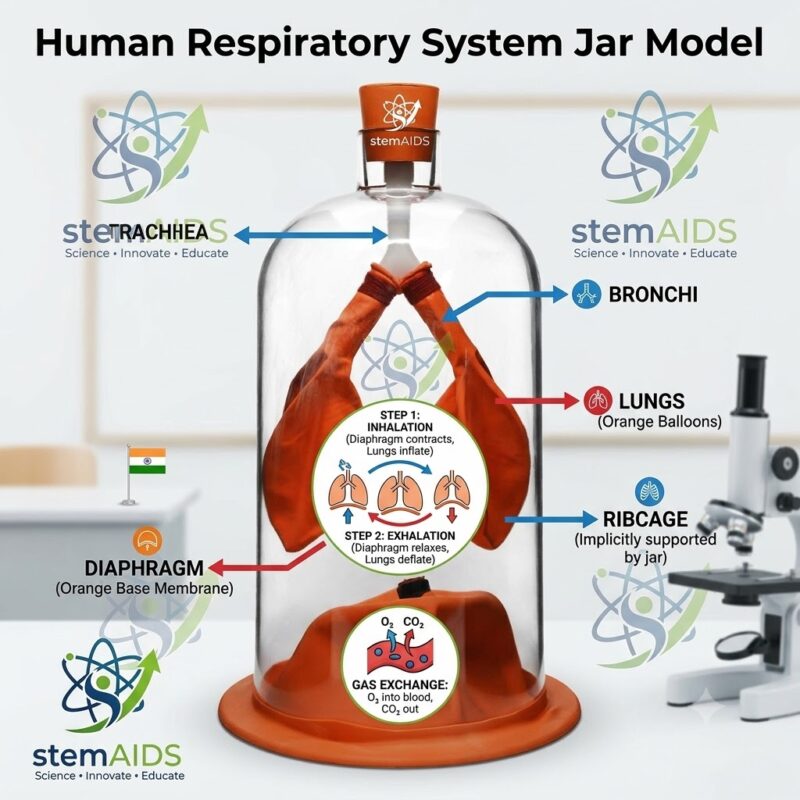
Quick Answer: The Human Respiratory System Jar Model is a classic bell-jar breathing demonstration: a clear jar stands for the chest cavity, a branched tube for the trachea and bronchi, two balloons for the lungs and a stretchable sheet across the base for the diaphragm. Pulling the sheet down makes the balloons inflate, showing that breathing depends on pressure changes.
What Each Part of the Jar Model Represents
In this human respiratory system jar model, the jar walls take the place of the rib cage and chest wall, closing off a space that works like the thoracic cavity. A single tube entering through the stopper divides into two branches, representing the trachea splitting into the left and right bronchi, and a balloon on each branch represents a lung. The flexible sheet stretched over the open base is the diaphragm.
When the sheet is pulled downward, the volume inside the jar increases and the air pressure around the balloons falls below atmospheric pressure. Air flows in through the tube and the balloons swell, just as the lungs fill during inhalation. Releasing or pushing the sheet up reduces the volume, raises the pressure and pushes air back out, which is exhalation. The demonstration is a direct application of Boyle’s law to the body.
Teachers should also point out what the model cannot show. In the body the diaphragm contracts and flattens under its own muscle power rather than being pulled from below, the intercostal muscles move the ribs outward, and the lungs are not free balloons but are held against the chest wall by the pleural membranes. Discussing these limits is a useful exercise in evaluating scientific models.
Classroom Applications
- Introducing the mechanism of breathing in middle-school biology
- Linking pressure and volume (Boyle’s law) between physics and biology lessons
- Model-evaluation tasks where students list how the jar differs from a real chest
- Revising the breathing mechanism before examinations
- Open days and exhibitions where visitors operate the diaphragm themselves
Specifications
| Item | Bell-jar model of the breathing mechanism |
| Lungs | Two balloons on a branched tube |
| Airway | Tube representing the trachea dividing into two bronchi |
| Diaphragm | Flexible sheet across the base of the jar |
| Operation | Manual: pull and release the diaphragm sheet |
| Jar size and material | Confirm at enquiry |
Care & Handling
- Pull the diaphragm sheet gently and evenly by its centre; sharp tugs can tear it or pull it off the rim.
- Balloons and rubber sheet perish with age and sunlight, so check them before each lesson and keep spares for replacement.
- Keep the stopper seated firmly; any air leak around it or around the rim stops the balloons from inflating.
- Clean the jar with a soft damp cloth only and store it upright where it cannot roll.
Why Choose LabEquip
Biology teachers buy this jar model for a first lesson on breathing, where every student can watch or take a turn pulling the diaphragm. LabEquip supplies it through the STEM kits range, and schools building a pressure theme can pair it with the Hand Pump Model, which uses the same pressure-difference idea to move water. Send your quantities through the contact page.
Frequently Asked Questions
Why do the balloons inflate when the rubber sheet is pulled down?
Pulling the sheet down increases the volume inside the jar, so the air pressure around the balloons drops. Outside air, at higher pressure, then flows in through the tube and expands the balloons. This mirrors inhalation in the chest.
What does the rubber sheet represent?
The sheet represents the diaphragm, the dome-shaped muscle below the lungs. In the body the diaphragm contracts and moves downward during inhalation, enlarging the chest cavity, and relaxes upward during exhalation.
What are the limitations of the bell jar model?
The jar cannot move, so it ignores the rib cage and intercostal muscles. A real diaphragm is moved by its own muscle, not pulled from below, and the lungs are not separate balloons in open space. The model also leaves out gas exchange in the alveoli.
Why won’t the balloons inflate on my model?
Usually the jar is leaking. Check that the stopper is tight, that the rubber sheet is sealed all round the rim, and that the balloons have no holes. Even a small leak lets outside air into the jar and stops the pressure from falling.
Which classes use the respiratory jar model?
It is used in middle-school and secondary biology when the breathing mechanism is introduced, and again in senior classes when pressure changes in the thorax are explained in more detail. Physics teachers sometimes borrow it to illustrate Boyle’s law.
Does the model show gas exchange?
No. It shows only ventilation, the movement of air in and out. Gas exchange across the alveolar walls is better taught with diagrams, charts or a lung model showing the bronchioles and alveoli.
Last Updated: September 2026
You must be logged in to post a review.
Bestsellers

Sale
Sale

Sale


Reviews
There are no reviews yet.