
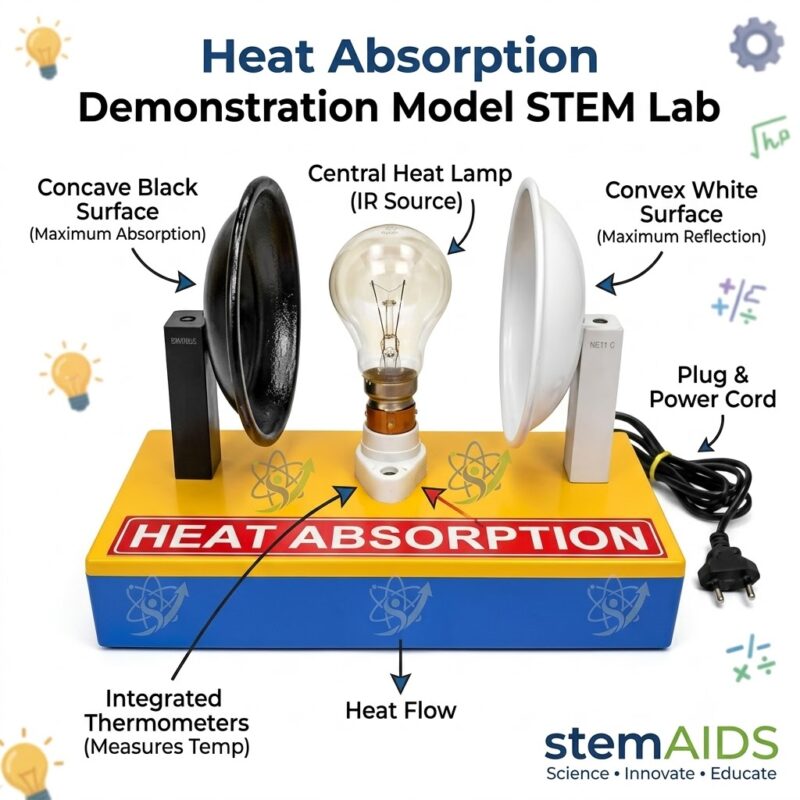
The Heat Absorption Demonstration Model is a physics apparatus used for comparing how different surfaces absorb radiant energy. It helps students, science teachers and laboratory instructors observe temperature changes in dark, light, dull or reflective surfaces under controlled exposure to one common heat or light source.
Product Description
The STEMAids Heat Absorption Demonstration Model provides a comparative setup for investigating the effect of surface properties on radiant-energy absorption. A typical apparatus uses similarly sized surfaces or containers with different colours or finishes, positioned at equal distances from a common radiation source.
Temperature measurements are recorded at regular intervals and compared. Under controlled conditions, a dark or dull surface commonly absorbs more incident radiation than a light-coloured or reflective surface and therefore shows a faster or larger temperature rise. The exact surfaces, sensors, heat source and measurement arrangement must be confirmed from the current STEMAids specification.
Key Features
- Compares surface absorption: Shows how colour and surface finish can affect the absorption of incident radiation.
- Provides measurable results: Supports temperature readings at fixed time intervals.
- Demonstrates controlled experimentation: Encourages equal distance, exposure time, area and starting temperature.
- Connects radiation with heating: Shows how absorbed electromagnetic energy can increase thermal energy.
- Supports graphing activities: Allows learners to plot temperature against exposure time.
- Introduces reflectivity and albedo: Helps explain why highly reflective surfaces absorb less incident solar energy.
- Suitable for group instruction: Supports physics, environmental-science and Earth-science demonstrations.
Technical Specifications
|
Specification |
Detail |
|
Product name |
Heat Absorption Demonstration Model |
|
Brand |
STEMAids |
|
Product category |
Thermal-radiation apparatus / physics demonstration model |
|
Setup capacity |
One comparative surface-heating experiment |
|
Teaching concepts |
Radiation absorption, reflection, surface colour, temperature change and experimental controls |
|
Intended users |
Secondary-school students, college beginners, physics teachers and laboratory instructors |
|
Standards or certifications |
No product-specific certification publicly verified |
What’s Included in the Kit
- Comparative test surfaces, plates or vessels
- Thermometers or temperature probes
- Heat lamp, radiation source or mounting holder
- Supporting frame, base and distance guide
- Power lead, switch or controller
- Experiment instructions and data table
Applications and Uses
- Comparing heat absorption by dark and light surfaces.
- Investigating dull and reflective surface finishes.
- Recording temperature change over time.
- Teaching radiation as a heat-transfer mechanism.
- Introducing reflectivity, absorptivity and surface albedo.
- Discussing solar collectors, clothing, roofs and urban heating.
- Supporting physics practicals and environmental-science projects.
How to Use the Heat Absorption Demonstration Model
- Place the apparatus on a stable, heat-resistant laboratory surface.
- Position all test surfaces at the same specified distance from the source.
- Confirm that each sample begins at approximately the same temperature.
- Insert or position the temperature sensors consistently.
- Switch on the approved radiation source and start timing.
- Record each temperature at equal time intervals without moving the setup.
- Switch off the source after the specified exposure period.
- Compare the temperature changes and plot the results where required.
Safety and handling: Lamps, surfaces and containers may become hot. Keep flammable materials away, avoid touching heated components, use heat-resistant handling equipment where required and disconnect the source before adjusting the apparatus.
Care & Maintenance
- Allow all components to cool completely before cleaning or storage.
- Clean test surfaces gently without altering their colour or finish.
- Inspect lamp holders, cables, plugs and insulation before use.
- Store thermometers and probes in protective cases away from impact and moisture.
Why Choose STEMAids
STEMAids develops educational models, experiment kits and laboratory resources for practical science instruction. Buyers can explore related physics laboratory products, educational science models, STEM learning kits and the complete scientific and educational product range. Request the current surface configuration, sensor type, lamp specification, electrical rating and packing list before procurement.
Frequently Asked Questions
What is a Heat Absorption Demonstration Model used for?
It is used to compare the temperature changes produced when surfaces with different colours or finishes receive radiant energy.
Why do dark surfaces usually heat faster?
Under comparable conditions, dark surfaces generally reflect less incident radiation and absorb a larger fraction of its energy.
Why must the surfaces be the same distance from the lamp?
Equal distance helps ensure that each surface receives a comparable radiation intensity, making the test fairer.
Does the model demonstrate conduction or radiation?
Its primary purpose is to demonstrate radiant-energy absorption, although conduction and convection may also influence measured temperatures.
Is the heat source included?
The supplied configuration is not publicly verified. Confirm whether a lamp, heater, stand or separate external source is required.
Which surface absorbs the most heat?
The result depends on wavelength, coating and test conditions, but a dull dark surface commonly absorbs more incident radiation than a light or highly reflective surface.
Explore more physics laboratory apparatus from STEMAids for heat transfer, radiation and thermal-energy experiments.
Recommended primary image ALT text: Heat Absorption Demonstration Model with dark and light test surfaces exposed to a common lamp.
Recommended detail image ALT text: Comparative thermal experiment showing temperature sensors on differently finished surfaces.
Recommended application image ALT text: Students recording surface temperatures with a Heat Absorption Demonstration Model.



Reviews
There are no reviews yet.