




Sale
In Stock
Formation of Sodium Ion Model
Original price was: ₹850.00.₹415.00Current price is: ₹415.00.
Quick Answer: The Formation of Sodium Ion Model is a chemistry display showing a sodium atom, with 11 electrons arranged 2,8,1, losing its single outer electron to become a positively charged sodium ion, Na⁺, with the arrangement 2,8. It helps students understand how metals form positive ions and why sodium is so reactive.
Losing One Electron
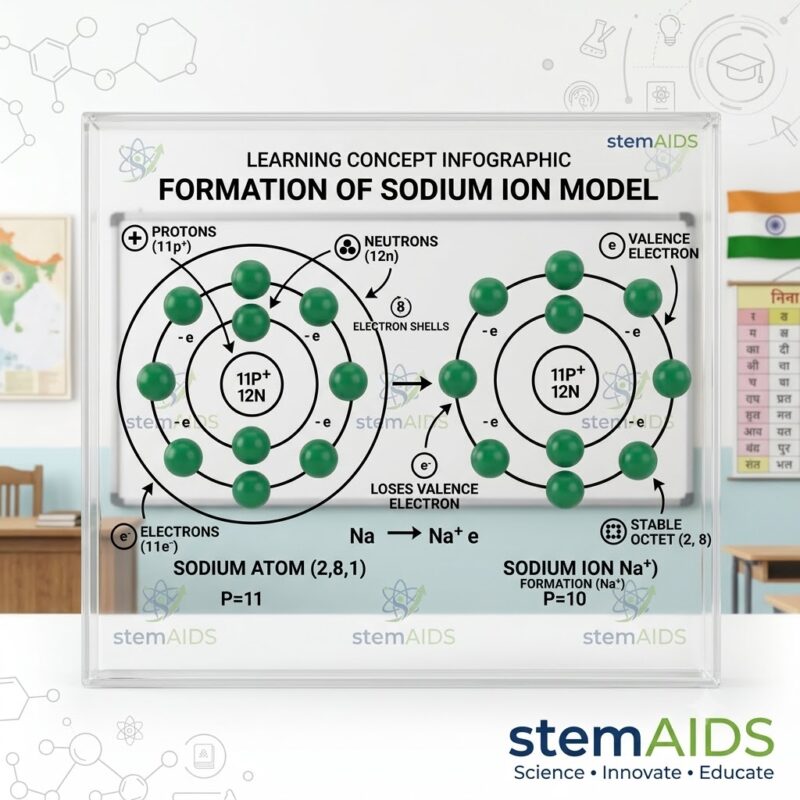
The listing image of the formation of sodium ion model shows the sodium atom, with a nucleus of 11 protons and 12 neutrons and electrons in three shells, next to the ion that remains once the lone outer electron has gone. The third shell disappears completely, so the ion has only two shells, with the same 2,8 arrangement as neon.
With 11 protons and now only 10 electrons, the sodium ion carries a charge of 1+. Losing an electron is oxidation, and removing sodium’s single outer electron takes little energy because it sits far from the nucleus, shielded by ten inner electrons. That low ionisation energy explains why sodium reacts vigorously with water and oxygen and is kept under oil in the laboratory.
The model also shows that the ion is much smaller than the atom: losing the whole outer shell lets the same nucleus pull the remaining electrons closer. Placed beside a chloride ion, it completes the picture of sodium chloride, in which each sodium atom gives up one electron and the oppositely charged ions attract into a lattice.
Specifications
| Item | Ion formation model for sodium |
| Sodium atom | 11 protons, 11 electrons, arrangement 2,8,1 |
| Sodium ion | 11 protons, 10 electrons, arrangement 2,8, charge 1+ |
| Nucleus shown | 11 protons and 12 neutrons (sodium-23), as pictured |
| Change shown | Loss of one electron (oxidation) |
| Size and mounting | Confirm at enquiry |
Care & Handling
- Keep the display dry and away from sunlight to protect the printed text.
- Dust with a soft brush and avoid solvents on any printed or acrylic surface.
- Store it flat or upright on a shelf where the beads cannot be knocked off.
Applications
- Introducing positive ions and the alkali metals
- Explaining the reactivity of sodium with water and air
- Building up the formation of sodium chloride with the chloride ion model
- Comparing atomic and ionic radius
Why Choose LabEquip
Schools teaching the chemical bonding unit in Classes 9 to 11 usually order this model as a pair with the Formation of Chlorine Ion Model. LabEquip lists both in the STEM kits range, along with the Magnesium Oxide Ionic Bond Model for a two-electron example. Share your requirements on the contact page.
Frequently Asked Questions
Why does sodium lose an electron so easily?
Its single outer electron is in the third shell, far from the nucleus and shielded by ten inner electrons. Little energy is needed to remove it, which is why sodium is so reactive.
What is the charge on a sodium ion and why?
It has a charge of 1+. After losing one electron, the ion has 11 protons but only 10 electrons, so there is one more positive charge than negative.
Is the sodium ion smaller or larger than the sodium atom?
Smaller, and by a large amount. The whole outer shell is lost, and the remaining ten electrons are held more tightly by the 11 protons in the nucleus.
Which noble gas has the same arrangement as the sodium ion?
Neon. Both have 10 electrons arranged 2,8, which is a full and stable outer shell.
Why is sodium metal stored under oil?
Sodium reacts quickly with oxygen and with moisture in the air, forming a coating of oxide and hydroxide. Storing it under paraffin oil keeps air and water away. Only teachers should handle sodium metal, using tongs and eye protection.
Does the number of protons change when an ion forms?
No. Only electrons are lost or gained. The nucleus, and therefore the identity of the element, stays exactly the same, which is why the ion is still sodium.
Last Updated: September 2026
You must be logged in to post a review.
Bestsellers


Sale

Sale

Sale


Reviews
There are no reviews yet.