




Sale
In Stock
Floating Magnet Demonstrator
Original price was: $1.80.$0.79Current price is: $0.79.
Quick Answer: The Floating Magnet Demonstrator is a set of ring magnets threaded on an upright rod with like poles facing, so that each ring hovers above the one below it. It shows magnetic repulsion acting across an air gap and lets students see how the gaps change with the weight each magnet has to support.
Rings That Hover on a Rod
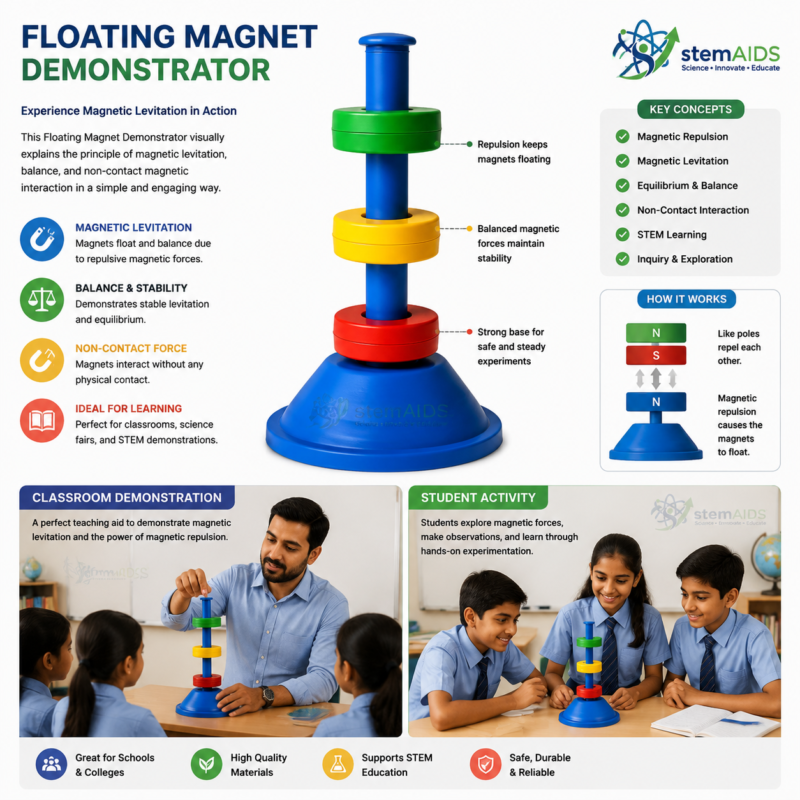
In the listing image the floating magnet demonstrator has a blue conical base with a vertical rod rising from its centre and a cap at the top. Ring magnets in red, yellow and green casings are threaded onto the rod, and clear air gaps separate them, because each ring has been placed so that it faces its neighbour with the same pole.
Magnetic repulsion grows rapidly as two magnets approach each other. Each ring therefore sinks until the push from the magnet below balances the weight it has to carry, which includes every ring above it. The lowest gap ends up the smallest and the top gap the largest, a pattern students can measure with a ruler. Pressing the top ring down and letting go shows a magnetic spring: the stack bounces and settles, much like a set of springs under load. Turning any ring over reverses its facing pole, and it snaps straight down onto its neighbour.
The rod is not decoration. A fixed arrangement of permanent magnets cannot hold another magnet in stable levitation by itself, a result known as Earnshaw’s theorem, so without the rod the rings would slide sideways or flip over and clamp together. Maglev trains overcome this with electromagnets under feedback control or with currents induced by their motion. For pole-finding and attraction activities to go alongside, see the Magnet Learning Kit.
Applications
- Showing that like poles repel and unlike poles attract by turning one ring over
- Measuring the gaps to relate magnetic force to distance and load
- Demonstrating a magnetic spring by pressing the top ring and releasing it
- Introducing maglev trains and why they need active control to stay stable
Specifications
| Apparatus type | Ring magnet repulsion stack |
| Magnets | Ring magnets in coloured casings, as pictured |
| Guide | Upright rod on a conical base, with a top cap |
| Principle | Repulsion between like poles |
| Level | Primary to senior secondary science |
| Number of rings and magnet material | Confirm at enquiry |
Care & Handling
- Lift rings off the rod one at a time and keep fingers out of the gaps, as a flipped ring snaps down sharply.
- Keep the magnets away from phones, bank cards and watches, and away from anyone with a pacemaker.
- Avoid dropping the rings, because many ring magnets are brittle ceramic and chip easily.
- Store the set assembled on its rod with the cap fitted.
Why Choose LabEquip
Primary and middle-school teachers use the floating magnet demonstrator to open a magnetism unit, since it poses a question children want answered straight away. LabEquip supplies it through the STEM kits range, and our contact page can confirm how many rings are included.
Frequently Asked Questions
Why do the rings float instead of resting on each other?
Neighbouring rings face each other with the same pole, so they repel. Each ring settles where the magnetic push from below balances the weight it carries, leaving an air gap between it and the ring beneath.
Why is the lowest gap the smallest?
The bottom pair of magnets has to hold up the weight of every ring above, so the rings must come closer before the repulsion is strong enough. Higher up there is less weight to support, so the gaps are wider.
What happens if one ring is turned over?
The pole it presents to its neighbour changes, so repulsion becomes attraction and the ring snaps onto the next one. This is a quick way to show that like poles repel and unlike poles attract.
Why is the rod needed?
Without it the rings would slide sideways or flip over and clamp together. Permanent magnets on their own cannot hold another magnet in a stable floating position, a result called Earnshaw’s theorem, so the rod supplies the sideways support.
Is this how maglev trains work?
Only partly. Maglev trains also use magnetic forces for lift, but they stay stable with electromagnets under feedback control, or with currents induced by their motion, rather than with permanent magnets on a guide rod.
Can the rings lose their magnetism?
Permanent magnets keep their strength for many years in normal use. Strong heat, repeated hard knocks and long storage next to other magnets in opposing positions can weaken them, so the set should be kept on its rod between lessons.
Last Updated: September 2026
You must be logged in to post a review.
Bestsellers



Sale

Sale
Sale


Reviews
There are no reviews yet.