




Sale
In Stock
Energy Conversion Kit
Original price was: $10.72.$5.25Current price is: $5.25.
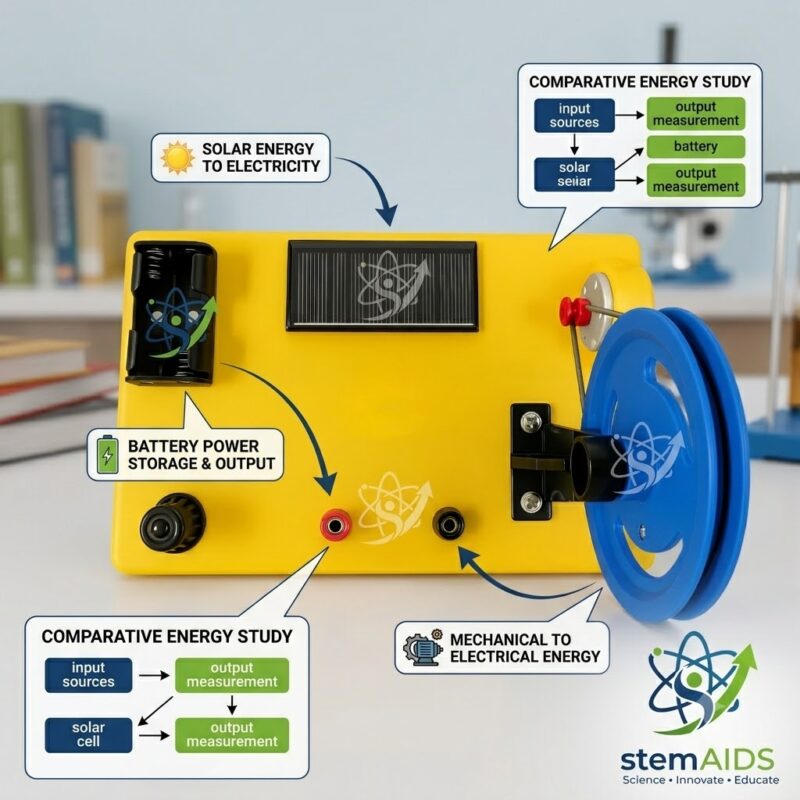
Quick Answer: The Energy Conversion Kit is a hands-on STEM science kit for showing how energy changes from one form to another. The listing image shows a panel carrying a solar cell, a battery holder, a hand-turned wheel for generating electricity and output sockets, so students can compare light, chemical and mechanical sources of electrical energy.
Comparing Three Sources of Electrical Energy
The energy conversion kit in the listing image is built on an upright yellow panel. A solar cell sits on the top face, a battery holder is set into one side, and a large grooved wheel with a handle is fitted at the other end to drive a generator, with red and black sockets and a switch on the front. Each part is a different starting point for the same end product: an electric current that can light a lamp, run a motor or sound a buzzer.
Seen together, the three sources make the idea of energy transfer concrete. In the solar cell, light energy is converted directly to electrical energy. In the cells, stored chemical energy is released as electrical energy. Turning the wheel converts the student’s own mechanical work into electrical energy through electromagnetic induction in the generator. Students can connect a load to each source in turn, describe the chain of energy changes, and discuss which sources are renewable.
Adding a voltmeter or ammeter to the output sockets turns the demonstration into a comparison: how does the solar output change with light level, or the generator output with cranking speed? Because the component list for kits of this name varies, the exact parts and output devices supplied should be confirmed at enquiry.
Classroom Activities
- Drawing energy transfer diagrams for each source and output
- Comparing solar output under a lamp and in shade with a voltmeter
- Showing that faster cranking gives a larger generator output
- Discussing renewable and non-renewable sources of electricity
Specifications
| Item | Energy conversion teaching kit |
| Sources shown | Solar cell, battery holder and hand-turned generator wheel (listing image) |
| Connections | Output sockets and switch on the panel |
| Energy changes | Light, chemical and mechanical energy to electrical energy |
| Concepts | Energy transfer, conservation of energy, renewable and non-renewable sources |
| Components and output devices supplied | Confirm at enquiry |
Care & Handling
- Take the cells out of the holder after each lesson to prevent leakage.
- Turn the generator wheel smoothly and do not force it against a stalled load.
- Keep the solar cell face clean and free of scratches.
- Store the energy conversion kit in a dry place with its leads coiled loosely.
Why Choose LabEquip
Energy topics appear in every science syllabus, and teachers want one kit that shows several sources side by side rather than separate pieces of apparatus. LabEquip lists this kit among its STEM science kits, with the Bicycle Dynamo Power Generation Model as a focused look at the generator alone. Ask for the current parts list through the contact page.
Frequently Asked Questions
What energy changes can the kit show?
Light to electrical energy in the solar cell, chemical to electrical energy in the batteries, and mechanical to electrical energy in the hand-turned generator. Connected outputs then convert electrical energy into light, sound or motion, completing each chain.
Is energy lost during each conversion?
Energy is never destroyed, but in every conversion some becomes heat or sound rather than the useful form. Students can feel the generator and wires warm slightly with use, which shows why no real device reaches 100 percent efficiency.
Why does the solar cell give less output indoors?
Its output depends on the intensity of light falling on it. Classroom lighting is far weaker than direct sunlight, so the current is smaller. Moving a lamp closer or tilting the cell to face it increases the output.
Why is the generator harder to turn when a load is connected?
When current flows, the generator coil experiences a force that opposes its motion, an effect explained by Lenz’s law. The more current the load draws, the more work the student must do, which shows that electrical energy is not produced for free.
Which classes is the kit designed for?
It suits upper primary and secondary science, where energy forms and transfers are introduced, and it is also useful for STEM clubs and exhibitions. Older students can add meters and calculate power.
What else is needed to run the kit?
Batteries of the type the holder takes, a light source such as a lamp or sunlight for the solar cell, and connecting leads if they are not included. Meters are optional but make the comparisons quantitative. Confirm the full contents when you enquire.
Last Updated: September 2026
You must be logged in to post a review.
Bestsellers

Sale
Sale
Sale

Sale


Reviews
There are no reviews yet.