













Sale
In Stock
Electromagnetic Induction Apparatus
Original price was: $3.38.$1.58Current price is: $1.58.
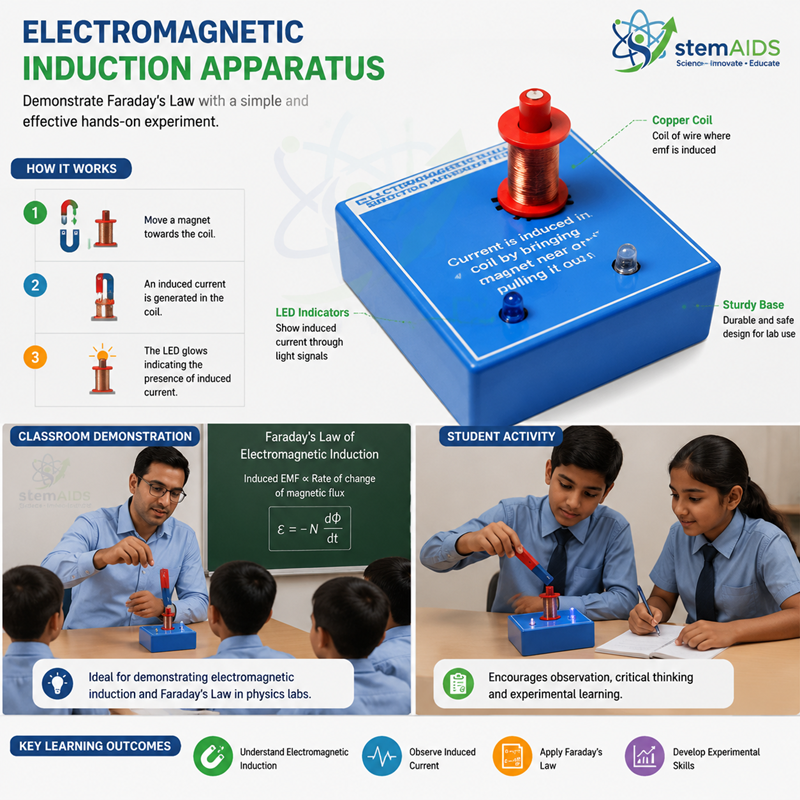
Quick Answer: The Electromagnetic Induction Apparatus is a coil of copper wire mounted on a base fitted with LEDs. Moving a magnet into or out of the coil induces a current that makes an LED flash, so students see Faraday’s law of induction at work without needing a separate meter.
Making Current With a Moving Magnet
The listing image of the electromagnetic induction apparatus shows copper wire wound on a red bobbin that stands on top of a blue case, with two LEDs set into the case beside it. In the classroom scenes a magnet is pushed down into the coil and pulled out again, and the LEDs act as the indicator in place of the galvanometer used in older versions of this experiment. Whether a magnet is supplied with the unit should be confirmed at enquiry.
Faraday’s law says that the voltage induced in a coil equals the number of turns multiplied by the rate of change of magnetic flux through it. Every part of that statement shows up on this apparatus. Hold the magnet still inside the coil and nothing happens, because the flux is not changing. Move it slowly and the LED may stay dark, since an LED needs a minimum forward voltage of roughly 2 to 3 volts, depending on its colour, before it glows. Plunge the magnet in quickly and the LED flashes, because the same change of flux now happens in less time.
The two LEDs add a lesson about direction. An LED conducts only one way, and in units like this the pair is normally connected in opposite directions across the coil, so one flashes as the magnet goes in and the other as it comes out. That reversal is the direction rule set out in Lenz’s law, which the Lenz’s Principle Verification Apparatus explores further.
Applications
- Demonstrating Faraday’s law with a hand-held magnet
- Showing that faster movement induces a larger voltage
- Showing that the induced current reverses when the motion reverses
- Introducing generators, dynamos and wireless charging
Specifications
| Apparatus type | Coil and LED induction demonstrator |
| Coil | Copper winding on a bobbin mounted on the case, as pictured |
| Indicator | Two LEDs on the case top |
| Energy source | The moving magnet; the induced current lights the LEDs |
| Magnet supply and number of turns | Confirm at enquiry |
Care & Handling
- Move the magnet in and out without striking the bobbin, which can crack or loosen the winding.
- Keep strong magnets away from phones, watches and bank cards.
- Dim the room lights a little so that brief LED flashes are easy to see.
- Store the unit dry and wipe the case with a dry cloth.
Why Choose LabEquip
Science teachers introducing electromagnetic induction in secondary school like this apparatus because the flash of light is visible to a whole class, where a galvanometer needle is not. LabEquip supplies it through the STEM kits range; questions about the coil or magnet can go through our contact page.
Frequently Asked Questions
Why does the LED light only while the magnet is moving?
A voltage is induced only while the magnetic flux through the coil is changing. A magnet held still gives a steady flux and no voltage, so the LED stays dark until the magnet moves again.
Why does moving the magnet faster make the LED brighter?
By Faraday’s law, the voltage generated depends on how quickly the flux linking the coil changes. Faster movement changes the flux in less time, which gives a larger voltage and a larger current through the LED.
Why might slow movement give no light at all?
An LED needs a minimum forward voltage, roughly 2 to 3 volts depending on its colour, before it glows. Slow movement can induce a small current that never reaches that threshold, so the LED stays dark.
Why are there two LEDs?
An LED conducts in only one direction. With two LEDs connected in opposite directions across the coil, one lights as the magnet enters and the other as it leaves, which shows that the induced current reverses when the motion reverses.
Does it matter which pole enters the coil first?
Yes. Pushing in a north pole induces current one way; pushing in a south pole, or pulling the north pole out, induces it the other way. With two opposed LEDs this shows up as a change in which LED flashes.
How does this relate to a dynamo or a power station generator?
Both keep a magnet and a coil moving relative to each other so that the flux changes continuously. This apparatus shows the principle one push at a time, while a generator repeats it many times a second by rotation.
Last Updated: September 2026
You must be logged in to post a review.
Bestsellers

Sale

Sale

Sale


Reviews
There are no reviews yet.