
















Sale
In Stock
Covalent Bond in Water Model
Original price was: ₹650.00.₹315.00Current price is: ₹315.00.
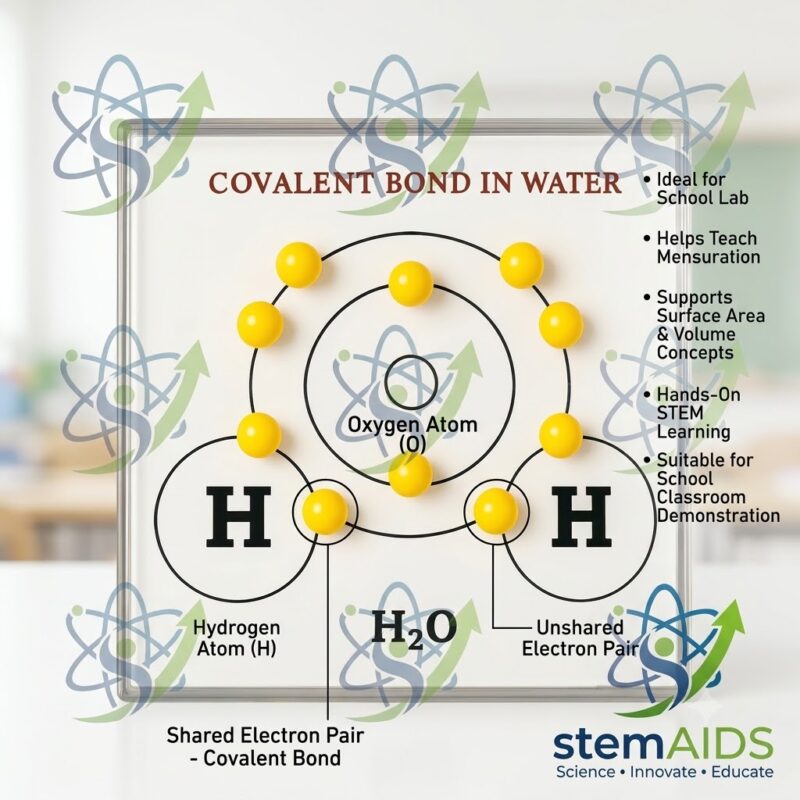
Quick Answer: The Covalent Bond in Water Model is a chemistry display of the H₂O molecule showing how an oxygen atom shares one pair of electrons with each of two hydrogen atoms. It marks the two shared pairs that form the covalent bonds and the two unshared lone pairs on oxygen, which explain water’s bent shape and polarity.
Shared Pairs and Lone Pairs
The listing image of the covalent bond in water model shows an oxygen atom with its electron beads between two hydrogen atoms, with labels picking out the shared electron pairs that make up each covalent bond and the unshared pairs that remain on the oxygen. It is essentially a large, permanent dot-and-cross diagram, the format students are asked to draw in examinations.
Oxygen has six outer electrons and needs two more; each hydrogen has one and needs one more to fill its first shell. By sharing one electron from oxygen and one from hydrogen in each bond, all three atoms reach a full shell: oxygen with eight electrons around it, each hydrogen with two. No electrons are transferred, so no ions form, which is the key contrast with ionic compounds such as magnesium oxide.
A flat display cannot show everything, and the rest is worth explaining. The two lone pairs repel the bonding pairs, so the molecule is bent, with an angle of about 104.5° between the bonds rather than a straight line. Oxygen also attracts the shared electrons more strongly than hydrogen does, so the oxygen end is slightly negative and the hydrogen ends slightly positive. These polar molecules attract each other through hydrogen bonds, which give water its unusually high boiling point, its surface tension and its ability to dissolve salts.
Specifications
| Item | Covalent bonding model of the water molecule |
| Atoms | One oxygen and two hydrogen atoms |
| Bonding pairs | Two shared electron pairs (O–H single bonds) |
| Lone pairs | Two unshared pairs on oxygen |
| Format | Dot-and-cross style display with electron beads, as pictured |
| Size and mounting | Confirm at enquiry |
Applications
- Teaching covalent bonding with a familiar molecule
- Drawing dot-and-cross diagrams and identifying lone pairs
- Explaining molecular shape and bond angle using electron-pair repulsion
- Introducing polarity and hydrogen bonding
Care & Handling
- Keep the display dry and clean it with a soft cloth.
- Handle it by the edges or base to protect the electron beads.
- Store it upright away from sunlight so the labels stay legible.
Why Choose LabEquip
Chemistry teachers usually buy this model for the covalent bonding lesson, where water is the first molecule most students meet. LabEquip lists it in the STEM kits range, and teaching it alongside the Magnesium Oxide Ionic Bond Model makes the difference between sharing and transferring electrons clear. Contact us through the contact page.
Frequently Asked Questions
How many covalent bonds are there in a water molecule?
Two. Each is a single covalent bond made of one shared pair of electrons between the oxygen atom and a hydrogen atom.
What are lone pairs?
Lone pairs are pairs of outer electrons that are not shared in a bond. The oxygen atom in water has two lone pairs, which affect the shape of the molecule and allow it to form hydrogen bonds.
Why is a water molecule bent and not straight?
The two lone pairs on oxygen repel the bonding pairs and push the hydrogen atoms closer together. The result is a bent shape with a bond angle of about 104.5 degrees.
What makes water a polar molecule?
Oxygen is more electronegative than hydrogen, so it pulls the shared electrons towards itself. Combined with the bent shape, this makes the oxygen side slightly negative and the hydrogen side slightly positive.
How is a covalent bond different from an ionic bond?
In a covalent bond atoms share electrons, typically between non-metals. In an ionic bond electrons are transferred from a metal to a non-metal, forming oppositely charged ions that attract each other.
Why does water have a high boiling point for such a small molecule?
Water molecules are held together by hydrogen bonds between the slightly positive hydrogen of one molecule and a lone pair on the oxygen of another. Extra energy is needed to break these attractions, so water boils at 100 °C instead of far lower.
Last Updated: September 2026
You must be logged in to post a review.
Bestsellers




Sale

Sale

Sale


Reviews
There are no reviews yet.