


Sale
In Stock
Covalent Bond in Water Model
Original price was: ₹650.00.₹315.00Current price is: ₹315.00.
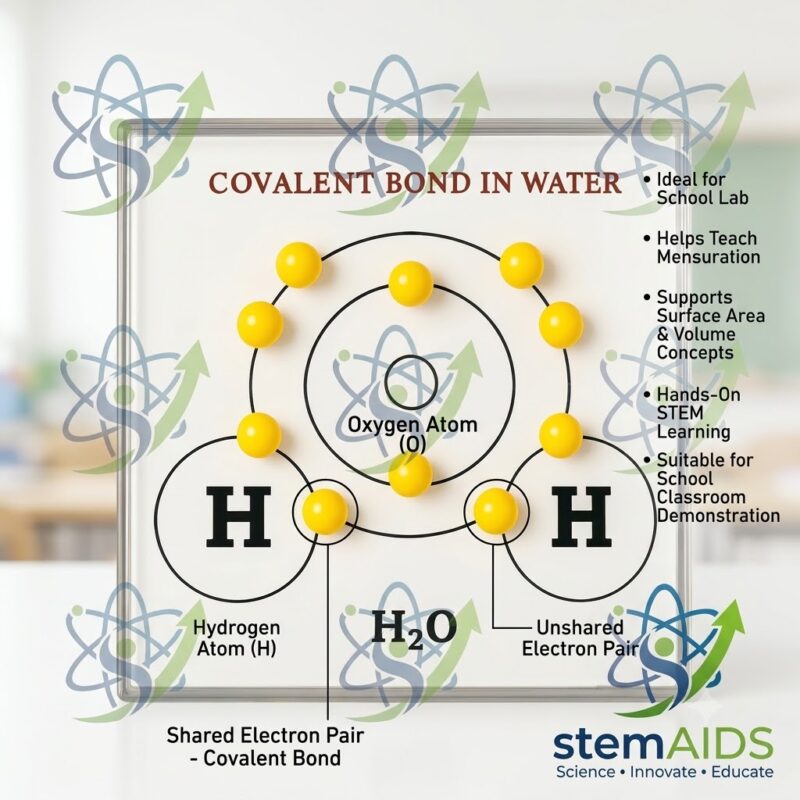
The Covalent Bond in Water Model is a chemistry teaching model used for explaining electron sharing and molecular geometry in an H₂O molecule. It helps students, chemistry teachers and laboratory instructors visualise two O–H covalent bonds, oxygen’s lone electron pairs, bond polarity and water’s bent molecular shape.
Product Description
The STEMAids Covalent Bond in Water Model provides a three-dimensional representation of one water molecule. A central oxygen atom forms two single covalent bonds with two hydrogen atoms. Each O–H bond involves a shared pair of electrons.
Oxygen also retains two lone electron pairs. Repulsion between bonding and lone electron pairs produces a bent molecular geometry rather than a straight structure. Because oxygen attracts shared electrons more strongly than hydrogen, each O–H bond is polar. The exact model scale, lone-pair display and bond-angle construction must be confirmed against the current STEMAids specification.
Key Features
- Represents one H₂O molecule: Shows one oxygen atom bonded to two hydrogen atoms.
- Demonstrates covalent bonding: Explains how atoms share electron pairs in the two O–H bonds.
- Shows bent geometry: Helps learners distinguish water’s angular shape from a linear arrangement.
- Introduces lone pairs: Supports discussion of the two non-bonding electron pairs on oxygen.
- Explains bond polarity: Connects unequal electron sharing with partial charges on oxygen and hydrogen.
- Supports VSEPR instruction: Relates electron-pair repulsion to molecular shape and bond angle.
- Suitable for group teaching: Supports chemistry lessons, revision activities and science exhibitions.
Technical Specifications
|
Specification |
Detail |
|
Product name |
Covalent Bond in Water Model |
|
Brand |
STEMAids |
|
Product category |
Covalent bonding model / molecular geometry teaching model |
|
Model capacity |
One H₂O molecular representation |
|
Represented molecule |
Water, H₂O |
|
Bond type |
Two polar single covalent O–H bonds |
|
Molecular geometry |
Bent or angular |
|
Approximate H–O–H angle |
104.5° in an isolated gas-phase water molecule |
|
Intended users |
Secondary-school students, college beginners and chemistry instructors |
|
Standards or certifications |
No product-specific certification publicly verified |
What’s Included in the Kit
- One oxygen atom element
- Two hydrogen atom elements
- Two O–H bond connectors
- Lone-pair or electron-pair elements
- Display base or supporting stand
- Assembly diagram or teaching guide
Applications and Uses
- Teaching covalent electron sharing in water.
- Identifying two O–H single bonds.
- Explaining lone pairs on the oxygen atom.
- Demonstrating bent molecular geometry.
- Introducing VSEPR theory and electron-pair repulsion.
- Explaining bond polarity and molecular dipoles.
- Supporting lessons on hydrogen bonding and water properties.
How to Use the Covalent Bond in Water Model
- Place the model on a stable surface or assemble it using the supplied guide.
- Identify the central oxygen atom and two hydrogen atoms.
- Locate the two connectors representing the O–H covalent bonds.
- Explain that each bond represents a shared electron pair.
- Identify the two lone electron pairs on oxygen where displayed.
- Observe the bent arrangement of the hydrogen atoms.
- Discuss why the O–H bonds are polar.
- Relate the molecular shape and polarity to water’s physical properties.
Safety and handling: Do not force connectors or suspend the model by one bond. Keep small detachable parts away from young children unless the product is approved for their age group.
Care & Maintenance
- Remove dust with a soft, dry cloth or brush.
- Support the complete model when moving it.
- Do not bend bond connectors or apply pressure to atom elements.
- Store loose components in a labelled container away from heat and moisture.
Why Choose STEMAids
STEMAids develops educational models, laboratory resources and hands-on STEM products for practical science instruction. Buyers can explore related educational science models, chemistry laboratory equipment, STEM learning kits and the complete scientific and educational product range. Buyers should request the current model photograph, bond-angle specification, material details and packing list before procurement.
Frequently Asked Questions
What is a Covalent Bond in Water Model used for?
It is used to explain electron sharing, O–H bonds, lone electron pairs, molecular polarity and the bent shape of water.
How many covalent bonds are present in water?
One water molecule contains two single covalent O–H bonds.
Why is water bent rather than linear?
Oxygen has two bonding pairs and two lone pairs. Repulsion among these electron pairs produces a bent molecular geometry.
What is the bond angle in a water molecule?
The H–O–H angle in an isolated gas-phase water molecule is approximately 104.5 degrees.
Are the bonds in water polar?
Yes. Oxygen attracts the shared electrons more strongly than hydrogen, giving oxygen a partial negative charge and the hydrogen atoms partial positive charges.
Does the model show lone electron pairs?
The displayed features are not publicly verified. Confirm whether the model includes separate lone-pair or valence-electron representations.
Explore more educational science models from STEMAids for chemical bonding, molecular structure and classroom demonstrations.
Recommended primary image ALT text: Covalent Bond in Water Model showing one oxygen atom bonded to two hydrogen atoms.
Recommended detail image ALT text: Bent H₂O molecular model illustrating polar O–H bonds and oxygen lone pairs.
Recommended application image ALT text: Chemistry teacher explaining covalent bonding and water molecular geometry with an H₂O model.
You must be logged in to post a review.
Bestsellers


Sale

Sale

Sale


Reviews
There are no reviews yet.