








Sale
In Stock
Angle Between Two Mirrors Apparatus
Original price was: ₹1,150.00.₹565.00Current price is: ₹565.00.
Quick Answer: The Angle Between Two Mirrors Apparatus is a pair of plane mirrors hinged together on a protractor base, used to study multiple images. Students place an object between the mirrors, set the angle, count the images and check the result against the formula n = 360°/θ − 1, which also explains how a kaleidoscope works.
Counting Images at Set Angles
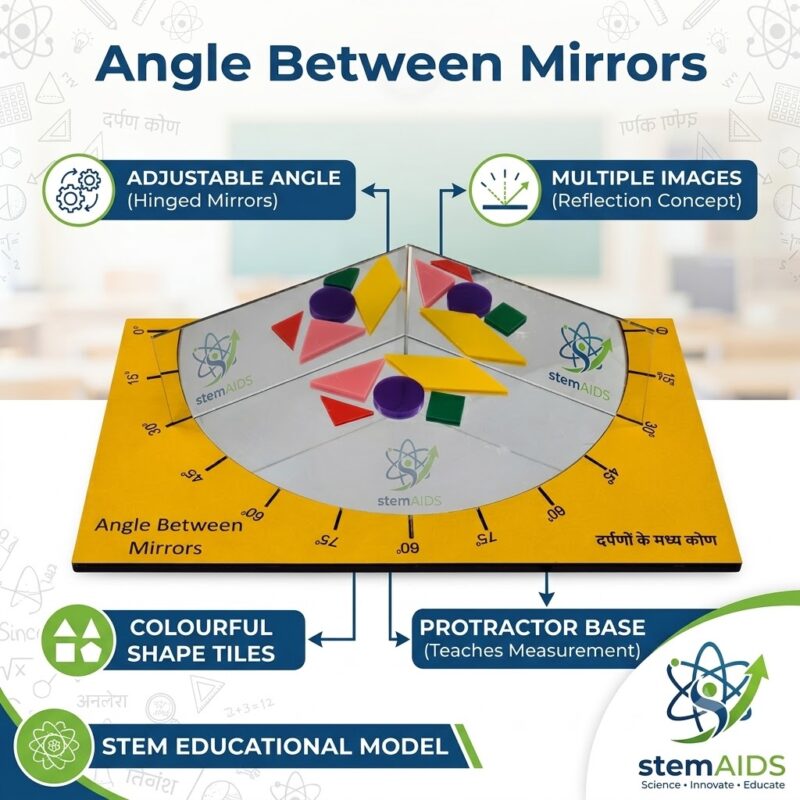
The listing image of the angle between two mirrors apparatus shows two hinged mirrors standing on a base marked in degrees, with brightly coloured shape tiles to place between them. Because the hinge line sits at the centre of the scale, the angle between the mirrors can be read directly, and a tile placed near the hinge is reflected again and again, forming a ring of images.
Each image formed by one mirror acts as an object for the other, so light can reflect several times before reaching the eye. When 360 divided by the angle gives an even whole number, as at 90, 60 or 45 degrees, the number of images is that quotient minus one: three images at 90 degrees, five at 60 and seven at 45. When the quotient is odd, as at 72 or 120 degrees, the count depends on where the object sits, which makes a good investigation for older students.
Recording the count at several angles and plotting it against the angle shows the number rising sharply as the mirrors close. At zero degrees the mirrors become parallel and the number of images becomes unlimited in principle, the idea behind the infinity mirror. The coloured tiles also turn the activity into a symmetry lesson, since the images build patterns with rotational and reflective symmetry just as a kaleidoscope does.
Applications
- Verifying the image-number formula at 90, 60, 45 and 30 degrees
- Graphing the number of images against the mirror angle
- Symmetry and pattern work in mathematics using the coloured tiles
- Explaining how a kaleidoscope creates its repeating patterns
Specifications
| Item | Two hinged plane mirrors on a protractor base |
| Angle scale | Degree markings on the base for setting the mirror angle |
| Objects | Coloured shape tiles, as shown in the listing image |
| Formula tested | n = 360°/θ − 1 for even quotients |
| Related topics | Multiple reflection, symmetry, kaleidoscope |
| Mirror and base size | Confirm at enquiry |
Care & Handling
- Open and close the hinge gently and support both mirrors while changing the angle.
- Clean the mirror faces with a soft cloth and avoid rubbing the silvered back or the edges.
- Keep the protractor scale clean and dry so the markings stay readable.
- Store the mirrors closed, face to face with a soft sheet between them, to prevent scratches.
Why Choose LabEquip
Physics teachers use this apparatus for the multiple-images practical, and mathematics teachers borrow it for symmetry lessons. LabEquip lists it in the STEM kits range; pair it with the Reflection of Light Experiment Kit for single-mirror ray work or the Infinite Reflection Mirror Model to show the parallel-mirror limit. Send enquiries through the contact page.
Frequently Asked Questions
What is the formula for the number of images between two mirrors?
When 360 divided by the angle is an even number, the number of images equals 360 divided by the angle, minus one. At 90 degrees there are three images, at 60 degrees five and at 45 degrees seven.
What happens when 360 divided by the angle is odd?
Then the count depends on the position of the object. If the object lies on the line bisecting the angle, the number of images is the quotient minus one; if it is off that line, the number equals the quotient. Students can test both positions at 72 or 120 degrees.
Why are some images dimmer than others?
Images at the back of the ring are formed after more reflections, and a little light is lost at each reflection. They therefore look slightly fainter than the first images seen directly in each mirror.
How does this relate to a kaleidoscope?
A kaleidoscope usually contains two or three mirrors set at 60 degrees. Coloured pieces at one end are reflected repeatedly, producing a symmetrical pattern, the same effect students see around the tiles in this apparatus.
What happens when the mirrors are parallel?
The angle becomes zero and, in theory, an unlimited number of images forms, receding into the distance. In practice light losses make the far images too faint to see, as in an infinity mirror.
What should students record in the practical?
They should record the angle, the number of images counted and the number predicted by the formula, repeating for several angles. A table and a graph of image count against angle make the relationship clear.
Last Updated: September 2026
You must be logged in to post a review.
Bestsellers

Sale
Sale
Sale


Reviews
There are no reviews yet.