


















Sale
In Stock
Ampere’s Law Demonstration Apparatus
Original price was: $10.15.$4.96Current price is: $4.96.
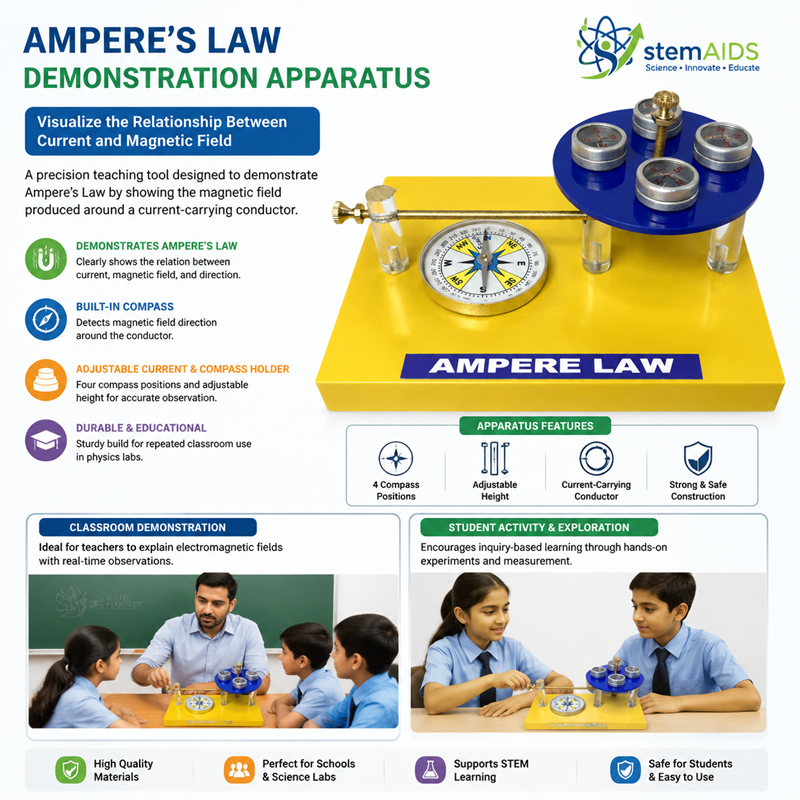
Quick Answer: The Ampere’s Law Demonstration Apparatus shows the magnetic field around a straight current-carrying conductor. In the listing image a vertical conductor passes through a platform ringed by small compasses, and a horizontal conductor runs above a larger compass; with current flowing, the needles turn to reveal the circular field around the wire.
Circles of Field Around a Straight Conductor
The listing image shows a flat base carrying two arrangements. A horizontal brass rod on clear supports runs a short distance above a large compass, and at one end a vertical brass conductor rises through the centre of a round platform on which several small compasses sit at equal distances around it. With no current, every needle simply points north.
Ampere’s law links the magnetic field around any closed path to the current passing through it. For a long straight wire this gives field lines that are concentric circles centred on the wire, with a strength proportional to the current and inversely proportional to the distance from the wire. When a large enough current flows up the vertical conductor, the small compasses swing round to lie along the tangents of those circles, and reversing the current reverses every needle at once. The right-hand grip rule predicts the result: thumb along the conventional current, fingers curled in the direction of the field.
The horizontal conductor reproduces Oersted’s 1820 observation. With the rod aligned north-south above the compass, current in the rod deflects the needle, and the SNOW rule gives the direction. Because the field of a single straight wire is weak, a low-voltage supply delivering several amperes is normally needed; the supply rating and number of compasses should be confirmed at enquiry. For the stronger field of coils, see the Magnetic Effect of Current apparatus.
Specifications
| Apparatus type | Straight-conductor magnetic field demonstrator |
| Conductors | Vertical conductor through a platform, horizontal conductor over a compass |
| Detectors | Small plotting compasses around the vertical conductor, a larger compass below the horizontal one |
| Base | Flat base with conductor supports, as pictured |
| Supply rating and compass count | Confirm at enquiry |
Care & Handling
- Pass current only in short bursts from a current-limited supply or through a rheostat, as the thick conductor has very low resistance.
- Expect the conductor to warm up if current flows for long; let it cool between runs.
- Keep steel objects and magnets away from the compasses during the experiment.
- Store the compasses level, and tap one gently if its needle sticks.
Applications
- Showing circular field lines around a vertical current-carrying wire
- Reproducing Oersted’s compass deflection with the horizontal conductor
- Applying the grip rule to predict needle directions before switching on
- Showing that the field grows with current and weakens with distance
Why Choose LabEquip
Senior secondary physics teachers use this apparatus when introducing the magnetic effect of current, because it shows the field of a single straight wire before coils and solenoids are met. LabEquip supplies it through the STEM kits range, and supply questions can be sent through our contact page.
Frequently Asked Questions
What does Ampere’s law say about a straight wire?
The magnetic field around a long straight current-carrying wire forms circles centred on the wire. Its strength is proportional to the current and inversely proportional to the distance from the wire, so compasses nearer the conductor respond more strongly.
Why do the compass needles form a circle around the vertical conductor?
Each needle lines up with the magnetic field where it sits. Because the field of the wire runs in circles round it, needles at different points point along different tangents, together tracing a circle when the wire’s field is strong compared with the Earth’s.
Why is a fairly large current needed?
The field of a single straight wire is weak. A few centimetres from a wire carrying a few amperes it is only about as strong as the Earth’s field, so a low-voltage supply able to deliver several amperes, switched on briefly, gives a clear deflection.
How does the right-hand grip rule give the field direction?
Imagine gripping the wire with the right hand, with the thumb pointing in the direction of conventional current. The curled fingers then show the direction of the magnetic field lines around the wire.
Which way does the needle under the horizontal conductor swing?
With the rod lying north-south above the needle and conventional current running northward, the needle’s north-seeking end is pushed westward; Indian textbooks remember this as the SNOW rule. Placing the conductor beneath the needle instead, or sending the current southward, makes it swing east.
How is this different from a coil-and-compass apparatus?
This apparatus uses straight conductors, so it shows the basic circular field of one wire and Oersted’s original observation. A coil apparatus adds the fields of many turns at its centre, which suits measurements such as the tangent galvanometer.
Last Updated: September 2026
You must be logged in to post a review.
Bestsellers

Sale

Sale

Sale

Sale


Reviews
There are no reviews yet.