







In Stock
Ring 24 LED RGB
₹489.00
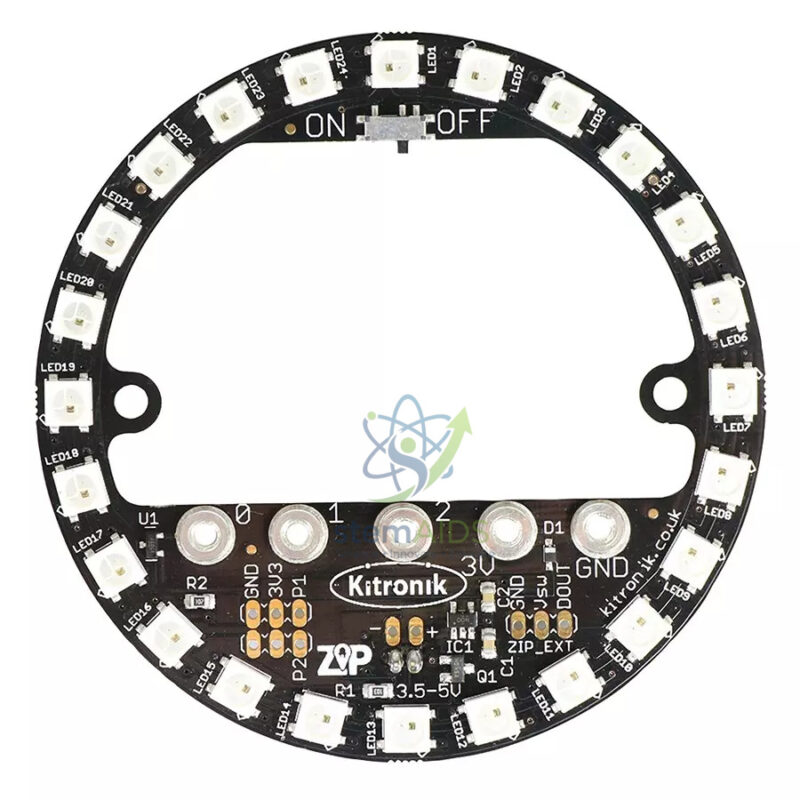
The StemAids 24 LED RGB Ring for micro:bit is a colourful programmable LED expansion module designed for BBC micro:bit based STEM learning, coding projects, robotics models, digital art, wearable projects, classroom demonstrations, and creative electronics activities. It includes 24 individually addressable RGB LEDs arranged in a circular ring, allowing students to create animations, colour patterns, lighting effects, timers, games, indicators, and interactive visual displays.
This RGB LED ring is suitable for schools, STEM labs, ICT classrooms, coding clubs, robotics labs, maker spaces, innovation labs, and science exhibition projects. It helps learners understand RGB colour mixing, sequencing, loops, variables, timing, brightness control, digital output, and real-world physical computing using micro:bit programming.
Product Overview
The StemAids 24 LED RGB Ring for micro:bit provides a bright circular LED display that can be controlled through the micro:bit. Each LED can be programmed separately to show different colours and effects. Students can create rainbow animations, countdown timers, reaction games, traffic indicators, compass displays, sound level meters, clock models, decorative lighting, and smart notification projects.
Depending on the model variant, the ring may bolt directly to the micro:bit board or connect through compatible pins, Grove connectors, jumper wires, or expansion boards. It is commonly programmed using Microsoft MakeCode NeoPixel blocks, JavaScript, Python, or MicroPython.
Key Features
- 24 RGB LEDs: Circular layout with 24 individually addressable full-colour LEDs.
- NeoPixel / WS2812B Compatible: Supports common RGB LED coding methods and colour effects.
- micro:bit Project Ready: Designed for BBC micro:bit coding, STEM activities, and classroom demonstrations.
- Individual LED Control: Each LED can be programmed for colour, brightness, sequence, and animation.
- Colour Mixing Learning: Helps students understand RGB values, brightness, gradients, and colour patterns.
- Creative Coding Use: Suitable for games, clocks, timers, sound meters, compass rings, and wearable light projects.
- Classroom-Friendly Design: Easy to demonstrate visual programming concepts in STEM and ICT labs.
- Expandable Projects: Can be combined with sensors, buttons, buzzers, robotics kits, and smart city models.
Product Specifications
| Product Name | 24 LED RGB Ring for micro:bit |
|---|---|
| Brand | StemAids |
| Product Type | micro:bit RGB LED Ring / Circular LED Expansion Board |
| Compatible Board | BBC micro:bit V1 and V2, depending on mounting and connection method |
| LED Quantity | 24 RGB LEDs |
| LED Type | Individually addressable ZIP / WS2812B / NeoPixel-compatible RGB LEDs depending on model variant |
| Colour Output | Full-colour RGB lighting with programmable colour and brightness control |
| Supply Voltage | Approx. 3.5V to 5V, depending on module specification and power setup |
| Connection Method | Direct micro:bit mounting, pin connection, Grove connection, or expansion board connection depending on model |
| Programming Support | Microsoft MakeCode, JavaScript, Python, MicroPython, NeoPixel libraries, and compatible RGB LED extensions |
| Approximate Board Size | Common 24 LED halo modules are around 80 mm diameter, depending on model variant |
| Applications | RGB animations, STEM projects, wearable lighting, coding games, smart indicators, timers, and visual displays |
| Recommended Users | Students, teachers, STEM trainers, coding beginners, robotics learners, and institutional buyers |
How to Use the StemAids 24 LED RGB Ring for micro:bit
- Check Compatibility: Confirm that the RGB ring is compatible with your BBC micro:bit board and connection method.
- Connect the Ring: Mount or connect the RGB ring to the micro:bit using screws, pins, Grove cable, jumper wires, or an expansion board as per the module design.
- Connect Power: Use USB power, battery power, or external power as required by the LED ring and project load.
- Open Coding Editor: Use Microsoft MakeCode, Python editor, or another compatible micro:bit programming platform.
- Add RGB LED Extension: In MakeCode, add the NeoPixel or compatible LED extension if required.
- Set LED Count: Configure the program for 24 RGB LEDs and select the correct control pin.
- Create Lighting Effects: Program colours, rainbow animations, brightness levels, timers, indicators, or sensor-based effects.
- Download Code: Transfer the program to the micro:bit using a USB cable.
- Test the Output: Run the project and check whether all 24 LEDs respond correctly.
- Improve the Project: Add buttons, accelerometer control, sound sensing, compass direction, or external sensors for advanced activities.
Educational Benefits
The StemAids 24 LED RGB Ring for micro:bit helps students learn coding through colourful visual output. It makes abstract programming concepts easier to understand by showing immediate results through light, colour, movement, and animation.
- Introduces RGB colour coding and digital output control
- Helps students learn loops, variables, arrays, timing, and brightness control
- Supports creative STEM projects, games, clocks, timers, and wearable designs
- Useful for sensor-based projects using light, sound, motion, or compass input
- Encourages visual learning, creativity, and project-based experimentation
- Suitable for classroom demonstrations, coding clubs, maker spaces, and exhibitions
Example Projects
- Rainbow animation ring
- Digital colour clock
- Countdown timer
- Reaction speed game
- Sound level meter
- Compass direction indicator
- Traffic signal light display
- Smart notification ring
- Wearable RGB badge
- STEM exhibition lighting model
Applications
- micro:bit coding lessons
- STEM lab activities
- Robotics and smart model projects
- RGB colour and animation learning
- Wearable technology projects
- Interactive classroom displays
- Science fair and exhibition models
- Maker space creative projects
- Timer, clock, and indicator projects
- Sensor-based visual feedback systems
Why Choose StemAids 24 LED RGB Ring for micro:bit?
StemAids provides practical STEM education products for schools, ICT labs, coding classrooms, robotics labs, and maker spaces. The 24 LED RGB Ring for micro:bit is a useful accessory for teaching creative coding, colour control, physical computing, and interactive project design.
With 24 programmable RGB LEDs, NeoPixel-compatible coding, circular visual output, and micro:bit project support, this module helps students create attractive and functional STEM projects while improving coding confidence and problem-solving ability.
Safety and Maintenance Guidelines
- Use only with compatible micro:bit boards, cables, expansion boards, and power sources.
- Do not exceed the recommended voltage range of the RGB LED ring.
- Use external power if required for high-brightness or full-white LED operation.
- Reduce brightness in classroom projects to avoid excessive current draw.
- Disconnect power before changing connections or mounting the ring.
- Avoid short circuits between pins, contacts, screws, and exposed pads.
- Do not bend or press the LED ring PCB forcefully.
- Keep the module away from water, dust, excessive heat, and physical impact.
- Use under teacher or trainer supervision in school laboratories.
Google E-E-A-T Focus
This product content is prepared for school procurement teams, STEM coordinators, ICT teachers, robotics trainers, coding educators, and institutional buyers. It focuses on verified product features, safe handling, micro:bit compatibility, classroom applications, and educational value to support Google E-E-A-T principles of experience, expertise, authoritativeness, and trustworthiness.
Frequently Asked Questions
1. What is the StemAids 24 LED RGB Ring for micro:bit used for?
It is used to create programmable colour lighting, animations, timers, games, indicators, wearable projects, and STEM demonstrations with the BBC micro:bit.
2. How many LEDs are included?
The ring includes 24 individually addressable RGB LEDs.
3. Is it compatible with micro:bit V2?
Yes, many 24 LED RGB ring modules are compatible with micro:bit V2, depending on the mounting and connection method.
4. Does it require soldering?
Most classroom micro:bit RGB ring modules are designed for direct mounting or connector-based use and do not require soldering for basic projects.
5. Can it be programmed using MakeCode?
Yes, it can be programmed using Microsoft MakeCode with a NeoPixel or compatible RGB LED extension.
6. Can it be programmed with Python?
Yes, it can be programmed using Python or MicroPython with compatible NeoPixel or WS2812B control libraries.
7. Does the micro:bit board come included?
The micro:bit board may or may not be included depending on the supplied package. Confirm the kit contents before purchase.
8. Why do LEDs become dim at high brightness?
RGB LEDs can draw higher current when many LEDs are bright at the same time. Using lower brightness or suitable external power can improve stability.
9. Is it suitable for STEM labs?
Yes, it is suitable for STEM labs, ICT classrooms, coding clubs, robotics labs, maker spaces, and school innovation projects.
10. What can students learn with this module?
Students can learn RGB colour control, loops, variables, timing, arrays, animations, sensor interaction, and physical computing concepts.
SEO Keywords
24 LED RGB Ring for micro:bit, StemAids 24 LED RGB Ring, micro:bit RGB LED ring, micro:bit LED halo, 24 LED NeoPixel ring micro:bit, WS2812B ring for micro:bit, RGB ring coding module, micro:bit colour LED ring, STEM LED ring module, micro:bit lighting project, MakeCode NeoPixel ring, RGB animation kit for micro:bit, micro:bit wearable LED project, programmable LED ring for classroom.
You must be logged in to post a review.
Bestsellers
Sale
Sale
Sale


Reviews
There are no reviews yet.