
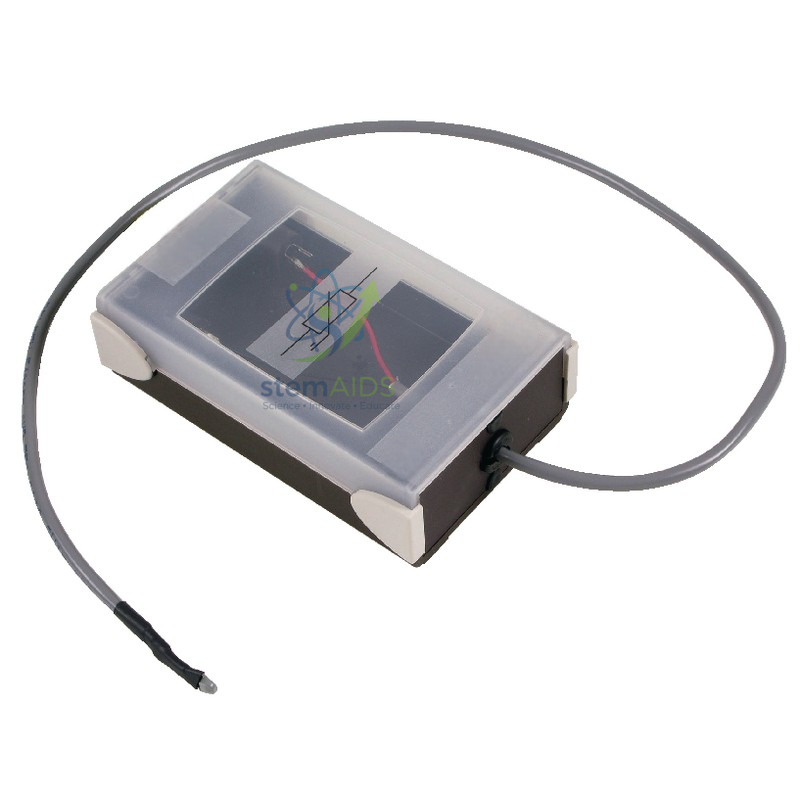
Quick Answer: The Thermistor Sensor is a temperature probe built around a thermistor, a resistor whose resistance changes strongly with temperature, packaged as a sensor rather than a bare component so it can be placed where the temperature is wanted and connected to a meter or data interface. As a thermistor temperature sensor it serves cooling curves, heating experiments and simple electronic thermometers.
A Sensor Rather Than a Bare Component
A bare thermistor is a small bead or disc on two thin leads: fine on a breadboard, awkward to put into a beaker. In sensor form the sensing element sits at the end of a probe or housing with a lead back to the measuring circuit, so it can be held at the point that matters and moved between samples. The circuit then converts its changing resistance into a reading, either through an ohmmeter and a calibration graph or through an interface that does the conversion.
Most thermistor probes use an NTC element, whose resistance falls as it warms, because it gives a large, easily measured change over everyday temperatures. The thermistor type, its nominal resistance and whether the probe is sealed for immersion in liquids should be confirmed before ordering, so that it matches the meter or interface it will work with.
Cooling Curves and Response Time
A classic use is the cooling curve. Warm a small tube of a substance such as stearic acid until it melts, place the probe in it and record the reading at fixed intervals as it cools. The flat section where the substance freezes shows latent heat being released at constant temperature. The same set-up reveals the sensor’s own response time: move the probe from cold water to warm and the reading approaches the new temperature gradually rather than at once, because the element and its housing must warm up first. A probe with less material around the element responds faster.
Practicals
- Cooling and heating curves, including the freezing plateau of a melting-point substance
- Newton’s law of cooling, comparing insulated and uninsulated containers
- Building an electronic thermometer and calibrating it against a liquid-in-glass thermometer
- Recording the temperature rise in specific heat capacity practicals
Specifications
| Type | Thermistor-based temperature sensor |
| Principle | Resistance changes with temperature |
| Output | Resistance, read by a meter, circuit or data interface |
| Typical uses | Cooling curves, calibration, heating experiments |
| Thermistor type, nominal resistance and immersion rating | Confirm at enquiry |
Care & Handling
- Before placing the thermistor sensor in a liquid, check that the probe is sealed for immersion, and never immerse the lead or connector.
- Rinse and dry the probe between different liquids so residues do not build up on the tip.
- Keep the sensor out of flames and off hot plate surfaces beyond its working temperature.
- Coil the lead loosely for storage; sharp kinks near the probe can break the internal wires.
Why Choose LabEquip
Schools and colleges using thermistor probes for heating and cooling practicals usually want one per group, matched to their meters or data interfaces. LabEquip supplies them within our physics lab equipment range together with the bare NTC thermistor for circuit work; tell us which interface you use through the contact page.
Frequently Asked Questions
What is the difference between a thermistor sensor and a bare thermistor?
The sensing element is the same kind of component, but the sensor mounts it in a probe or housing with a lead to the measuring circuit, so it can be placed in a sample and moved between samples. A bare thermistor is better suited to building circuits on a board.
How is the resistance turned into a temperature?
Either by measuring the resistance with an ohmmeter and reading the temperature from a calibration graph or table, or by connecting the sensor to a meter or data interface that does the conversion. Because the response is non-linear, a straight-line scale is accurate only over a narrow range.
How do I calibrate the sensor?
Place it beside a reliable thermometer in a stirred water bath and record its resistance at several temperatures as the bath warms. Plot resistance against temperature and use the curve, or fit the readings to the standard thermistor equation, to convert later readings.
Why does the reading take time to settle?
The sensing element and the material around it must reach the temperature of the sample before the resistance stops changing. This response time depends on the size and construction of the probe and on how well the sample is stirred.
Is the sensor NTC or PTC?
Most thermistor temperature probes use an NTC element because it changes strongly over everyday temperatures. The type and nominal resistance of this model should be confirmed at enquiry so it can be matched to your meter or interface.
Can the sensor measure air temperature?
Yes. Held in still air it reads the air temperature, though it settles more slowly than in a stirred liquid because air transfers heat less effectively. Shield it from direct sunlight and lamps, which would warm the tip above the true air temperature.
Last Updated: October 2026




Reviews
There are no reviews yet.