
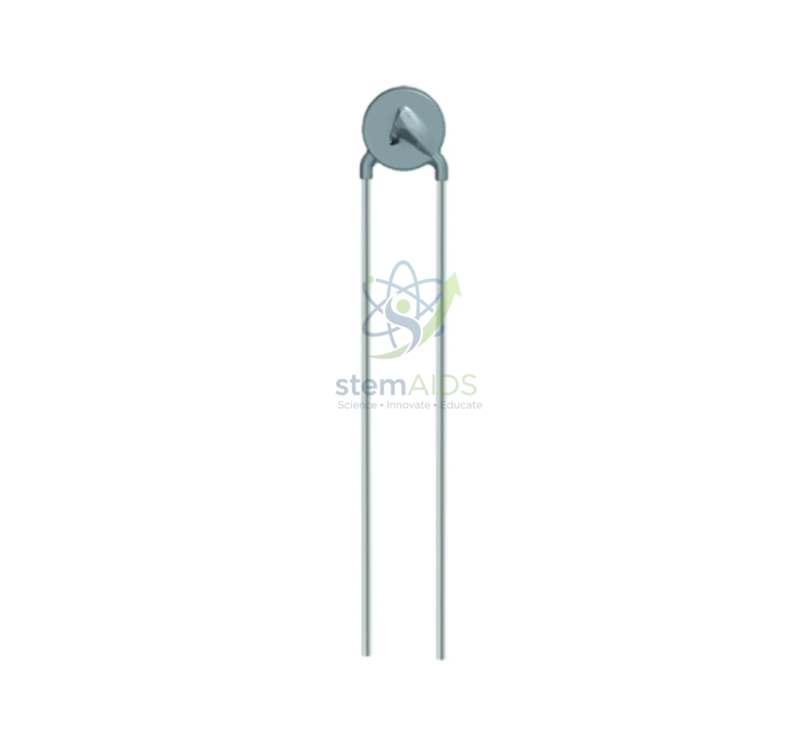
Quick Answer: The NTC Thermistor is a temperature-sensitive resistor made from a semiconducting material whose resistance falls as its temperature rises, which is what negative temperature coefficient means. In the physics lab the NTC thermistor is used to plot resistance against temperature and as the sensing element in simple temperature-measuring and control circuits.
Why Its Resistance Falls When Heated
These thermistors are made from sintered metal oxides that behave as semiconductors. At room temperature only a limited number of charge carriers are free to move. Heating gives more of them enough energy to take part in conduction, and although each carrier is scattered more by the vibrating lattice, the large increase in their number wins, so the resistance drops. A metal wire behaves the opposite way: its number of free electrons is fixed and only the scattering grows, so its resistance rises.
The change is large and non-linear. Across the temperatures a school water bath can reach, the resistance typically falls several-fold, far more than a copper or platinum wire would change, and that is what makes the component a sensitive sensor. The curve is close to exponential, and advanced courses describe it with a material constant known as the B value.
Specifications
| Component | NTC (negative temperature coefficient) thermistor |
| Material type | Semiconducting metal-oxide ceramic |
| Behaviour | Resistance falls as temperature rises |
| Response | Non-linear, close to exponential |
| Nominal resistance and tolerance | Confirm at enquiry |
The Resistance-Temperature Practical
Seal the thermistor and its leads in a dry test tube, or use a waterproof sleeve, and stand it in a beaker of water with a thermometer beside it. Heat the water slowly while stirring and record the resistance from an ohmmeter at regular temperature steps, then repeat as the water cools. A graph of resistance against temperature shows the steep, curving fall; plotting the natural logarithm of resistance against the reciprocal of absolute temperature gives a straight line for older students.
Applications
- Plotting the resistance-temperature characteristic of a semiconductor
- Building a potential-divider temperature sensor that switches a buzzer or LED
- Comparing NTC behaviour with a PTC thermistor and with a metal wire
- Calibrating a simple electronic thermometer against a liquid-in-glass thermometer
Care & Handling
- Keep the measuring current small; current through the NTC thermistor warms it and lowers its resistance, distorting the readings.
- Do not put bare leads into water; use a dry test tube or waterproof sleeve so the water cannot form a parallel conduction path.
- Avoid bending the leads right at the bead, which can crack its coating.
- Give the thermistor time to reach the water temperature before each reading.
Why Choose LabEquip
NTC thermistors turn up in school and college practicals on semiconductors, sensors and control circuits, so departments tend to buy several at once. LabEquip supplies them with resistors, meters and other physics lab equipment; tell us the nominal resistance you need through the contact page.
Frequently Asked Questions
What does NTC mean?
Negative temperature coefficient: the resistance of the component goes down as its temperature goes up. The opposite type, a PTC thermistor, has a positive coefficient and its resistance rises with temperature.
Why does the resistance of a thermistor fall while a metal wire’s resistance rises?
In a metal the number of free electrons is fixed, and heating only increases collisions with the vibrating lattice, so resistance rises. In the semiconducting material of a thermistor, heating releases many more charge carriers, and that outweighs the extra collisions, so resistance falls.
Is the resistance-temperature graph a straight line?
No. It is a steep curve that flattens at higher temperatures. Plotting the natural logarithm of resistance against one over absolute temperature gives an approximately straight line, which is the usual way to analyse the results in advanced courses.
How do I use an NTC thermistor to switch something on when it gets hot?
Put it in a potential divider with a fixed resistor and feed the junction to a transistor or comparator. As the thermistor warms its resistance falls, the junction voltage changes and the transistor switches the buzzer or LED. Exchanging the two resistors gives a cold-activated circuit.
What is self-heating?
The current used to measure the thermistor’s resistance also dissipates power in it and warms it slightly. Because its resistance depends on temperature, this shifts the reading. A small measuring current keeps the error negligible.
Can the thermistor be put directly into water?
Only if it has a waterproof coating made for immersion. Bare leads in tap water let current flow through the water as well, which lowers the measured resistance. A dry test tube standing in the water bath avoids the problem.
Last Updated: October 2026




Reviews
There are no reviews yet.