
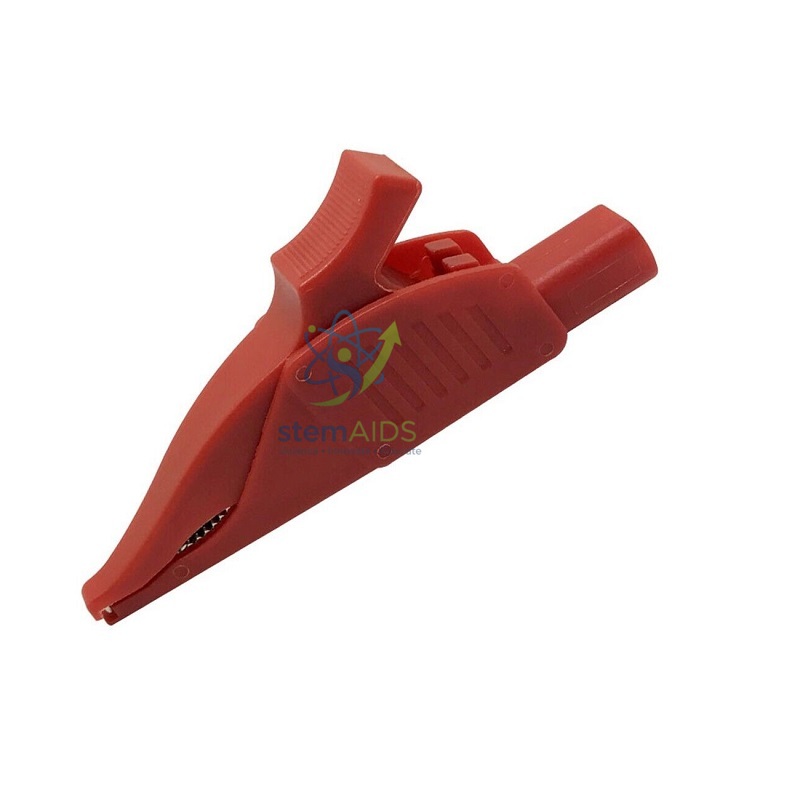
Quick Answer: This safety crocodile clip with 4 mm female connector is a fully insulated crocodile clip, red in the product photograph, whose rear end is a 4 mm socket that accepts a plug lead. A safety crocodile clip turns a plug-ended lead into a clip lead whenever a wire, terminal or component has no socket of its own.
From Plug Lead to Clip Lead
Circuit work constantly meets connections that are not 4 mm sockets: the end of a resistance wire, a battery tab, a component leg, a metal sample. Pushing a lead’s plug into the socket at the back of the safety crocodile clip gives a gripping jaw at the end of that lead in seconds, and pulling it out returns the lead to normal use. One set of leads therefore serves both purposes.
Because the clip body is insulated and the socket is set inside it, a shrouded safety plug can go in with no exposed metal at the joint. The only bare metal is inside the jaws, where contact is needed.
Getting a Good Contact
Contact resistance depends on how much metal touches and how clean it is. Clip onto bare, clean metal rather than an oxidised or painted surface, and seat the jaws so the teeth bite fully across a wire instead of catching its tip. In low-resistance measurements a poor clip contact can add more resistance than the sample itself, so measure the resistance of clip and lead together before starting.
Use red clips on positive connections and black on negative or common, matching the leads, so circuits stay easy to read and check.
Specifications
| Product | Safety crocodile clip with female connector |
| Connector, from title | Ø 4 mm female socket |
| Shown in photograph | Red, fully insulated clip |
| Accepts | 4 mm plug leads, including shrouded safety plugs |
| Use | Gripping wires, terminals, tabs and component leads |
| Jaw opening and electrical rating | Confirm at enquiry |
Applications
- Connecting resistance wire in resistivity practicals
- Clipping leads onto battery tabs, electrodes and metal samples
- Making temporary connections to components without sockets
- Converting safety leads into clip leads for electrochemistry
Care & Handling
- Keep jaws clean and free of corrosion, especially after electrochemistry
- Do not open the jaws beyond their range or use them as pliers
- Inspect the insulation for cracks and replace damaged clips
- Rinse and dry clips that have been used near electrolytes
Why Choose LabEquip
Teachers buy these clips in red and black pairs so the department’s 4 mm leads can reach any connection. They take leads made with a 4 mm safety banana plug and sit alongside our other physics lab equipment; contact LabEquip for colours and quantities.
Frequently Asked Questions
Why choose a crocodile clip with a socket rather than a fixed clip lead?
A socketed clip turns any 4 mm plug lead into a clip lead and back again, so one set of leads covers both uses, and a worn clip is replaced without replacing the lead.
Does a shrouded safety plug fit the socket?
The clip is made as a safety clip with a 4 mm female connector, the kind that takes shrouded safety plugs. Try it with your own leads if they are an unusual make.
Why do I get a high reading when clipping onto a wire?
Oxide, paint or a poor bite of the jaws adds contact resistance. Clean the wire, clip across it rather than at the very end, and measure clip and lead resistance first.
Can the clips be used in electrolysis?
Yes, to connect electrodes, but keep the jaws above the liquid. Electrolyte on the metal corrodes it, so rinse and dry the clips after use.
Why are there red and black clips?
The colours follow the usual convention of red for positive and black for negative or common, making circuits easier to wire and check.
How wide do the jaws open?
The jaw opening is not given in the listing and can be confirmed at enquiry. Clips of this kind are intended for wires, tabs and terminals rather than large bars.
Last Updated: October 2026









Reviews
There are no reviews yet.