
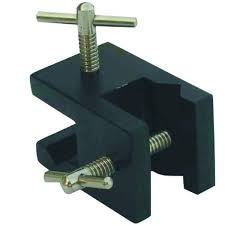
Quick Answer: The Boss Head Square Type is a square-bodied clamp holder with two screw-tightened slots set at right angles, used to fix one rod across another on a laboratory stand. In physics practicals this square boss head holds the cross-rods, clamps and hooks from which springs, pendulums and capillary tubes are hung.
Where a Square Boss Head Fits in Physics Set-ups
Most mechanics and properties-of-matter practicals begin with a retort stand, and the boss head is the joint that turns a single upright into a working frame. One slot grips the vertical rod of the stand; the second, turned through 90 degrees, grips a horizontal rod or the shank of a clamp. With two stands and two boss heads a cross-bar can be fixed between them for a simple pendulum, a loaded spring or a hanging wire, and its height changed in seconds by slackening one screw.
The square type differs from the other patterns in this range mainly in body shape. The rectangular Euro boss head uses a longer, flatter block, and the standard aluminium boss head has two open, hook-shaped jaws that slip onto a rod from the side. A square body places its two clamping screws on neighbouring faces of a compact block. The listing title does not state the metal, the finish, whether the slots are open or closed, or the largest rod each slot takes, so these points are worth matching to your stands.
For physics work the stiffness of the joint matters as much as its grip: a pendulum support that twists or a spring support that sags under load shows up directly as error in the readings.
Specifications
| Type | Boss head (double clamp holder), square pattern |
| Function | Joins two rods at right angles at any height |
| Fixing | One clamping screw for each slot |
| Typical partners | Stand uprights, cross-rods, clamps and hooks |
| Material, finish and rod diameter range | Confirm at enquiry |
Physics Practicals That Use It
- Fixing a horizontal rod between two stands to hang a simple pendulum from a split cork
- Holding the spring support and pointer scale steady in a Hooke’s law extension experiment
- Clamping a capillary tube vertically above a beaker for the capillary rise method of surface tension
- Mounting a pulley, a metre rule or a thermometer at a set height for mechanics and heat practicals
Care & Handling
- Tighten each screw by hand, then check both again once the load is hung, since a joint can settle under weight.
- Do not overtighten on thin-walled tubular rods, which dent and then slip.
- Keep the threads free of grit and add a drop of light oil if a screw turns stiffly.
- Keep the boss head close to the upright when a heavy load hangs from the cross-rod.
Why Choose LabEquip
Schools equipping a physics laboratory need boss heads in the same numbers as stands and clamps, because each practical bench uses two or three at a time. LabEquip lists this square pattern among its physics lab equipment, and our team can help match boss heads to the rod sizes of the stands you already own through the contact page.
Frequently Asked Questions
Can the square boss head hold a rod at an angle other than 90 degrees?
No. Its two slots are fixed at right angles, so the rods always cross squarely. To tilt the apparatus, turn the clamp about its own rod inside the slot, or use a clamp with a swivel joint, for example when a tube must slope in a set-up.
Why choose a square boss head rather than an open-jaw type?
A square body gives a compact block with the two screws on neighbouring faces, which suits crowded set-ups. Open-jaw boss heads can be fitted or removed from the side without sliding them off a rod. The choice is largely one of habit and of the stands a laboratory already uses.
How do I stop a cross-rod slipping under a heavy load?
Tighten the screw on the stand upright first, then the one on the cross-rod. If a large mass hangs from the rod, fit a second boss head directly below the first as a stop collar, so the load cannot drag the joint down the upright.
Will the boss head hold rods of different diameters?
A screw clamp grips any rod narrower than its slot, provided the screw can reach it, so thinner rods are held securely. The largest diameter depends on the casting, so compare it with the rods on your stands before ordering.
Which physics experiments need a boss head?
Almost any experiment that hangs or holds something above the bench: the simple pendulum, Hooke’s law with a spring, capillary rise, the resonance column and many optics supports. It also fixes thermometers and stirrers in calorimetry.
How should boss heads be maintained?
Wipe off spills, keep the screw threads clean and oil them lightly if they stiffen. Replace a screw whose thumb-piece is bent or whose thread is worn, because a joint that cannot be tightened is a hazard when glassware or weights hang from it.
Last Updated: October 2026




Reviews
There are no reviews yet.