
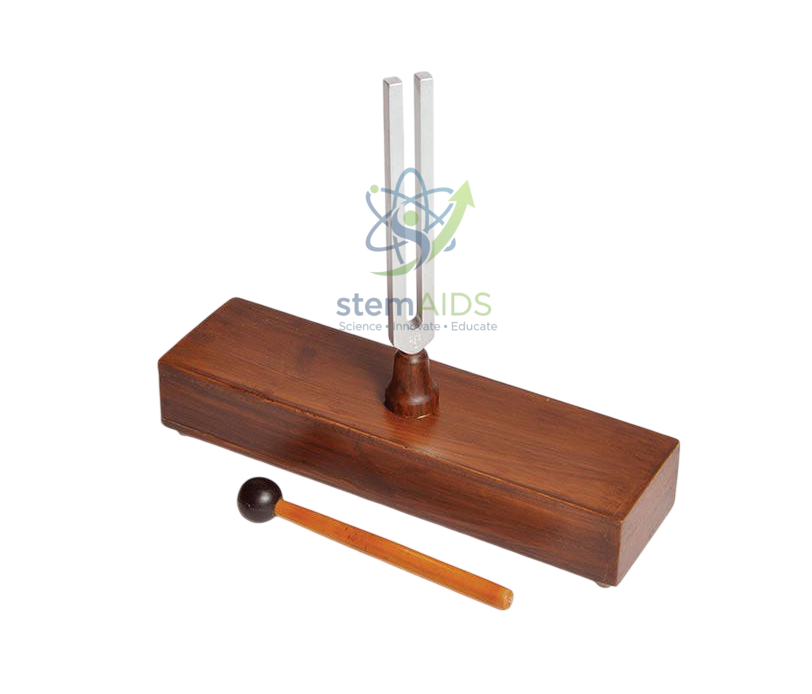
Quick Answer: A resonance box with tuning forks is a hollow wooden sound box with a socket on top into which a tuning fork is fixed, so that the box and the air inside it amplify the fork’s note. The product photo shows one box carrying its fork, with a ball-headed mallet for striking the prongs.
How the Box Amplifies the Fork
A bare fork moves very little air. Mounted on the box, the fork’s stem drives the wooden top and the enclosed air resonates. Such boxes are usually open at one end and closed at the other, with a length close to a quarter of the sound wavelength for the fork they are made for: for a 440 Hz fork that comes to about 19 to 20 cm. The box then reinforces exactly the note the fork produces.
Louder does not mean longer. Because the box radiates the fork’s energy into the room much faster, a fork on its box rings strongly for a shorter time than the same fork held in the hand. The extra sound comes from the energy stored in the struck fork, not from the box.
Sympathetic Resonance and Beats
With two boxes carrying forks of the same frequency and placed with their open ends facing, striking one fork and then silencing it by hand leaves the second fork audibly ringing: sound waves crossing the gap have driven it at its natural frequency. With forks of different frequencies nothing happens, because resonance needs a frequency match.
Clipping a small mass or pressing a little wax onto one prong of one fork lowers its frequency slightly. Sounding both forks together then gives beats, a slow rise and fall in loudness whose rate equals the difference between the two frequencies. The paired demonstrations need two matched units, so check how many forks and boxes this listing includes.
Specifications
| Item | Wooden resonance (sound) box with a socket for a tuning fork |
| Shown in the product photo | One box with a fork mounted on top and a ball-headed mallet |
| Box design | Hollow wooden box, commonly open at one end, with a length near a quarter wavelength of the fork note |
| Function | Amplifies the fork note; used for sympathetic resonance and beats |
| Fork frequency and number of forks and boxes | Confirm at enquiry |
Demonstrations and Practicals
- Making a fork’s note loud enough for a whole class to hear during sound lessons
- Sympathetic resonance between two boxes carrying forks of equal frequency
- Beats between a matched pair after one fork has been slightly loaded
- Comparing how long a fork rings on and off the box to discuss energy transfer and damping
Care & Handling
- Tap the prongs near their tips with the mallet; do not hit the box or the socket that holds the stem
- Lift the fork straight out of its socket for storage and keep the socket free of dust and grit
- Keep the wooden box away from water, heaters and direct sun, which can warp or crack it
- Store the forks so their prongs cannot knock together or against other metal
Why Choose LabEquip
Teachers buy the resonance box for classroom sound demonstrations, where a bare fork is too quiet for students at the back of the room. It is listed in LabEquip’s physics lab equipment range, individual tuning forks can be ordered for bench practicals, and you can contact LabEquip to confirm the fork frequency and whether boxes come singly or as matched pairs.
Frequently Asked Questions
Why does the fork sound louder on the resonance box?
The fork’s stem drives the wooden box, and the air inside resonates at the fork’s frequency. A large vibrating surface and air column move far more air than the thin prongs, so much more of the fork’s energy leaves as sound.
Why does the note fade faster when the fork is on the box?
A struck fork holds a fixed store of vibration energy, and the box radiates it much faster, so the sound is louder but shorter. Held in the hand, the fork rings quietly for longer.
Does each fork need a matching box?
For the strongest effect, yes. A box is usually built so that its air column resonates near one fork’s frequency. A fork of another frequency still sounds louder on it, mainly through the wooden walls, but much less so.
How is sympathetic resonance shown?
Place two boxes with forks of the same frequency a short distance apart, open ends facing. Strike one fork, let it ring for a few seconds, then grip its prongs to stop it. The second fork can now be heard, set vibrating by the sound waves from the first.
How do I make beats with two resonance boxes?
Load one prong of one fork with a little wax or a small clip-on mass to lower its frequency slightly, then strike both forks. The sound swells and fades regularly, and the number of swells per second equals the difference between the two frequencies.
How should the mallet be used?
Tap the outer face of a prong near its tip and let the mallet bounce straight off. A light, quick tap excites the fundamental cleanly, while hitting the box or striking too hard produces a clang and can mark the prongs.
Last Updated: October 2026




Reviews
There are no reviews yet.