
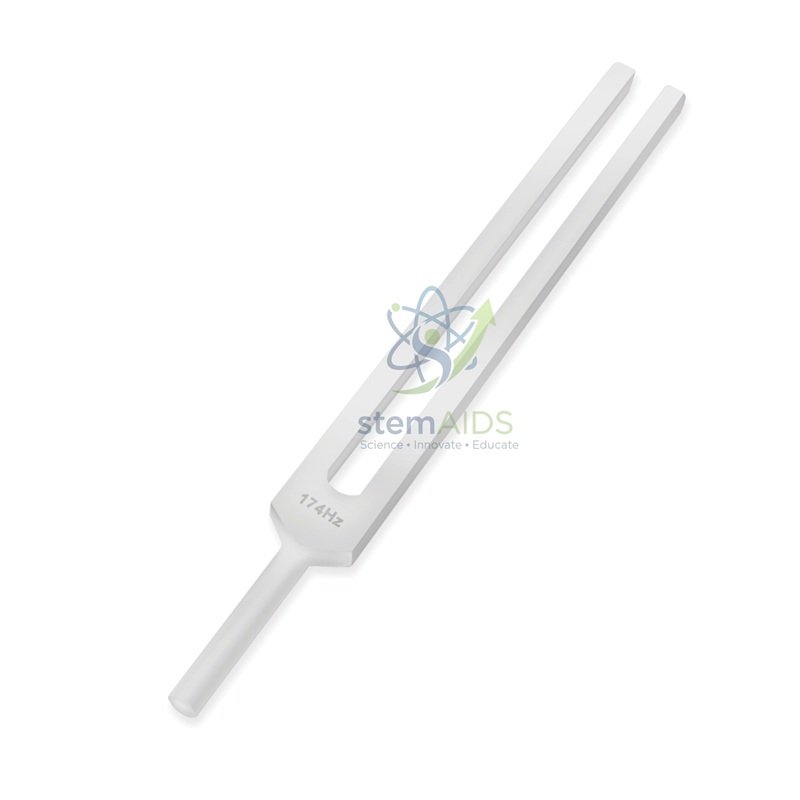
Quick Answer: Tuning forks are two-pronged metal forks on a stem that ring at one fixed frequency when struck, giving physics students a dependable reference note. The product photo shows a single fork, so this listing suits buyers who need forks of one particular frequency or replacements for a set.
What Fixes a Tuning Fork’s Pitch
A tuning fork’s frequency is set by the size of its prongs and the metal they are made from. Each prong behaves like a short bar clamped at the bend of the U. For prongs of the same metal and thickness, frequency varies inversely with the square of prong length, so a fork whose prongs are about 0.7 times as long sounds roughly an octave higher. Thicker prongs raise the pitch, and so does a stiffer, lighter metal. The frequency is normally stamped on the stem and holds for years unless the fork is dropped or knocked.
Why a Fork Is Quiet on Its Own
The two prongs swing in opposite directions, so the air pushed out by one is partly drawn back by the other, and a fork held in the hand is surprisingly faint. Turn a ringing fork slowly beside the ear and the note almost disappears in four directions around it, where the waves from the two prongs cancel.
Pressing the stem against a bench top or wooden box makes the note much louder. The stem moves up and down slightly as the prongs vibrate, and that motion drives the larger surface, which moves far more air. LabEquip also lists a resonance box with tuning forks built for exactly this purpose.
Specifications
| Item | Tuning fork: two parallel prongs joined in a U and carried on a stem |
| Sound produced | One fixed frequency, close to a pure tone |
| Marking | Frequency normally stamped on the stem |
| How it is sounded | Struck on a rubber pad or activator while held by the stem |
| Supplied as | Individual forks (the product photo shows a single fork) |
| Frequency, metal and quantity | Confirm at enquiry |
Practicals That Use a Single Fork
- Resonance column: finding the first and second resonance lengths over a water-filled tube to measure the speed of sound in air
- Sonometer: adjusting a stretched wire’s vibrating length until a paper rider on it is thrown off
- Beats: sounding two forks of the same marked frequency after loading one prong of the second with wax
- Displaying a near-sinusoidal waveform on an oscilloscope or sound sensor
Care & Handling
- Strike the fork on a rubber pad or rubber activator, never on the bench edge, a metal object or another fork
- Hold the fork by its stem only; a hand on the prongs stops the vibration and leaves sweat that slowly marks the metal
- Do not drop the fork or let its prongs clash, since a bent or nicked prong changes the frequency
- Wipe the fork dry after use and store it where the prongs cannot touch other metal items
Why Choose LabEquip
Physics teachers often order single forks to give every bench the same frequency for a resonance tube practical, or to replace one missing from a set. LabEquip lists them in its physics lab equipment range next to complete tuning fork sets; contact LabEquip with the frequencies and number of forks you need.
Frequently Asked Questions
Why does a tuning fork give an almost pure note?
Once struck, a fork vibrates almost entirely in its fundamental mode, with the two prongs swinging in and out together. The next mode sits at about six times the fundamental frequency and fades within a fraction of a second, leaving a tone close to a single sine wave.
How can I check the frequency of a fork?
The frequency is usually stamped on the stem. To check it, hold the ringing fork near a microphone connected to an oscilloscope or sound sensor and measure the period of the trace, or compare it by beats with a fork of known frequency.
Which frequency suits a resonance tube experiment?
Higher-pitched forks are usually more convenient. At 512 Hz the wavelength in room-temperature air works out at about 67 cm, so the first resonance appears near 16 cm and the second roughly 33 cm further down, both within a typical one-metre tube. Lower forks need a longer column to reach the second resonance.
What changes the frequency of a tuning fork?
Damage is the main cause: a bent, nicked or filed prong changes the vibrating mass and stiffness. A little wax on one prong lowers the frequency slightly, which is how a matching fork is detuned on purpose for beats. Room temperature has only a very small effect.
Why should a fork not be struck on the bench?
A hard knock excites extra high-frequency modes, heard as a metallic clang, and over time it dents or bends the prongs and shifts the pitch. Striking on a rubber pad or a rubber-headed activator gives a clean fundamental and protects the fork.
Should I buy single forks or a set?
Single forks suit practicals that use one frequency at every bench, and they replace a lost or damaged fork. A set of graded forks lets students repeat a measurement at several frequencies and draw a graph, as in the law-of-length practical on the sonometer.
Last Updated: October 2026





Reviews
There are no reviews yet.