
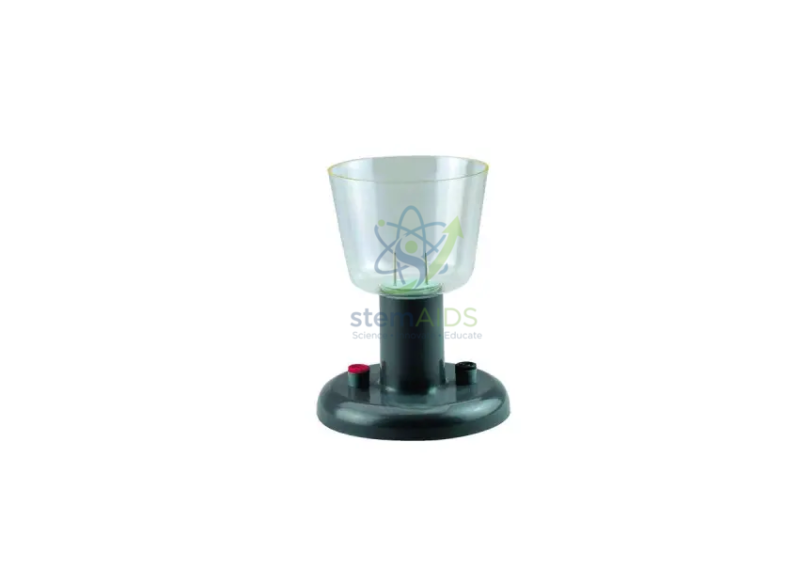
Quick Answer: The platinum electrode electrolyzer is a clear electrolysis cell mounted on a base with two terminal sockets, as pictured, with platinum electrodes inside the cell wired to those sockets. Connected to a low-voltage DC supply and filled with a dilute electrolyte, the platinum electrode electrolyzer splits water into hydrogen and oxygen, which can be collected in graduated tubes placed over the electrodes.
Why the Electrodes Are Platinum
In water electrolysis the anode is where oxygen forms, and oxygen formed at an electrode surface is very reactive. Many metals would oxidise or dissolve there, releasing ions into the solution and spoiling the result. Platinum is one of the most unreactive metals, so it carries the current without taking part in the reaction. The electrodes stay clean, the electrolyte stays unchanged, and the gas volumes reflect only the splitting of water.
Platinum is also a good catalyst for the electrode reactions themselves, so gas bubbles form readily at a modest voltage. That makes the cell suitable for quick class demonstrations as well as longer quantitative runs.
What Students Observe
Pure water conducts very poorly, so a little electrolyte such as sodium sulfate or dilute sulfuric acid is added. When the supply is switched on, bubbles stream from both electrodes. Hydrogen collects above the cathode (negative) and oxygen above the anode (positive). With graduated tubes in place, the hydrogen volume is close to twice the oxygen volume, matching the formula H₂O. A lighted splint gives a squeaky pop with the hydrogen, and a glowing splint relights in the oxygen.
Specifications
| Product | Water electrolysis cell with platinum electrodes |
| Shown in photograph | Clear cell on a dark base with red and black terminal sockets |
| Electrode metal | Platinum, as titled |
| Power | Low-voltage DC laboratory supply |
| Used with | Graduated gas tubes, dilute electrolyte, splints |
| Cell volume and electrode form | Confirm at enquiry |
Experiments
- Splitting water and showing the 2:1 ratio of hydrogen to oxygen by volume
- Testing the gases collected with lighted and glowing splints
- Relating the volume of gas to current and time as an introduction to Faraday’s laws
- Comparing electrolytes to show why pure water hardly conducts
Care & Handling
- Run the cell from a low-voltage DC supply, and turn the supply off whenever tubes are being fitted or lifted out
- Wear eye protection when using acidic electrolytes and rinse spills promptly
- Empty and rinse the cell with distilled water after use and leave it to dry
- Never wipe or scrape the platinum surfaces; rinse them only
Why Choose LabEquip
Schools and colleges choose a platinum cell when they want clean, repeatable gas volumes for the water formula and Faraday’s laws. LabEquip supplies it with matching graduated tubes, the Hofmann voltameter and other physics lab equipment; contact LabEquip to plan an electrolysis set.
Frequently Asked Questions
What explains the 2:1 ratio of hydrogen to oxygen?
Splitting water releases two hydrogen atoms for every oxygen atom, so two molecules of hydrogen gas form for each molecule of oxygen gas. By Avogadro’s law, equal volumes of gases at the same temperature and pressure hold equal numbers of molecules, so the volumes follow the same 2:1 ratio.
Why does pure water need an electrolyte added?
Pure water contains very few ions, so it barely conducts. Adding a little sodium sulfate or dilute sulfuric acid supplies ions to carry the current without changing the gases produced.
Which electrode gives hydrogen?
Hydrogen forms at the cathode, the electrode connected to the negative terminal. Oxygen forms at the anode, connected to the positive terminal.
Why is platinum used instead of copper or iron?
Copper or iron would react at the anode and dissolve or oxidise. Platinum does not react, so only water is split and the electrodes last.
Why is the oxygen volume sometimes a little less than half?
Oxygen dissolves in water more readily than hydrogen does, so at first part of it stays in solution. The ratio comes closer to 2:1 once the solution is saturated.
How is the cell compared with a Hofmann voltameter?
Both split water with inert electrodes. A Hofmann voltameter has built-in graduated limbs, while this cell uses separate tubes placed over the electrodes, which are easier to handle and replace.
Last Updated: October 2026




Reviews
There are no reviews yet.