
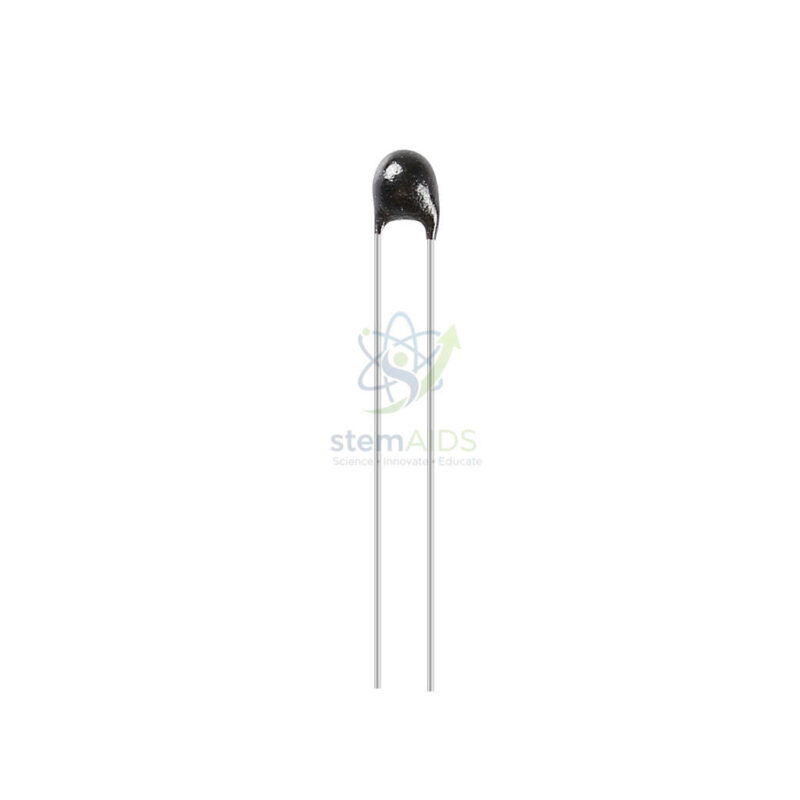
Quick Answer: This PTC thermistor is a temperature-dependent resistor with a positive temperature coefficient, so its resistance rises as it gets hotter. In physics and electronics practicals a PTC thermistor is used to show this behaviour alongside an NTC type and to demonstrate self-resetting overcurrent protection and self-regulating heating.
Two Kinds of PTC Behaviour
Most components of this type are made from a doped ceramic, often based on barium titanate, whose resistance stays fairly low and steady until a particular switching temperature and then climbs very steeply over a narrow range. Near that point the crystal structure of the material changes and electrical barriers form between its grains, blocking conduction. The result behaves almost like a temperature-operated switch.
A second, less common kind uses doped silicon and shows a gentle, nearly linear rise in resistance across its range, which suits measurement rather than switching. Which kind this component is, and its switching temperature if it is the ceramic type, should be confirmed before ordering, because that decides which experiments it suits.
Self-Resetting Protection and Self-Regulating Heat
Place a switching thermistor of this type in series with a load and let too much current flow, and the component heats itself. Its resistance shoots up, cutting the current to a small value that just keeps it warm. Remove the fault or switch off, and it cools and resets. This is the principle of the resettable fuse found in battery packs and USB ports. Students can watch it in a low-voltage circuit with a lamp and an ammeter: briefly bypassing the lamp lets a large current flow, the thermistor warms and the current falls to a trickle, and only after the bypass is removed and the thermistor cools does the lamp light normally again.
The same feedback makes a PTC element a heater that limits its own temperature. As it warms its resistance rises, so at a fixed supply voltage its power falls, and it settles where heat produced balances heat lost.
Applications
- Plotting resistance against temperature and comparing it with an NTC thermistor
- Demonstrating a self-resetting fuse in a low-voltage lamp circuit
- Showing self-regulating heating, where power falls as temperature rises
- Over-temperature sensing that switches off a circuit when a set point is passed
Specifications
| Component | PTC (positive temperature coefficient) thermistor |
| Behaviour | Resistance rises with temperature |
| Common form | Ceramic switching type with a steep rise above a set temperature |
| Uses | Resettable overcurrent protection, self-regulating heating, over-temperature sensing |
| Type, nominal resistance and switching temperature | Confirm at enquiry |
Care & Handling
- Expect a switching thermistor to be hot after it trips, and let it cool before handling.
- Use only low-voltage supplies within the component’s rating for overcurrent demonstrations.
- Keep the thermistor away from flammable material while demonstrating self-heating.
- Leave time between trips for it to cool and reset, otherwise readings will drift.
Why Choose LabEquip
Electronics and physics teachers buy positive-coefficient thermistors to set beside NTC types so students see both behaviours, and to show a real protection device at work. LabEquip supplies them within our physics lab equipment range; send the resistance or switching temperature you need through the contact page.
Frequently Asked Questions
What does PTC stand for?
Positive temperature coefficient. The resistance of the component increases as its temperature rises, the opposite of an NTC thermistor, whose resistance falls when it is heated.
How does a PTC thermistor act as a resettable fuse?
Under normal current it has a low resistance and stays cool. Excess current heats it past its switching temperature, its resistance rises sharply and the current falls to a small value. When the fault is removed and it cools, the resistance drops again and the circuit works normally, with nothing to replace.
Why does the resistance rise so suddenly?
In ceramic positive-coefficient thermistors the material changes its crystal structure near a particular temperature, and electrical barriers form at the boundaries between its grains. These barriers grow rapidly with further heating, so the resistance can increase many times over a narrow temperature range.
How can I compare a PTC with an NTC thermistor in one practical?
Place both in dry test tubes in the same stirred water bath beside a thermometer and record each resistance as the water is heated. Plotting both against temperature on one graph shows one curve falling and the other rising, sharply if the PTC is a switching type.
Why does a PTC heater not overheat?
As the heater warms its resistance rises, so at a fixed supply voltage the current and power fall. It settles at a temperature where the heat it produces balances the heat it loses, without needing a separate thermostat.
Is a PTC thermistor the same as a fuse?
It protects a circuit in a similar way but resets itself after cooling, whereas an ordinary fuse melts and must be replaced. A PTC device also lets a small current flow while tripped, so it limits the current rather than breaking the circuit completely.
Last Updated: October 2026




Reviews
There are no reviews yet.