

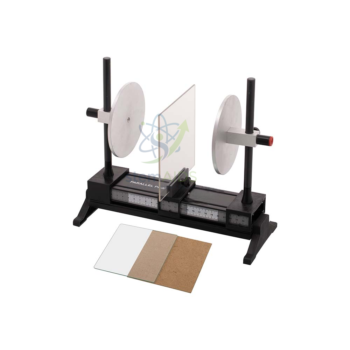
Quick Answer: The Millikan apparatus is used for the classic oil drop experiment, in which tiny charged oil droplets are watched through a microscope between two horizontal metal plates. By timing the drops with and without an electric field, students find each drop’s charge and show that charge is quantised in multiples of the elementary charge e.
Balancing Gravity and the Electric Force
A fine spray introduces oil droplets into the space between two parallel plates. Some droplets pick up charge from friction in the atomiser or from ionising radiation. With no voltage on the plates a drop falls under gravity and quickly reaches a steady terminal speed, at which its weight is balanced by air resistance as described by Stokes’ law. From that speed the drop’s radius, and hence its mass, can be calculated.
When a voltage is applied, the electric force qE acts on the charged drop. Students either adjust the voltage until the drop hangs still, so that qE equals the weight, or time the drop rising under a stronger field and falling with the field off. Either method gives the charge q on that drop.
Seeing the Quantisation
No single measurement proves anything; the evidence comes from many drops. When the charges found for twenty or thirty drops are listed, they cluster around whole-number multiples of a single smallest value, about 1.6 × 10⁻¹⁹ coulomb. Plotting the charges on a number line or as a histogram makes the gaps between clusters obvious.
Choosing the right drops is part of the skill. Small, slowly falling drops carrying only a few elementary charges give the clearest steps, while large fast drops with many charges blur the pattern. Where the apparatus allows the charge on a drop to be changed, its speed jumps by a definite step each time.
Specifications
| Experiment | Millikan oil drop experiment |
| Principle | Balance of weight, viscous drag and electric force on a charged droplet |
| Measured quantities | Drop speeds with and without the field, plate voltage |
| Result | Charges on individual drops and the elementary charge e |
| Microscope scale, plate supply and accessories | Confirm at enquiry |
What Students Measure
- Determining the elementary charge from many individual drop charges
- Demonstrating that electric charge is quantised
- Practising Stokes’ law and terminal velocity calculations
- Combining with an e/m measurement to estimate the electron mass
Care & Handling
- Use only the oil intended for the apparatus, and keep the atomiser clean so it does not clog
- Switch the plate voltage off before opening the chamber or cleaning the plates
- Wipe oil from the plates and window regularly, as a film affects both the field and the view
- Shield the chamber from draughts and lamp heat, which make drops drift sideways
Why Choose LabEquip
Colleges and universities choose a Millikan apparatus for the modern physics practical that nearly every degree course includes. Pair it with the specific charge of the electron experiment so students can combine e and e/m to find the electron mass; contact LabEquip to confirm the accessories included.
Frequently Asked Questions
Why are such tiny oil drops used?
Small drops fall slowly, so their terminal speeds can be timed accurately, and they usually carry only a few elementary charges. That makes the steps between possible charges large compared with the measurement error.
How is the mass of a drop found?
From its terminal speed with the field off. At that speed the weight equals the drag given by Stokes’ law, which depends on the drop’s radius and the viscosity of air, so the radius and then the mass can be calculated.
What is the difference between the balancing and dynamic methods?
In the balancing method the voltage is adjusted until the drop hangs still. In the dynamic method the drop is timed moving up with the field on and down with it off, which is often more accurate because a perfectly still drop is hard to judge.
Why do some drops not respond to the field?
Those drops carry no net charge, so the electric force on them is zero. Students should choose drops that move clearly when the voltage is switched on.
How many drops should be measured?
Twenty or more is a sensible minimum. The quantisation becomes clear only when enough charges are collected to show the clusters at whole-number multiples of e.
What precautions does the apparatus need?
The plates carry a high voltage, so switch it off before opening the chamber. Keep the oil away from the lamp, and clean the plates and window so the field and view stay clear.
Last Updated: October 2026








Reviews
There are no reviews yet.