
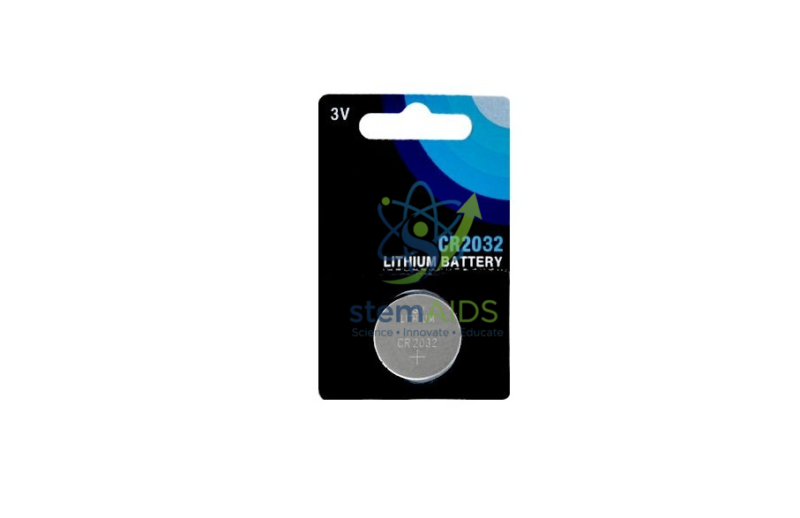
Quick Answer: The CR2032 is a 3 V lithium button cell, a flat coin-shaped primary battery used in small electronic instruments. In the laboratory the CR2032 lithium button cell powers timers, digital thermometers, calculators and data loggers, and it is handy for simple LED experiments.
Reading the CR2032 Code
Button cells follow a naming scheme in which the letters give the chemistry and shape and the digits give the size. In CR2032, C indicates lithium manganese dioxide chemistry, R indicates a round cell, 20 is the diameter in millimetres and 32 is the thickness in tenths of a millimetre, so 3.2 mm. Any cell marked CR2032 therefore fits the same holder, whoever makes it.
The nominal voltage of 3 V comes from the lithium chemistry and is double that of an alkaline cell. The voltage stays fairly flat through most of the cell’s life and then falls quickly near the end, which suits electronics that need a steady supply. The cell is designed for small, steady currents; it has a relatively high internal resistance, so the voltage at its terminals drops noticeably if a large current is drawn.
A Small Cell for Big Ideas
Placing a red LED directly across a coin cell of this type is a familiar classroom activity: the LED lights without a series resistor because the cell’s internal resistance limits the current. That observation opens a discussion of internal resistance and the difference between the e.m.f. of a cell and its terminal voltage. Measuring the voltage across the cell with a multimeter, first with no load and then with the LED connected, makes the drop visible. Comparing LEDs of different colours shows that each needs a different minimum voltage, red the least and blue or white the most, so their brightness on the same cell differs.
Specifications
| Product | Lithium button (coin) cell |
| Designation | CR2032 |
| Nominal voltage | 3 V, as titled |
| Size from the code | 20 mm diameter, 3.2 mm thick |
| Type | Primary cell, not rechargeable |
| Pack quantity | Confirm at enquiry |
Applications
- Replacing cells in digital timers, stopwatches, thermometers and data loggers
- Lighting an LED directly to introduce internal resistance and terminal voltage
- Memory backup cells on instrument circuit boards
- Low-power sensor and electronics projects using coin cell holders
Care & Handling
- Keep the cells out of reach of young children; a swallowed button cell is a medical emergency
- Never try to recharge the cell or put it in a battery charger
- Store loose cells so they cannot touch each other or metal objects, which would short them
- Collect used cells for battery recycling rather than general waste
Why Choose LabEquip
Schools keeping timers, digital thermometers and data loggers running buy these cells in packs for the prep room. LabEquip can add them to an order of physics lab equipment; for rechargeable cells and their charging, see the universal charger, and send quantities through our contact page.
Frequently Asked Questions
Can a CR2032 be recharged?
No. It is a primary lithium cell and must not be charged; attempting to do so can make it overheat or leak. Rechargeable coin cells exist under different codes and need their own chargers.
Why is a button cell dangerous if swallowed?
A coin cell lodged in the throat can cause serious internal burns within a short time because current flows through the moist tissue. Keep cells and devices with loose battery covers away from young children, and seek medical help at once if one is swallowed.
What do the numbers in CR2032 mean?
The 20 is the diameter in millimetres and the 32 is the thickness in tenths of a millimetre. The letters C and R indicate lithium manganese dioxide chemistry and a round shape.
Can a CR2025 or CR2016 be used instead?
They have the same diameter and voltage but are thinner, so they may fit loosely in a holder made for the thicker cell and they hold less charge. Use them only if the holder grips them firmly.
Why does an LED light without a resistor on this cell?
The cell’s internal resistance limits the current to a level the LED can tolerate for short periods. With a larger battery of the same voltage the current could be much higher, so a series resistor would be needed.
How should used cells be disposed of?
Collect them for battery recycling. Before storing used cells, cover both faces with tape or keep them in a non-conductive container so they cannot short together.
Last Updated: October 2026




Reviews
There are no reviews yet.