
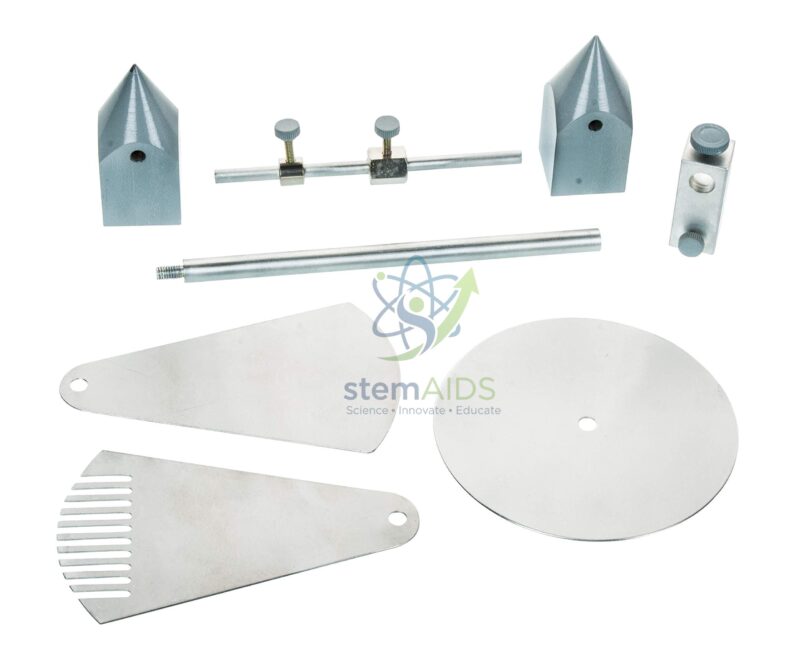
Quick Answer: Lenz’s law accessories are a set of metal parts for eddy-current experiments with an electromagnet: in the product photograph, two pointed pole pieces, a pendulum suspension with clamping screws, a rod, a solid and a slotted pendulum plate, and a flat disc. Swinging the plates between the poles shows magnetic braking by induced currents.
The Eddy-Current Pendulum
Fit the pointed pole pieces to an electromagnet so that a narrow gap with a strong field lies between them, and hang the solid plate from the suspension so it swings through the gap. With the magnet off, the plate swings freely for a long time. Switch the magnet on and the plate stops almost at once, as if it were moving through thick oil.
The cause is induction. As the plate moves into and out of the field, the flux through each part of it changes, and eddy currents circulate in the metal. By Lenz’s law those currents produce forces opposing the motion, so the plate’s kinetic energy turns into heat in the metal. The faster the plate moves, the stronger the braking.
Solid Versus Slotted Plate
Repeat the swing with the slotted plate, the comb-shaped one in the photograph. Its slots cut across the paths the eddy currents need, so the currents are much smaller and the plate swings through the field with little braking. The comparison is the clearest proof that the effect comes from induced currents rather than ordinary attraction, and it explains why transformer and motor cores are made from thin insulated sheets.
Experiments
- Damping a solid pendulum between the poles of an electromagnet
- Comparing the solid and slotted plates
- Showing that the braking grows with the magnet current
- Explaining eddy-current brakes and laminated cores
Specifications
| Parts shown | Pole pieces, suspension, rod, solid and slotted plates, disc |
| Plates | Thin non-magnetic metal, as pictured |
| Used with | U core, coils and a DC supply forming an electromagnet |
| Principle | Eddy currents and Lenz’s law |
| Fit with existing cores | Confirm at enquiry |
Care & Handling
- Switch off the electromagnet before adjusting the pole gap
- Set the gap so the plates swing freely without touching the pole pieces
- Keep the plates flat; a bent plate rubs and confuses the result
- Store the small parts together so the set stays complete
Why Choose LabEquip
These accessories extend a demountable transformer set into eddy-current work, so schools that own the U core gain a further practical without buying major new apparatus. LabEquip supplies them with the copper tube Lenz’s law experiment and other physics lab equipment.
Frequently Asked Questions
Why does the solid plate stop so quickly?
Its motion through the field induces eddy currents in the metal. The currents create forces opposing the motion, converting the plate’s kinetic energy into heat.
Why does the slotted plate keep swinging?
The slots interrupt the current paths, so only small eddy currents flow and the braking force is much weaker.
Are the plates attracted to the magnet?
No. They are made of non-magnetic metal, so a stationary plate feels no pull. The force appears only while the plate moves.
What are the pointed pole pieces for?
They concentrate the field into a narrow gap, giving a strong field where the plate passes and a more dramatic braking effect.
What is the flat disc used for?
A disc can be swung or turned between the poles in the same way, showing eddy-current braking in rotary form, the principle behind eddy-current brakes and the damping discs of older electricity meters.
Where is eddy-current braking used?
In trains and roller coasters, in some exercise machines and in the damping of balances and meter pointers. It works without contact, so nothing wears out.
Last Updated: October 2026






Reviews
There are no reviews yet.