
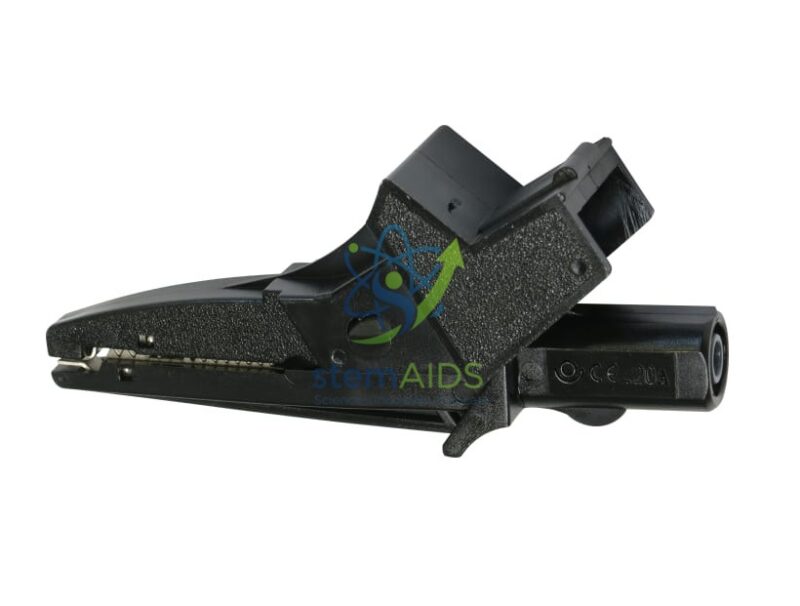
Quick Answer: Insulated crocodile clips are spring clips whose jaws and handles are covered by an insulating moulding, leaving only the gripping teeth exposed. Supplied as a pair, as titled, they connect to a laboratory lead at the rear and grip rods, electrodes, plates and terminals so that the connection cannot easily short against nearby metal.
What the Insulation Adds
A bare crocodile clip is a lump of metal that conducts everywhere on its surface. On a crowded bench, two bare clips that touch, or a clip that falls against a metal stand, create a short circuit that can drain cells, blow a meter fuse or upset a measurement. The black moulding visible in the product photograph covers the outside of the jaws and the handles, so contact can only be made where the teeth bite.
The clips are sold in twos because most connections come in pairs: one for each end of a component, or one for each terminal of a cell or electrode pair. The rear of each clip is made to take a laboratory lead, so a standard lead becomes a clip lead without cutting or soldering anything.
Good Uses on the Bench
Covered clips earn their keep in electrolysis and electrochemistry, where carbon or metal electrodes sit close together over a beaker, and in electromagnetism experiments where clips must hold the ends of a coil near a metal frame. They are also the safer choice where students work with larger currents from a low-voltage supply, since an accidental touch between two clips does not complete a circuit through the outside of the jaws. Compared with the small bare clips on crocodile clip jumper wires, they are bulkier, so very closely spaced component legs can be easier to reach with smaller clips. Another insulated clip listing is also available in the same category.
Specifications
| Product | Crocodile clips with insulating cover |
| Quantity | Two (x2), as titled |
| Insulation | Moulded cover over jaws and handles, as in the product photograph |
| Colour in the photograph | Black |
| Use | Low-voltage laboratory connections |
| Lead connection type and jaw opening | Confirm at enquiry |
Applications
- Holding carbon and metal electrodes in electrolysis and cell experiments
- Connecting coils, wires and rods near metal stands without risk of shorting
- Fitting clips to laboratory leads for components without terminals
- Circuits with larger low-voltage currents where bare clips could short
Care & Handling
- Grip the insulated body, not the teeth, when opening and attaching the clips
- Rinse off electrolyte splashes promptly and dry the clips to limit corrosion of the teeth
- Check that the insulating cover is intact; a split cover should be replaced
- Keep the pair together in a labelled box with other lead accessories
Why Choose LabEquip
Teachers running electrolysis, electrochemistry and electromagnetism practicals buy insulated crocodile clips in pairs so every bench has a matched set. LabEquip can supply them with leads and adapters; send quantities through our contact page or browse physics lab equipment.
Frequently Asked Questions
What is the advantage of a covered clip over a bare one?
The insulating cover prevents accidental contact between neighbouring clips or with metal stands, which would short the circuit. Only the gripping teeth are exposed, so the connection is made exactly where intended.
Why are the clips supplied in pairs?
Most connections need two clips, one at each end of a component or one on each electrode of a cell. A pair also lets one lead of each colour be fitted with a clip.
Are these clips suitable for mains voltages?
No. Like other crocodile clips used in school labs, they are intended for low-voltage circuits. The cover reduces accidental shorts but does not make them suitable for mains work.
Can the clips be used in electrolysis?
Yes. They are well suited to holding electrodes over a beaker. Keep the clips above the liquid, as electrolyte on the metal teeth causes corrosion and can take part in the reaction.
How is a lead fitted to the clip?
The clip is designed to take a laboratory lead at the rear. Make sure your leads’ plugs match the clip’s connection before ordering, especially if your laboratory uses shrouded safety leads.
How should corroded teeth be cleaned?
Brush them with a small wire brush or fine abrasive paper, then wipe them dry. Heavily corroded clips grip poorly and add resistance, and are better replaced.
Last Updated: October 2026




Reviews
There are no reviews yet.