
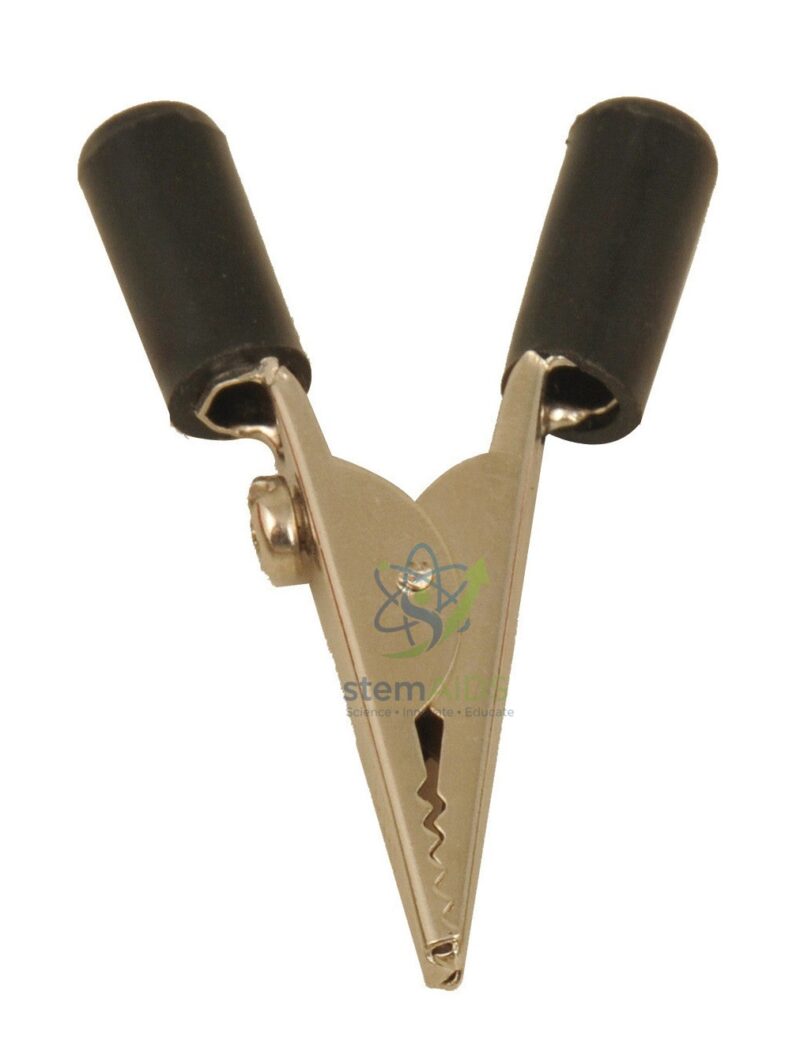
Quick Answer: Insulated crocodile clips are spring-loaded metal clips whose handles are covered with insulating sleeves, as in the product photograph, leaving only the jaws exposed. They make quick temporary connections in laboratory circuits while reducing the risk of accidental short circuits and of touching bare metal.
What the Insulating Sleeve Does
A crocodile clip has two jobs: to grip a conductor firmly and to carry current from it into a lead. The jaws must be bare to make contact, but the rest of the clip need not be. Covering the handles with an insulating sleeve means two clips can lie next to each other on a bench without short-circuiting, and a hand squeezing the clip touches only insulation.
In the product photograph the handles are sheathed in black insulation, with the metal jaws protruding at the front. Where red and black clips are both in use, red conventionally marks the positive side of the circuit and black the negative, which helps students build and check circuits from a diagram.
Uses
- Connecting batteries, lamps and components in student circuits
- Making temporary test connections to component leads
- Building circuits where several clips sit close together
- Attaching sensors and probes in data-logging practicals
Insulated or Bare Clips
Bare clips with a screw terminal are slimmer and suit making up leads, but their exposed bodies can touch. Insulated clips trade a little size for safety and are the more usual choice for student practicals, especially in crowded circuits on breadboards, battery packs and component boards. For mains-connected equipment neither type replaces properly rated safety leads.
Specifications
| Type | Spring-loaded crocodile clip with insulated handles |
| Insulation | Sleeve over the handles, jaws exposed, as pictured |
| Use | Temporary low-voltage connections |
| Pairs with | Connecting leads, batteries and component boards |
| Pack quantity | Confirm at enquiry |
Care & Handling
- Check sleeves for splits and replace damaged clips
- Do not pull leads out of the clip by the wire
- Wipe flux or grease off the jaws to keep the contact good
- Store clips in a tray so the springs are not left squeezed open
Why Choose LabEquip
Insulated clips are standard consumables for school and college electricity benches. LabEquip supplies them with 4.5 V batteries, crocodile clips on stand and other physics lab equipment; class quantities can be requested via the contact page.
Frequently Asked Questions
What is the difference between insulated and non-insulated crocodile clips?
Insulated clips have an insulating sleeve over the handles, so they are less likely to short against each other or to leave fingers on bare metal. Non-insulated clips are bare metal throughout.
Are insulated crocodile clips suitable for mains voltages?
No. They are intended for low-voltage laboratory circuits. Mains work needs properly rated safety leads and connectors.
Why are the jaws not insulated?
The jaws must touch the conductor to make an electrical contact, so they are left bare while the handles are covered.
How is a wire attached to the clip?
Depending on the design, the wire is soldered, crimped or clamped by a screw at the rear of the clip. The connection should be firm and the bare wire kept inside the sleeve.
Why use red and black clips?
Colour coding shows which side of the circuit is positive and which is negative, making circuits easier to build and check.
Why do clips sometimes give a poor connection?
Oxide, grease or a weak spring reduces the contact. Cleaning the jaws or replacing a tired clip restores a reliable connection.
Last Updated: October 2026




Reviews
There are no reviews yet.