
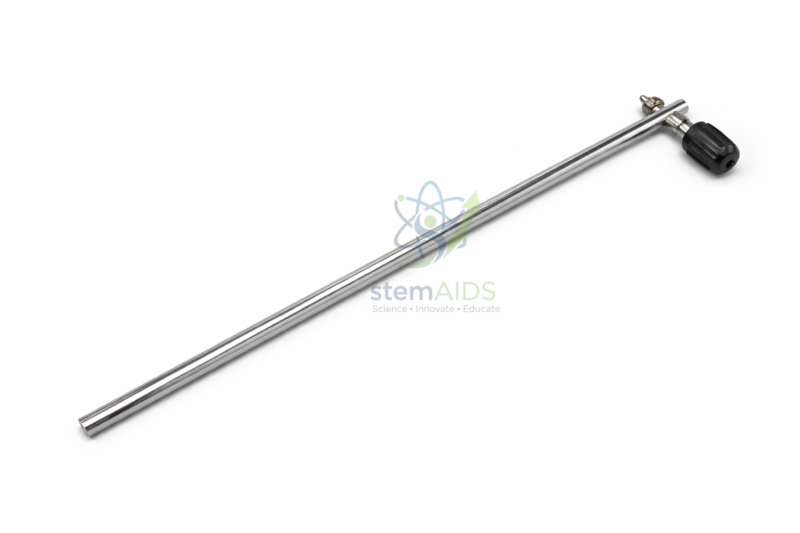
Quick Answer: The Iron Rod and Plate is a laboratory support stand made of a heavy iron base plate and an upright metal rod, on which boss heads and clamps are fixed to hold apparatus. With an iron rod and plate, burettes, flasks, thermometers, springs and pendulums can be held steady at any height along the rod.
Building a Stable Support
A support stand stays upright as long as the combined centre of gravity of stand and load lies above the base plate. The rod is normally fixed towards one end of the plate, so apparatus should be clamped on the side where the plate extends beneath it, never facing away over the bench. Heavy items should be held low on the rod and close to it. For tall or heavy set-ups, the plate can be clamped to the bench or weighted.
As pictured, the rod is a plain, straight metal rod with a fixing at one end. How it attaches to the plate, and the plate size, rod length and finish, can be confirmed at enquiry.
Boss Heads and Clamps
The rod itself holds nothing; the work is done by a boss head, which grips the rod at any height and angle, and by the clamp or ring it carries. A universal clamp holds flasks, condensers and tubes; a burette clamp holds one or two burettes upright; a ring supports a funnel or a gauze. Arranging these on one rod lets students build distillation, titration and heating set-ups as well as physics rigs.
Uses in Physics Practicals
In physics the stand supports pendulums, springs for Hooke’s law, thermometers in calorimetry and cooling experiments, and pulleys and optical parts. One caution applies to magnetism work: an iron stand is itself magnetic and distorts the field near it, so it should be kept well away from compasses and magnetometers, or replaced by a wooden or non-magnetic support for those experiments.
Applications
- Holding burettes for titrations and flasks for heating and distillation
- Suspending pendulums and springs for timing and Hooke’s law experiments
- Supporting thermometers in calorimetry and cooling-curve practicals
- Mounting pulleys, lenses and screens in mechanics and optics work
Specifications
| Type | Support stand: base plate with upright rod |
| Base | Iron plate, as titled |
| Rod | Straight metal rod carrying boss heads and clamps |
| Used with | Boss heads, clamps, burette clamps and rings |
| Plate size, rod length and diameter, fixing type and finish | Confirm at enquiry |
Care & Handling
- Tighten the rod firmly into the base before loading the iron rod and plate.
- Clamp apparatus over the plate, keep heavy loads low and do not overreach the rod with long arms.
- Wipe off spilled chemicals promptly and touch up chipped paint to stop rust.
- Keep the stand away from compasses and magnetometers during magnetism experiments.
Why Choose LabEquip
Schools and colleges buy support stands in class sets, since almost every chemistry and physics practical needs one. LabEquip lists this stand with its physics lab equipment. Ask about quantities and matching boss heads and clamps through the contact page.
Frequently Asked Questions
Why should the load hang over the plate?
The stand only stays upright while the centre of gravity of the stand and its load lies above the base. Clamping the load on the side where the plate extends keeps it there.
How high can apparatus be clamped safely?
As low as the experiment allows. The higher and heavier the load, and the further it reaches from the rod, the easier it is to tip the stand, so heavy items belong low and close to the rod.
What is a boss head for?
A boss head grips the rod and holds a clamp or rod at right angles to it. It lets the clamp be set at any height and turned to any direction around the rod.
Can an iron stand be used in magnetism experiments?
It is better not to. Iron is magnetic and bends the field around it, so a compass or magnetometer near the stand gives misleading readings. A wooden or non-magnetic support avoids the problem.
How can a stand be kept from toppling with tall apparatus?
Clamp the plate to the bench with a G-clamp, place a weight on the plate, or use a second stand to share the load. Tall glassware assemblies should always be supported at more than one point.
How should the stand be looked after?
Wipe off spills straight away, keep the rod fixing tight, and repaint any chips in the base finish so that the iron does not rust.
Last Updated: October 2026







Reviews
There are no reviews yet.